


China yesterday issued wanted notices for two Taiwanese influencers, accusing them of committing “separatist acts” by criticizing Beijing, amid broadening concerns over China’s state-directed transnational repression.
The Quanzhou Public Security Bureau in a notice posted online said police are offering a reward of up to 25,000 yuan (US$3,523) for information that could contribute to the investigation or apprehension of pro-Taiwanese independence YouTuber Wen Tzu-yu (溫子渝),who is known as Pa Chiung (八炯) online, and rapper Chen Po-yuan (陳柏源).
Wen and Chen are suspected of spreading content that supported secession from China, slandered Chinese policies that benefit Taiwanese and discrimination against Chinese spouses of Taiwanese nationals, the bureau said.
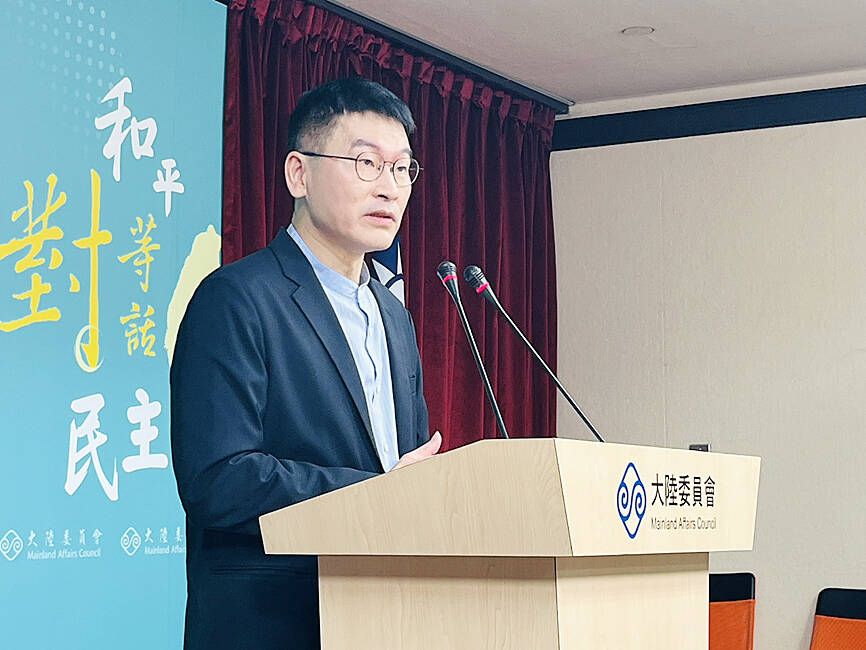
Photo: Chen Yu-fu, Taipei Times
The two celebrities are “hitmen and accomplices of Taiwanese independence who exercise a malign influence,” it added.
China’s Taiwan Affairs Office spokesman Chen Binhua (陳斌華) later that day called the two “malcontents... who must be severely punished to achieve the nation’s unification and rejuvenation.”
Executive Yuan spokesperson Michelle Lee (李慧芝) told a post-Cabinet meeting news conference that no democratic nation would suffer the affront of China’s barbarism, which pose a direct threat to Taiwanese freedom and human rights.
The government is able and willing to protect the safety of all Taiwanese, she said, adding that Taiwan works closely with other nations to head off Beijing’s illegitimate efforts to undermine the rules-based international order.
The legislature and opposition parties are urged to defend the dignity of the Legislative Yuan from Chinese meddling, Lee said, referring to Beijing’s threatened legal action against Democratic Progressive Party (DPP) Legislator Puma Shen (沈伯洋).
A majority of the 60 nations that have extradition treaties with China do not extradite people accused of political crimes, Mainland Affairs Council Legal Affairs Department Deputy Head Tung Yu-yun (董玉芸) told reporters.
The UN’s “double criminality” principle stipulates that a nation may not extradite anyone unless they committed an act that is deemed a crime in both jurisdictions, she said.
This means the risk of a democratic nation extraditing Taiwanese to China is minimal, Tung said.
Taiwanese who volunteer information or otherwise aid China in its attempts to deprive the rights and freedoms of their fellow Taiwanese could face criminal prosecution in Taiwan, she said.
Tunghai University professor of China studies Hung Pu-chao (洪浦釗) said Beijing has no legal or actual jurisdiction in Taiwan and that the notices are little more than tools of psychological and legal warfare.
“By making a show of issuing wanted notices, Beijing is testing the resolve of the Taiwanese government and society to see if fear can be utilized to manipulate the nation’s civil discourse,” he said.
The government should make it clear that Taiwan does not recognize Chinese law or wanted notices, Chinese police have no ability to hand out rewards in Taiwan and free speech will be protected against foreign meddling, he added.

FUKUOKA SITUATION: Japanese media reported that the pathogen is expected to be identified by the summer, while the CDC downplayed the idea that it was hMPV A “mysterious cold-like illness” reported in Japan’s Fukuoka Prefecture does not seem to be a new disease, but Japanese authorities have been asked about the situation, the Centers for Disease Control (CDC) said yesterday. The Fukuoka Prefectural Medical Association on Wednesday told a news conference that a “mystery cold” that has become a hot topic on social media is “highly likely to be caused by some kind of viral infection,” Japan’s KBC News reported. “Many people are experiencing symptoms starting with a sore throat, followed by a runny nose, phlegm and a severe cough,” KBC News reported, citing association officials. Health authorities are

Nvidia Corp CEO Jensen Huang (黃仁勳) arrived in Taiwan yesterday ahead of upcoming AI and technology events, saying he plans to meet with clients and Taiwan Semiconductor Manufacturing Co Chairman C.C. Wei (魏哲家) during his visit. After landing at Taipei Songshan Airport, Huang posed for photos with fans and handed out Yakult drinks to reporters and supporters waiting at the scene, saying he has “a lot to do” during the trip. Asked about reports that Nvidia’s planned headquarters site in Taipei’s Beitou Shilin Technology Park could break ground on May 27, Huang said that if the company holds an event, he would

Carrefour Taiwan is to begin using a new name from the start of July, but it cannot divulge the name until then, the chairman of the supermarket chain's parent company said today. President Chain Store Co chairman Lo Chih-hsien (羅智先) was asked by reporters after a shareholders' meeting to confirm whether the company has settled on a new name for the supermarket brand. In March, the government-registered name of two Carrefour Taiwan branches was quietly changed to "Le Chia Kang" (樂家康) in Chinese, raising speculation that has been selected as the name. Lo said that because of local regulations and contractual obligations, the
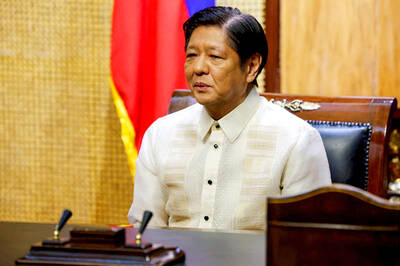
The Philippines would likely be involved in any conflict over Taiwan due to its proximity to the democracy claimed by China, President Ferdinand Marcos Jr said, reiterating a stance that risks angering Beijing. “In the Philippines, we do not have a choice because Taiwan is so close to the Philippines and we have almost 200,000 Filipino nationals living and working in Taiwan,” Marcos said in an interview with Japanese media in Manila on Monday. The Philippine leader’s comments come ahead of a state visit to Japan next week, where he is to meet with Japanese Prime Minister Sanae Takaichi to discuss security


 RSS
RSS