


The suspect in a stabbing attack that killed three people and injured 11 in Taipei on Friday had planned the assault and set fires at other locations earlier in the day, law enforcement officials said yesterday.
National Police Agency (NPA) Director-General Chang Jung-hsin (張榮興) said the suspect, a 27-year-old man named Chang Wen (張文), began the attacks at 3:40pm, first setting off smoke bombs on a road, damaging cars and motorbikes.
Earlier, Chang Wen set fire to a rental room where he was staying on Gongyuan Road in Zhongzheng District (中正), Chang Jung-hsin said.
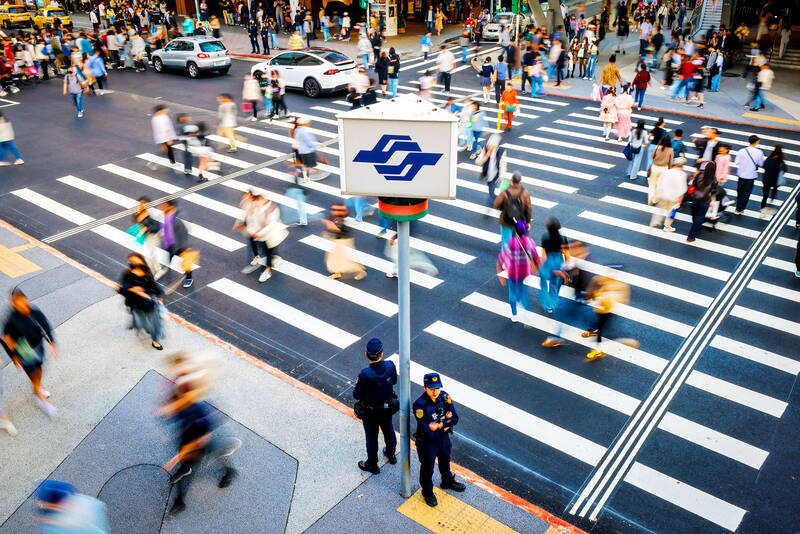
Photo: Ritchie B. Tongo, EPA
The suspect later threw smoke grenades near two exits of Taipei Main Station and fatally stabbed a person who tried to stop him, Chang Jung-hsin said.
After the attack, the suspect returned to a hotel room near Zhongshan MRT Station, which he had rented two days earlier, the official said.
The suspect was next seen on a road outside Eslite Spectrum Nanxi department store near Zhongshan MRT Station, where he threw more smoke grenades before fatally stabbing another person outside the department store, the official said.
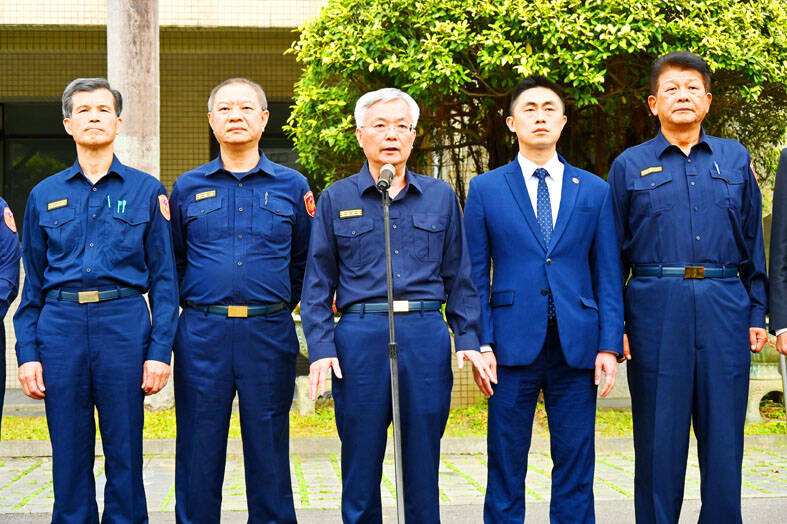
Photo: George Tsorng, Taipei Times
The suspect stormed into the department store and fatally wounded another person on the fourth floor before he jumped from the sixth floor, the official said, adding that he was rushed to Cathay General Hospital and pronounced dead at 7:42pm.
The suspect had visited the Eslite department store the day before the attack and asked the staff how he could access the roof “to take photos of Christmas decorations,” Chang Jung-hsin said.
The suspect also purchased gasoline containers and a trolley he used to carry Molotov cocktails, which were not used, indicating that the attack had been premeditated, the official said.
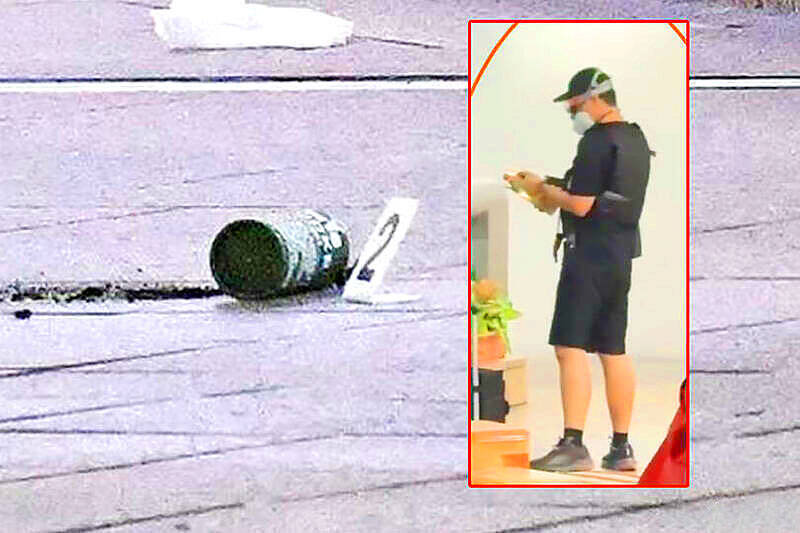
Photo: Taipei Times
The smoke grenades the assailant used could be purchased online, he said.
“The suspect planned an indiscriminate attack. He acted according to a plan,” Chang Jung-hsin said, adding that the initial investigation had not found anyone else who might have acted with the suspect.
Police unlocked two password-protected tablets found in the hotel room and were searching the devices for information, the NPA chief said.
Authorities added that they had obtained a laptop computer and a cellphone belonging to the suspect during a search of his family home in Taoyuan.
Sources said that a Taipei police task force had preliminarily succeeded in decrypting the suspect’s “crime plan” stored in the cloud.
The suspect had extensively browsed and recorded information related to Cheng Chieh (鄭捷) — who killed four people and injured 23 in a stabbing frenzy on a Taipei MRT in 2014, police said.
Authorities were still unable to determine a motive for the crime, but initially said that they believe he was a “copycat offender,” as he attempted to use Cheng’s method to attract societal attention and create fear.
Taipei Police Department Commissioner Li Hsi-ho (李西河) said the suspect had not been in contact with his parents after he was expelled from the military two years ago for driving under the influence of alcohol.
He was scheduled to report for reserve military service training on Nov. 25 last year, and an arrest warrant for him was issued on July 11 for contravening military service regulations, authorities said.
People used their phones to record the scene at the time of the attack after smoke from the grenades permeated the air near the M7 exit of Taipei Main Station.
A netizen wrote on social media yesterday that a video they captured showed the moment that the suspect had finished throwing the grenades and was covering his mouth and nose, pretending to be a passerby.
“It’s shocking to know that I brushed past him,” the netizen said.

Yangmingshan National Park authorities yesterday urged visitors to respect public spaces and obey the law after a couple was caught on a camera livestream having sex at the park’s Qingtiangang (擎天崗) earlier in the day. The Shilin Police Precinct in Taipei said it has identified a suspect and his vehicle registration number, and would summon him for questioning. The case would be handled in accordance with public indecency charges, it added. The couple entered the park at about 11pm on Thursday and began fooling around by 1am yesterday, the police said, adding that the two were unaware of the park’s all-day live
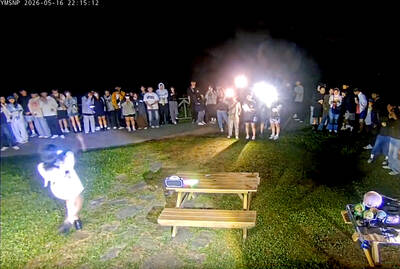
Yangmingshan National Park’s Qingtiangang (擎天崗) nature area has gone viral after a park livestream camera observed a couple in the throes of intimate congress, which was broadcast live on YouTube, drawing large late-night crowds and sparking a backlash over noise, bright lights and disruption to wildlife habitat. The area’s livestream footage appeared to show a couple engaging in sexual activity on a picnic table in the park on Friday last week, with the uncensored footage streamed publicly online. The footage quickly spread across social media, prompting a tide of visitors to travel to the site to “check in” and recreate the
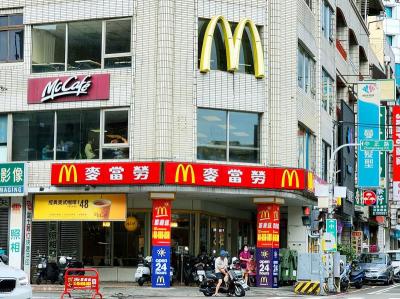
Fast food chain McDonald's is to raise prices by up to NT$5 on some products at its restaurants across Taiwan, starting on Wednesday next week, the company announced today. The prices of all extra value meals and sharing boxes are to increase by NT$5, while breakfast combos and creamy corn soup would go up by NT$3, the company said in a statement. The price of the main items of those meals, if ordered individually, would remain the same. Meanwhile, the price of a medium-sized lemon iced tea and hot cappuccino would rise by NT$3, extra dipping sauces for chicken nuggets would go up

Minister of Digital Affairs Lin Yi-ching (林宜敬) yesterday cited regulatory issues and national security concerns as an expert said that Taiwan is among the few Asian regions without Starlink. Lin made the remarks on Facebook after funP Innovation Group chief executive officer Nathan Chiu (邱繼弘) on Friday said Taiwan and four other countries in Asia — China, North Korea, Afghanistan and Syria — have no access to Starlink. Starlink has become available in 166 countries worldwide, including Ukraine, Malaysia, the Philippines and Vietnam, in the six years since it became commercial, he said. While China and North Korea block Starlink, Syria is not


 RSS
RSS