


Bangladesh’s national soccer team face daunting odds at their first-ever Women’s Asian Cup, but have already scored a major victory by qualifying.
In the South Asian nation of 170 million, social stigma, family expectations, poverty and religious hardliners have long relegated women and girls to sports sidelines.
The first women’s soccer league matches took place in 2011 and the squad, known to fans as the Red and Green, have kept pressing forward despite deeply embedded prejudices.
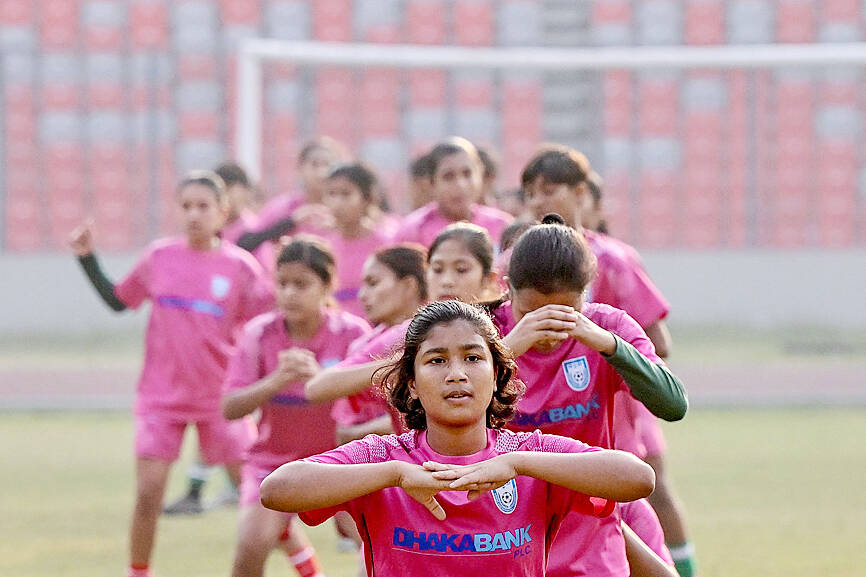
Photo: AFP
“Many more girls would have joined us if the community had been even slightly supportive,” captain Afeida Khandaker told AFP ahead of her side’s March 3 debut in Australia.
In rural areas especially, women and girls are discouraged from, or even harassed, for playing sports, with some religious leaders deeming it indecent.
“Girls often had to quit football after primary school,” Khandaker said. “Neighbors would complain about how teenage girls could play football while wearing shorts.”
To stay on the pitch, girls have to fend off pressure to marry before they turn 18.
Local league player Ennima Khanom Richi, 20, said many of her teammates were forced out of soccer and into arranged marriages.
“Families often cannot bear the social pressure, so they stop their girls from playing,” she said.
Two years of political turmoil have only increased the obstacles. Emboldened by upheaval since the 2024 uprising that overthrew the government, Islamist activists have directed much of their attention toward Bangladeshi women, accusing them of insufficient modesty.
Several women’s soccer matches were canceled last year after pitch invasions and threats of violence.
While the Bangladesh Nationalist Party, which won last month’s general elections, has vowed to back women’s rights, an Islamist coalition’s unprecedented share of the vote stirred fears of regressive gender policies.
Skipper Khandaker, from a southern constituency where Islamist lawmakers won big in recent elections, knows the cost of serving as a role model.
“My sister and I both wanted to be footballers and for that my parents — especially my mother — had to endure bitter words,” said the 20-year-old, who started playing at the age of five.
Her father, Khandaker Arif Hossain Prince, backed his daughters’ athletic ambitions, but he said not all families have that luxury.
“Our aspiring footballers come from marginalized families and it is often not possible for them to provide financial support,” said Prince, a women’s soccer organizer.
“Some of their parents are rickshaw pullers, laborers or tea vendors... Some cannot afford it and quit football. I feel like quitting too every time I see a girl leaving the game,” Prince said.
While on a break from passing drills at an early morning training session at the National Stadium in Dhaka, Bangladesh Football Federation coach Saiful Bari Titu, 53, said “just talking about the women’s team is a privilege for me.”
“They faced a lot of protests,” he added.
After years of building grassroots support for women’s football, the federation is starting to see a payoff.
More than 40 soccer clubs across Bangladesh now train girls from the age of nine.
“We didn’t even have a national women’s team before 2008,” said Mahfuza Akter Kiron, 59, head of the BFF women’s wing. “It was a real struggle for them to play football.”
While salaries for national team players remain low, especially compared to the men’s earnings, the small amount of money has brought stability to dozens of families.
“I wanted to offer a livelihood to the footballers,” Kiron added. Organizers said that as progress in women’s soccer becomes evident, sponsors are beginning to show interest and people’s attitudes are shifting.
“People seem happy now,” said Khandaker. “They gather to see me when I go home.”
She is clear-sighted about the scale of the competition as Bangladesh open the tournament against nine-time Asian champions China on Tuesday.
“China and North Korea are far ahead of us in the rankings... but we will give our best,” she said.

After letting another big lead slip with an error-strewn performance at the French Open on Wednesday, top-ranked Aryna Sabalenka felt like getting as far away from the courts as possible. “Just want to quit tennis right now,” Sabalenka said after wasting a lead of a set and two breaks in a 3-6, 7-5, 6-0 loss to Diana Shnaider in the women’s singles quarter-finals. “We’ll see in few days. Hopefully I’ll get back on track mentally.” Sabalenka’s wait for a first French Open title continues despite the four-time major winner leading 4-1 in the second set and being two points from victory while

BIG NAMES GONE: Zverev is the clear favorite for a maiden Grand Slam title, reaching semi-finals for the fifth time in six years and finishing second on three occasions Alexander Zverev on Tuesday breezed past Rafael Jodar to stay on course for an elusive Grand Slam title at the French Open, while Jakub Mensik halted Joao Fonseca’s scintillating run in the quarter-finals. Zverev, the highest-ranked player left in the men’s draw, put an end to Spanish teenager Jodar’s impressive Roland Garros debut, easing into the semi-finals with a 7-6, (7/3), 6-1, 6-3 win. The 29-year-old Zverev is the clear favorite for a maiden Grand Slam title. He has finished runner-up on three occasions, including at the 2024 French Open. “I want to win the matches that are ahead of

For some, Cristiano Ronaldo remains the essential spearhead for Portugal’s FIFA World Cup bid, while others believe his presence would prevent Roberto Martinez’s strong side from flourishing. The debate around the five-time Ballon d’Or winner rages on, as it did at UEFA Euro 2024 and four years ago in Qatar — yet Ronaldo endures, ready to play in a record sixth World Cup. The 41-year-old remains a global superstar despite swapping the European elite for Saudi Arabia’s Al-Nassr, and is the leading men’s international goalscorer with 143 strikes. With 25 of those coming in 30 games under Martinez, the coach

Taiwanese sprinter Chen Yi-cen on Friday won the silver medal in the women’s 400m final at the Asian U20 Athletics Championships in Hong Kong, with a time of 53.16 seconds. Chen, 15, was the youngest among the eight finalists, and her performance also met the qualifying standard of 53.50 seconds for the Nagoya Asian Games in Japan in September and October. Chen first made her mark at the National Games in Tainan in 2023, at the age of 13, winning the women’s 400m final in 55.55 seconds to become the youngest gold medalist in the history of the event. Meanwhile,


 RSS
RSS