


Taiwan is awaiting official notification from the US regarding the status of the Agreement on Reciprocal Trade (ART) after the US Supreme Court ruled US President Donald Trump's global tariffs unconstitutional.
Speaking to reporters before a legislative hearing today, Premier Cho Jung-tai (卓榮泰) said that Taiwan's negotiation team remains focused on ensuring that the bilateral trade deal remains intact despite the legal challenge to Trump's tariff policy.
"The US has pledged to notify its trade partners once the subsequent administrative and legal processes are finalized, and that certainly includes Taiwan," Cho said when asked about opposition parties’ doubts that the ART was still valid.
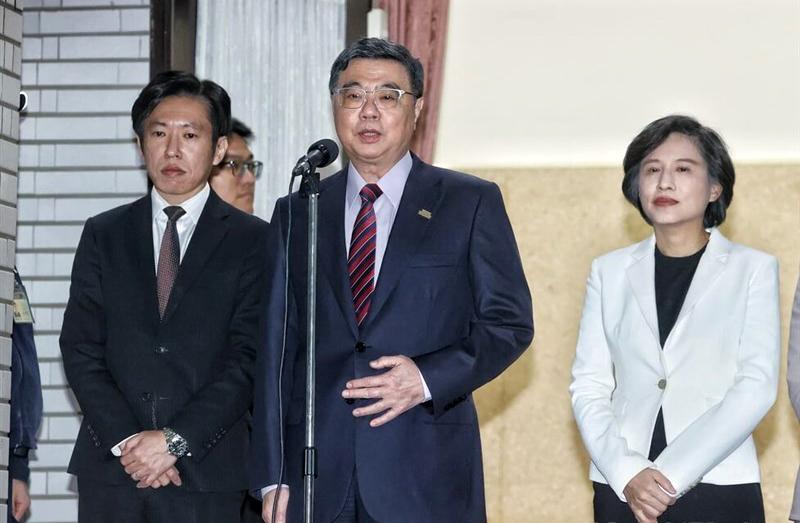
Photo: CNA
"This is the most current update we have," he said.
The ART, signed on Feb. 12, established a 15 percent tariff on Taiwanese goods and included provisions exempting 1,735 categories of goods from "reciprocal" duties.
Combined with another 337 categories of goods exempted for all US trading partners under an executive order, the exemptions would bring the average effective tariff on Taiwan's exports under the Trump tariff policy down to 12.33 percent, official estimates showed.
The agreement was originally slated for submission to the Legislative Yuan for deliberation alongside a memorandum of understanding (MOU) on Taiwan-US investment signed on Jan. 15.
The legal landscape shifted when the Supreme Court on Feb. 20 found that the Trump administration's use of the International Emergency Economic Powers Act of 1977 to impose its "reciprocal" tariffs exceeded executive authority, rendering them invalid.
In a swift countermove, Trump signed a proclamation invoking Section 122 of the Trade Act of 1974 to impose a global 15 percent tariff based on balance-of-payments authority.
However, the US government had as of early this month only imposed a 10 percent tariff on global imports under Section 122, lower than the average effective tariff of 12.33 percent Taiwan secured under the ART.
Vice Premier Cheng Li-chiun (鄭麗君) late last month reassured the public that the Supreme Court's decision would not undermine the core benefits Taiwan secured under the ART.
Beyond the benefits of the ART, provisions within the investment MOU continue to provide Taiwan with preferential treatment regarding potential tariffs stemming from Section 232 investigations under the US Trade Expansion Act, she said at the time.

FUKUOKA SITUATION: Japanese media reported that the pathogen is expected to be identified by the summer, while the CDC downplayed the idea that it was hMPV A “mysterious cold-like illness” reported in Japan’s Fukuoka Prefecture does not seem to be a new disease, but Japanese authorities have been asked about the situation, the Centers for Disease Control (CDC) said yesterday. The Fukuoka Prefectural Medical Association on Wednesday told a news conference that a “mystery cold” that has become a hot topic on social media is “highly likely to be caused by some kind of viral infection,” Japan’s KBC News reported. “Many people are experiencing symptoms starting with a sore throat, followed by a runny nose, phlegm and a severe cough,” KBC News reported, citing association officials. Health authorities are

Nvidia Corp CEO Jensen Huang (黃仁勳) arrived in Taiwan yesterday ahead of upcoming AI and technology events, saying he plans to meet with clients and Taiwan Semiconductor Manufacturing Co Chairman C.C. Wei (魏哲家) during his visit. After landing at Taipei Songshan Airport, Huang posed for photos with fans and handed out Yakult drinks to reporters and supporters waiting at the scene, saying he has “a lot to do” during the trip. Asked about reports that Nvidia’s planned headquarters site in Taipei’s Beitou Shilin Technology Park could break ground on May 27, Huang said that if the company holds an event, he would

The Ministry of Finance this afternoon announced the winning numbers for the March-April uniform invoice lottery. The winning number for the NT$10 million (US$318,060) special prize is 19531471, and the winning number for the NT$2 million grand prize is 85941329. Three numbers were drawn for the NT$200,000 first prize: 07225810, 20231230 and 83518781. Those with receipts matching the last seven digits of any of the first-prize numbers will win the NT$40,000 second prize, while those matching the last six digits will win the NT$10,000 third prize. Those whose receipts match the last five digits of the first-prize numbers can claim the NT$4,000 fourth prize,
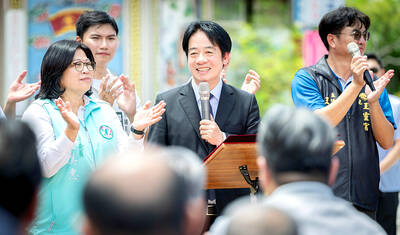
SIX SUBSIDIES: The monthly allowance for older farmers is to increase to NT$10,000, and NT$5,000 is to be given to homemakers under the national pension system, Lai said The government is to implement major welfare policies for disadvantaged groups, including raising the monthly allowance for older farmers to NT$10,000 and providing homemakers with NT$5,000 per month, President William Lai (賴清德) said yesterday. Lai made the remarks during a visit to Wangling Temple in Chiayi County, saying that the planned increases were being introduced amid economic growth and an increase in tax revenue. Touting a policy, in which the government plans to provide a monthly allowance of NT$5,000 for every child under the age of 18 in a bid to address Taiwan’s low birthrate, Lai said that if received for the


 RSS
RSS