


If China chose to invade Taiwan tomorrow, it would only have to sever three undersea fiber-optic cable clusters to cause a data blackout, Jason Hsu (許毓仁), a senior fellow at the Hudson Institute and former Chinese Nationalist Party (KMT) legislator, told a US security panel yesterday.
In a Taiwan contingency, cable disruption would be one of the earliest preinvasion actions and the signal that escalation had begun, he said, adding that Taiwan’s current cable repair capabilities are insufficient.
The US-China Economic and Security Review Commission (USCC) yesterday held a hearing on US-China Competition Under the Sea, with Hsu speaking on a panel about undersea infrastructure and strategic resources.
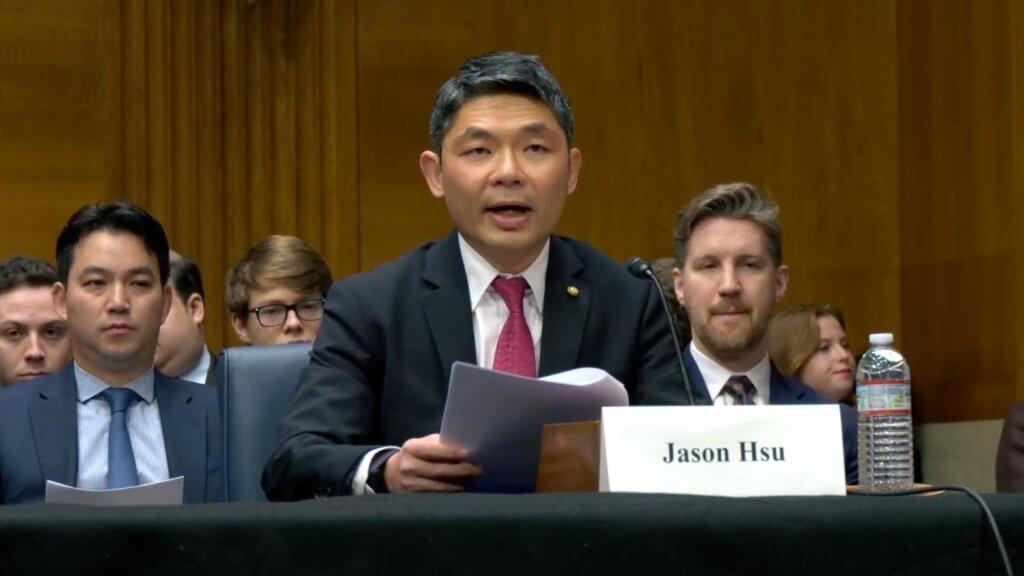
Photo: Screen grab from Jason Hsu’s Facebook page
The USCC is a legislative branch of the US Congress assigned to monitor, investigate and report on the national security implications of the bilateral trade and economic relationship between the US and China, and was established in 2000.
China has deliberately targeted Taiwan's undersea cables as part of its expanding “gray zone” warfare toolkit, with a notable and alarming escalation since 2023, Hsu said in his testimony.
It is one of the most urgent security challenges facing Taiwan and the broader Indo-Pacific region as a “gray zone” warfare tactic that is “calibrated, deniable and escalating,” he said.
Severing three cable clusters near the Bashi Channel could reduce Taiwan’s international bandwidth by up to 95 percent when combined with cyberoperations and satellite jamming, Hsu said.
Taiwan is connected to the global network through just 24 undersea cables, 14 of which are international links to Japan, Philippines, Singapore, South Korea and the US, he said.
Any disruption to undersea cables would cost Taiwan up to US$55 million per day, before considering the wider implications of interrupting semiconductor supply chains, he said.
It would “paralyze financial markets, disrupt the semiconductor manufacturing that underpins the global technology supply chain and sever critical military and government communications,” Hsu said.
In peacetime, average cable repair time exceeds 40 days, he said, adding that Taiwan has no indigenous cable repair ships.
In wartime, repairs would be “nearly impossible,” while satellites would be insufficient, he said.
Hsu recommended actions to Congress, including passing the Taiwan Undersea Cable Resilience Initiative Act, introduced in July last year, investing in cable repair capacity and increasing sanctions on vessels that cut cables.
Meanwhile, Taiwan should build domestic cable repair capacity, ideally with Japan, and its coast guard should expand vessel watch lists and patrols near critical cable corridors, he said.
Hsu then spoke directly to the Legislative Yuan as a former legislator.
The legislature must pass the defense budget, he said, adding that Taiwan’s national security “cannot be a partisan issue.”
President William Lai (賴清德) in November announced a NT$1.25 trillion (US$39.68 billion) special defense budget to be allocated over eight years, including arms purchases from the US.
KMT and Taiwan People’s Party lawmakers repeatedly blocked the bill from proceeding to committee for review, but it is to be examined on Friday along with a NT$400 billion version from the TPP and a planned version from the KMT.
Taiwan’s political parties, both ruling and opposition, must stand in unity when facing national security threats, Hsu said.
“Only by strengthening our own resilience, demonstrating resolve and backing commitments with action can we ask the world to stand with us,” he said.
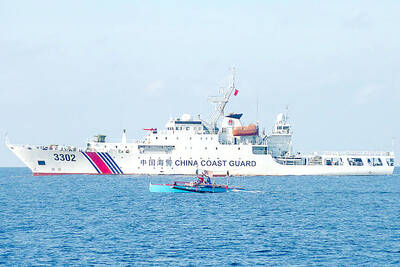
EXPANSIONIST: China deploys an average of 40 to 50 warships and coast guard vessels daily in the South China Sea, despite pledges not to militarize the region, an official said China is attempting to expand its influence across the First Island Chain and increase pressure on Japan by sending coast guard vessels into waters off of Taiwan under the pretext of maritime negotiations with Japan and the Philippines, a national security official said yesterday. China’s recent actions in the waters east of Taiwan and Japan and the Philippines’ exclusive economic zones (EEZ) are attempts to establish dominance in First Island Chain waters, said the official who declined to be named, adding that this is “expansion disguised as law enforcement.” Framing China’s actions solely as a cross-strait issue is a serious misjudgment that
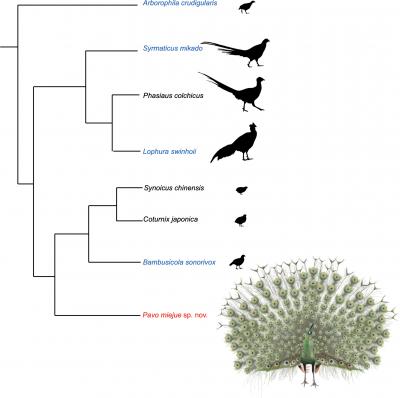
Through analyzing fossil evidence, a research team at National Taiwan University (NTU) discovered the largest endemic bird to have lived in Taiwan, naming it Pavo miejue, or extinct peafowl (滅絕孔雀). The Mikado pheasant, which is printed on the back of the NT$1,000 bank note, was previously believed to be the biggest endemic bird to Taiwan. The research team’s findings suggest that Pavo miejue lived during the Pleistocene epoch tens of thousands of years ago. It is the first endemic extinct bird species discovered and formally named in Taiwan. The study was coauthored by NTU Institute of Ecology and Evolutionary Biology professor Tsai Cheng-hsiu (蔡政修),
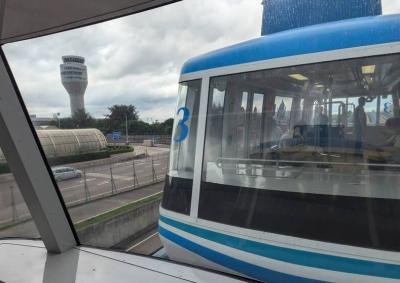
Taiwan Taoyuan International Airport is to suspend its automated Skytrain service connecting Terminal 1 and Terminal 2 starting on July 1 to facilitate connection works for the upcoming Terminal 3, the airport operator said today. Passengers and staff who need to travel between the two terminals after the suspension can instead use the Taoyuan MRT or the airport's 24-hour shuttle bus service, Taoyuan International Airport Corp said. The Taoyuan MRT Airport Line directly links the two terminals, while the shuttle buses are to operate around the clock, the company added. The Skytrain provides free transportation between the airport’s two terminals for travelers and
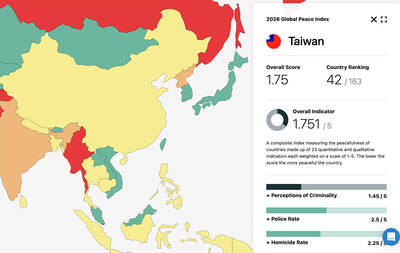
Taiwan ranked 42nd in terms of peacefulness among 163 countries, down five places from last year, according to this year’s Global Peace Index. With an overall score of 1.751, Taiwan dropped from 37th last year, the report published by the global Institute for Economics and Peace showed. The overall score measures a country’s level of peacefulness using 23 quantitative and qualitative indicators across three domains — ongoing domestic and international conflict, societal safety and security, and militarization. While Taiwan ranked 42nd worldwide, it was listed in ninth place among the 19 Asian-Pacific countries in the report, after New Zealand, Singapore, Japan, Malaysia,


 RSS
RSS