


The Ministry of Foreign Affairs (MOFA) yesterday rebuked a statement by China’s embassy in Israel that it would evacuate Taiwanese holders of Chinese travel documents from Israel amid the latter’s escalating conflict with Iran.
Tensions have risen across the Middle East in the wake of US and Israeli airstrikes on Iran beginning Saturday.
China subsequently issued an evacuation notice for its citizens. In a news release, the Chinese embassy in Israel said holders of “Taiwan compatriot permits (台胞證)” issued to Taiwanese nationals by Chinese authorities for travel to China — could register for evacuation to Egypt.

Photo: Taipei Times
In Taipei, the ministry yesterday said Taiwan has already activated its own mechanisms and does not require Beijing to “meddle.”
“MOFA and its overseas missions are committed to providing timely and necessary assistance to ensure the safety of Republic of China nationals,” ministry spokesman Hsiao Kuang-wei (蕭光偉) said, adding that Taiwan’s consular protection rights must not be reduced to a tool for political manipulation.
According to the ministry, the approximately 3,000 Taiwanese nationals currently in the Middle East with whom it has established contact are safe.
Of those Taiwanese, 2,000 are in Saudi Arabia, 300 in the United Arab Emirates, 262 in Israel, 200 in Qatar, 124 in Jordan, 50 in Kuwait, 23 in Oman, 22 in Bahrain and four in Iran.
The ministry said it would continue to monitor the latest situation in the region and maintain close contact with other countries to make timely adjustments to its response measures.
In case of an emergency in the Middle East, the ministry urged Taiwanese to call the nearest Taiwanese representative office for assistance or ask their families in Taiwan to contact the ministry’s all-hours toll-free emergency hotline at +886-800-085-095.
The Tourism Bureau added yesterday that an estimated 773 Taiwanese travelers from 28 tour groups have been affected due to airspace closures in the region.
The bureau said it has asked local travel agencies to come up with alternative flight routes to ensure traffic safety and to make sure the planned group visits would not be affected.
Separately yesterday, an official said on condition of anonymity that China’s evacuation notice’s reference to “Taiwanese compatriots” is simply another instance of Beijing “taking advantage of Taiwan.”
“Taiwan has a representative office in Israel and does not need the Chinese Communist Party to overstep its role,” they said.
Taiwan maintains cordial and substantive ties with Israel, while Iran has cultivated close relations with the People’s Republic of China, the official said.
Venezuela was previously characterized by Beijing as an “all-weather strategic partner” and a critical node in the Western hemisphere, while Iran is regarded as the heart of China’s Belt and Road Initiative in the Middle East and one of its most important strategic partners.
Iran was also listed alongside Russia and North Korea as a “VVIP” during China’s Sept. 3 military parade. Beijing’s close relationship with the theocratic regime led by supreme leader Ali Khamenei is widely recognized, the official said.
If Taiwanese were to align themselves with China at this juncture — identifying as Chinese nationals or as allies of Iran — it could create the perception that Taiwan is positioning itself against democratic countries, potentially complicating future international travel, the official warned.
China’s strong backing of Iran’s theocratic regime has coincided with crackdowns on pro-democracy Iranians, resulting in arrests and killings.
With public sentiment in Iran toward China increasingly negative, being identified locally as “Chinese” could expose Taiwanese to heightened risk, the official said.
Additional reporting by Chen Yun and CNA
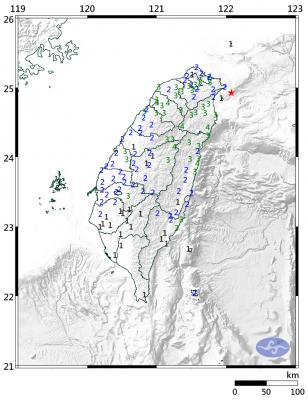
A magnitude 6.1 earthquake struck off the coast of Yilan County at 8:39pm tonight, the Central Weather Administration (CWA) said, with no immediate reports of damage or injuries. The epicenter was 38.7km east-northeast of Yilan County Hall at a focal depth of 98.3km, the CWA’s Seismological Center said. The quake’s maximum intensity, which gauges the actual physical effect of a seismic event, was a level 4 on Taiwan’s 7-tier intensity scale, the center said. That intensity level was recorded in Yilan County’s Nanao Township (南澳), Hsinchu County’s Guansi Township (關西), Nantou County’s Hehuanshan (合歡山) and Hualien County’s Yanliao (鹽寮). An intensity of 3 was
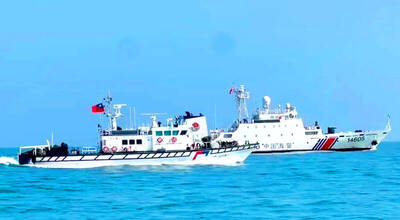
Instead of focusing solely on the threat of a full-scale military invasion, the US and its allies must prepare for a potential Chinese “quarantine” of Taiwan enforced through customs inspections, Stanford University Hoover fellow Eyck Freymann said in a Foreign Affairs article published on Wednesday. China could use various “gray zone” tactics in “reconfiguring the regional and ultimately the global economic order without a war,” said Freymann, who is also a nonresident research fellow at the US Naval War College. China might seize control of Taiwan’s links to the outside world by requiring all flights and ships entering or leaving Taiwan
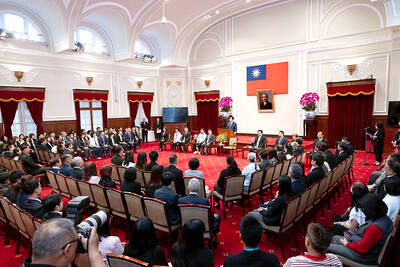
The next minimum wage hike is expected to exceed NT$30,000, President William Lai (賴清德) said yesterday during an award ceremony honoring “model workers,” including migrant workers, at the Presidential Office ahead of Workers’ Day today. Lai said he wished to thank the awardees on behalf of the nation and extend his most sincere respect for their hard work, on which Taiwan’s prosperity has been built. Lai specifically thanked 10 migrant workers selected for the award, saying that although they left their home countries to further their own goals, their efforts have benefited Taiwan as well. The nation’s industrial sector and small businesses lay
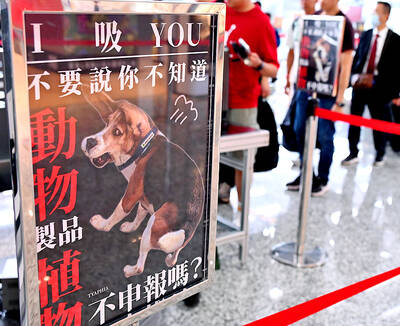
Quarantine awareness posters at Taiwan Taoyuan International Airport have gone viral for their use of wordplay. Issued by the airport branch of the Animal and Plant Health Inspection Agency, the posters feature sniffer dogs making a range of facial expressions, paired with advisory messages built around homophones. “We update the messages for holidays and campaign needs, periodically refreshing materials to attract people’s attention,” quarantine officials said. “The aim is to use the dogs’ appeal to draw focus to quarantine regulations.” A Japanese traveler visiting Taiwan has posted a photo on X of a poster showing a quarantine dog with a


 RSS
RSS