


Beijing could eventually see a full amphibious invasion of Taiwan as the only "prudent" way to bring about unification, the US Department of Defense said in a newly released annual report to Congress.
The Pentagon's "Annual Report to Congress: Military and Security Developments Involving the People's Republic of China 2025," was in many ways similar to last year’s report but reorganized the analysis of the options China has to take over Taiwan.
Generally, according to the report, Chinese leaders view the People's Liberation Army's (PLA) capabilities for a Taiwan campaign as improving, but they remain uncertain about its readiness to successfully seize Taiwan while countering potential US involvement.
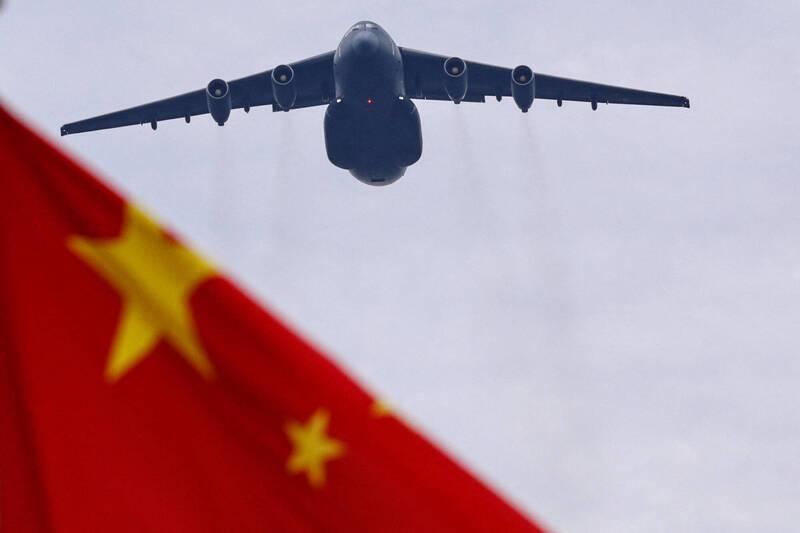
Photo: Reuters
The report said Beijing is busy refining several military options to force unification with Taiwan, ranging from coercive actions short of war to a full-scale joint island landing campaign (JILC).
A landing campaign involving a large-scale amphibious invasion of Taiwan would be the most decisive and riskiest option, the report said.
It would require highly complex, coordinated operations to "break through Taiwan's shore defenses and establish a beachhead that allowed the PLA to build up enough combat power to seize key targets or territory to force unification," the report said.
Yet despite the risks and Beijing's preference for less dramatic options, "it is preparing for a JILC and could determine that it is the only prudent option for compelling unification," the report said.
"We lack information about whether Beijing has determined the viability of other unification options, and the decisiveness of a JILC will probably make it an increasingly more appealing option as the decision space for other options is constrained," the report said.
The three less dramatic options, also covered in last year’s report, were coercion short of war, a joint firepower strike campaign and a joint blockade campaign.
Over the past year, the report said, the PLA has conducted operations exercising key elements of these options, including drills focused on blockading key ports, striking sea and land targets, and countering possible US military intervention.
Coercion consists of combining escalating military pressure with economic, informational and diplomatic tools to compel Taipei’s capitulation and could include cyberattacks, electronic warfare or conventional strikes against Taiwan’s political, military and communications infrastructure.
The goal would be to instill fear and degrade public confidence, with the aim of forcing negotiations on Beijing’s terms without launching a full invasion, the report said.
The success of that option would depend heavily on Taiwan’s resilience and will to resist Chinese coercion, as well as external support from the US and others.
A joint firepower strike campaign would involve missile and air strikes against key government and military targets "to degrade Taiwan's defenses, decapitate its military and political leadership or undermine the public's resolve to resist."
Such operations would require complex coordination across PLA services, potentially limiting their effectiveness, according to the report.
A joint blockade campaign would employ maritime and air blockades to cut off Taiwan's vital imports over weeks or months while conducting missile strikes and possible seizure of Taiwan's offshore islands "to compel Taiwan to negotiate or surrender."
However, the report did not offer any assessment of the factors that would determine the potential success or failure of a blockade strategy.
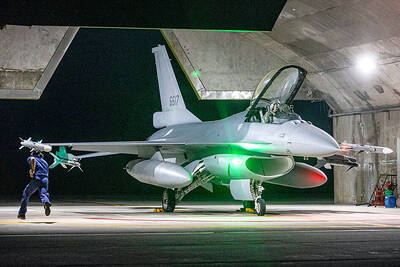
Taiwan has received more than US$70 million in royalties as of the end of last year from developing the F-16V jet as countries worldwide purchase or upgrade to this popular model, government and military officials said on Saturday. Taiwan funded the development of the F-16V jet and ended up the sole investor as other countries withdrew from the program. Now the F-16V is increasingly popular and countries must pay Taiwan a percentage in royalties when they purchase new F-16V aircraft or upgrade older F-16 models. The next five years are expected to be the peak for these royalties, with Taiwan potentially earning

STAY IN YOUR LANE: As the US and Israel attack Iran, the ministry has warned China not to overstep by including Taiwanese citizens in its evacuation orders The Ministry of Foreign Affairs (MOFA) yesterday rebuked a statement by China’s embassy in Israel that it would evacuate Taiwanese holders of Chinese travel documents from Israel amid the latter’s escalating conflict with Iran. Tensions have risen across the Middle East in the wake of US and Israeli airstrikes on Iran beginning Saturday. China subsequently issued an evacuation notice for its citizens. In a news release, the Chinese embassy in Israel said holders of “Taiwan compatriot permits (台胞證)” issued to Taiwanese nationals by Chinese authorities for travel to China — could register for evacuation to Egypt. In Taipei, the ministry yesterday said Taiwan

Taiwan is awaiting official notification from the US regarding the status of the Agreement on Reciprocal Trade (ART) after the US Supreme Court ruled US President Donald Trump's global tariffs unconstitutional. Speaking to reporters before a legislative hearing today, Premier Cho Jung-tai (卓榮泰) said that Taiwan's negotiation team remains focused on ensuring that the bilateral trade deal remains intact despite the legal challenge to Trump's tariff policy. "The US has pledged to notify its trade partners once the subsequent administrative and legal processes are finalized, and that certainly includes Taiwan," Cho said when asked about opposition parties’ doubts that the ART was
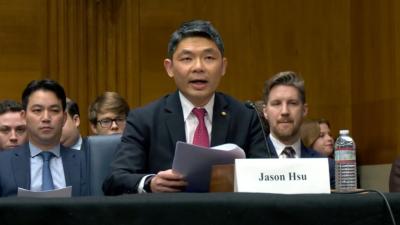
If China chose to invade Taiwan tomorrow, it would only have to sever three undersea fiber-optic cable clusters to cause a data blackout, Jason Hsu (許毓仁), a senior fellow at the Hudson Institute and former Chinese Nationalist Party (KMT) legislator, told a US security panel yesterday. In a Taiwan contingency, cable disruption would be one of the earliest preinvasion actions and the signal that escalation had begun, he said, adding that Taiwan’s current cable repair capabilities are insufficient. The US-China Economic and Security Review Commission (USCC) yesterday held a hearing on US-China Competition Under the Sea, with Hsu speaking on


 RSS
RSS