


The Nuremberg trials have inspired filmmakers before, from Stanley Kramer’s 1961 drama to the 2000 television miniseries with Alec Baldwin and Brian Cox. But for the latest take, Nuremberg, writer-director James Vanderbilt focuses on a lesser-known figure: The US Army psychiatrist Douglas Kelley, who after the war was assigned to supervise and evaluate captured Nazi leaders to ensure they were fit for trial (and also keep them alive). But his is a name that had been largely forgotten: He wasn’t even a character in the miniseries.
Kelley, portrayed in the film by Rami Malek, was an ambitious sort who saw in this assignment an opportunity to write a book (bestselling, he hoped) on his findings about the men who committed such atrocities. Over several months he conducted many hours interviews and Rorschach tests with the inmates, including fallen Reichsmarschall Hermann Goering (Russell Crowe), who proved an especially fascinating subject as the highest ranking official still living.
The film centers on a series of conversations between Kelley and Goering, who develop something almost like a friendship — or at least a temporary understanding. It’s interesting, morally murky territory fitting of the filmmaker best known as the screenwriter of Zodiac that does gesture toward some provocative ideas — including the very concept of war tribunals overseen by the victors. But it can’t quite synthesize its classical form with the bleak, sobering truths at its core.
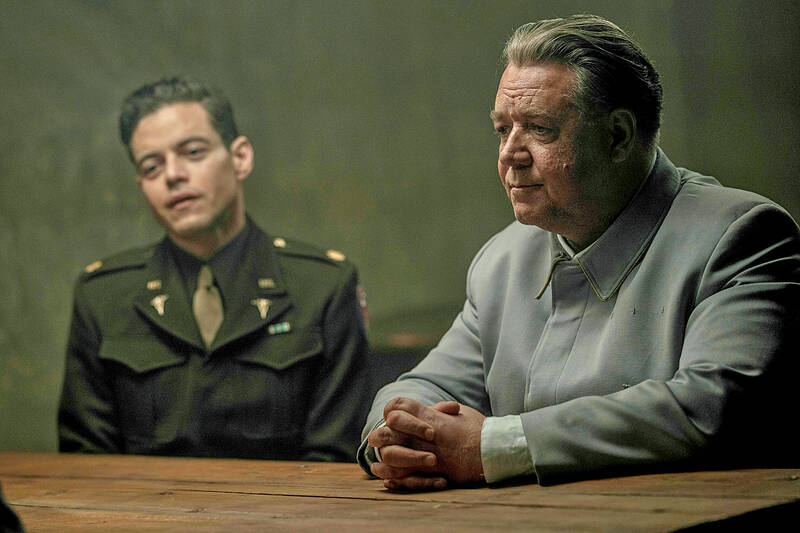
Photo: AP
Crowe, who speaks both German and English in the film, is well suited to playing this charismatic, larger-than-life egoist who believes he can outwit those around him. Curious choices are made, though, about what to tell of his transgressions during the war and the angelic representation of his wife and daughter in hiding.
Goering is likely not as much of a household name as Nuremberg seems to assume, but Crowe does get to do some of his best work in years. Malek, wild-eyed as ever, portrays Kelley as an overconfident opportunist who is more than willing to cross lines to gain Goering’s trust. Are we rooting for him, though? Not exactly.
You might think that these chats would be the kinds you don’t want to leave — a meeting of two unique minds trying to figure one another out, and yet there’s a spark and intrigue lacking. An unnerving descent into the mind of Hitler’s right hand man this is not. Instead, they talk about fathers and greatness and sometimes magic tricks. Perhaps that’s why Vanderbilt, who based his film on Jack El-Hai’s book The Nazi and the Psychiatrist, broadens his scope beyond the prison cell to include the story of how the unprecedented trial came together, with Supreme Court Justice Robert H. Jackson (a very good Michael Shannon) leading the charge to build a case against the Nazi leaders.
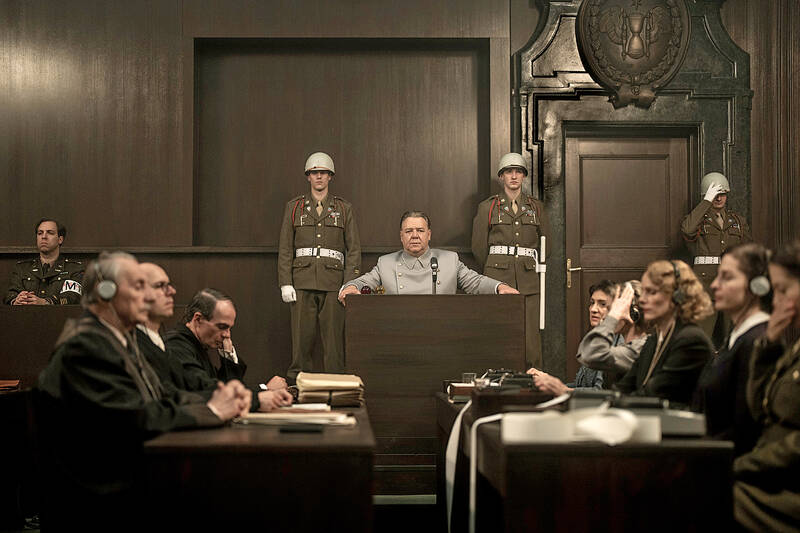
Photo: AP
What results is a familiar historical drama, weaving together many various characters in the buildup to the climactic courtroom showdown. With an expansive and recognizable ensemble cast, including Richard E. Grant as the British lawyer Sir David Maxwell-Fyfe, John Slattery as the commandant of Nuremberg prison, Colin Hanks as another psychiatrist brought into the fold (Gustave Gilbert, whose writings would eclipse Kelley’s) and Leo Woodall as a German speaking US officer, Nuremberg, stately and sober, is what we might have called Oscar-bait once upon a time.
The most fascinating character is probably Woodall’s, but the real story of Sergeant Howie Triest, a German Jewish emigre, is used as a reveal late in the film to motivate a humiliated Kelley to “do the right thing” and help Jackson and the lawyers bring Goering to justice.
Oddly, the trial is filmed like a standard courtroom drama, resorting to cliches and a rousing but hollow “we got him” moment that feels antithetical to the film’s larger point, that there is little glory in the charade and the convictions. At the end of it all is death anyway.
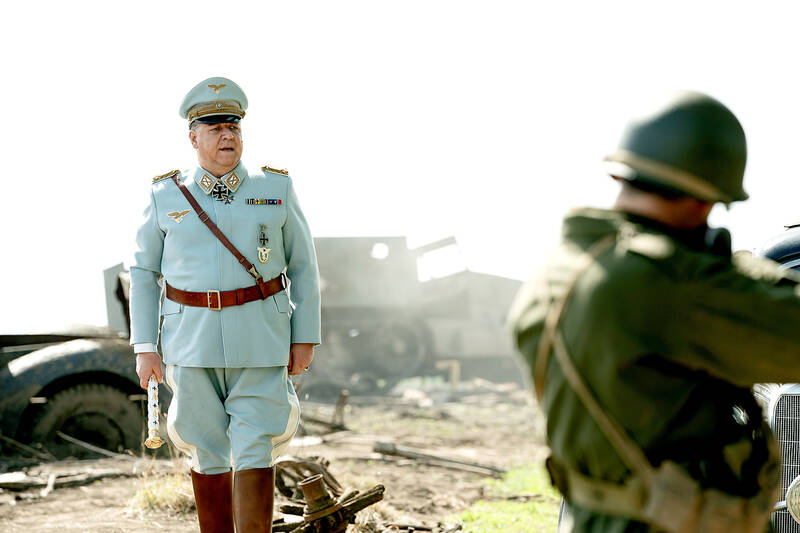
Photo: AP
What does it say about a nearly two-and-a-half hour drama when the 80-year-old footage from inside Nazi concentration camps that was shown inside the real courtroom is the most compelling and memorable sequence? Perhaps in these days of Holocaust denial, it’s never a bad idea to remind people of the truth. But will anyone harboring those assumptions stumble upon Nuremberg and, if they do, make it that far into the film?
Kelley would go on to write that book, 22 Cells in Nuremberg, but his chilling conclusions were not exactly embraced in that postwar moment. He did not find monsters or psychopaths in those cells, after all, but instead saw essentially normal people. Kelley wrote a warning: “I am convinced that there is little in America today which could prevent the establishment of a Nazi-like state.”

Ajay Verma, a consultant gastroenterologist at Kettering general hospital in Northamptonshire, says our gut is a “complex machine.” “It is constantly providing us with the nutrition we need, initially to grow and develop, and then for us to survive, thrive and repair from injury and illness.” How can we keep it functioning well? Put simply: “Make sure what you put into it is balanced, and that you clear out its waste products adequately,” Verma says. “In a general gastroenterology clinic, the most common conditions we see are irritable bowel syndrome (IBS), gastroesophageal reflux disease, inflammatory bowel disease and constipation,” says Nisha
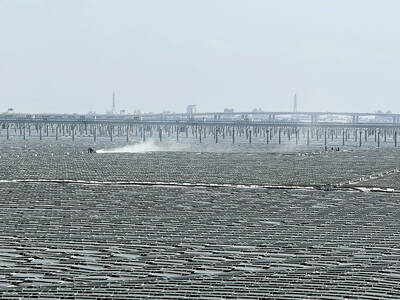
The arithmetic is straightforward and uncomfortable. By the end of 2025, Taiwan had committed itself to a 50-30-20 electricity mix — half natural gas, 30 per cent coal, 20 per cent renewables. The Ministry of Economic Affairs’s (MOEA) own monthly energy reports tell a different story. Natural gas reached 47.8 per cent of generation last year. Coal stood at 35.4 per cent, comfortably above its target ceiling. Renewables came in at 13.1 per cent, well short of the 20 per cent Taipei had pledged a decade earlier. Installed renewable capacity reached roughly half of the 12 gigawatts (GW) the government

Last week US President Donald Trump was asked by a reporter whether he would speak on the phone to the President of Taiwan. “l’ll speak to him. I speak to everybody. We have that situation very well in hand,” Trump said. This marked the second time in a couple of weeks he had said he would talk to the President of Taiwan. In 2016 he famously took a call from then-president Tsai Ing-wen (蔡英文), when he was president-elect. Despite warnings that the apocalypse was nigh because of a phone call, the world quickly forgot about the conversation between two democratically-elected presidents.

May 25 to May 31 Few believed that apples could be cultivated on a commercial scale in Taiwan’s high mountains. When horticulturalist Cheng Chao-hsiung (程兆熊) first proposed the idea in 1955, both American and Taiwanese colleagues dismissed it as implausible, arguing that temperate fruit could not be reliably grown on a subtropical island, especially on rugged terrain. However, it was this terrain in the Central Mountain Range where many Chinese Civil War veterans were resettled in the late 1950s. With limited job prospects and no family in Taiwan, they were placed on cooperative farms aimed toward self-sufficiency. Some say the conditions


 RSS
RSS