


Jan. 19 to Jan. 25
In 1933, an all-star team of musicians and lyricists began shaping a new sound. The person who brought them together was Chen Chun-yu (陳君玉), head of Columbia Records’ arts department. Tasked with creating Taiwanese “pop music,” they released hit after hit that year, with Chen contributing lyrics to several of the songs himself.
Many figures from that group, including composer Teng Yu-hsien (鄧雨賢), vocalist Chun-chun (純純, Sun-sun in Taiwanese) and lyricist Lee Lin-chiu (李臨秋) remain well-known today, particularly for the famous classic Longing for the Spring Breeze (望春風). Chen, however, is not a name that readily comes to mind while discussing that era.
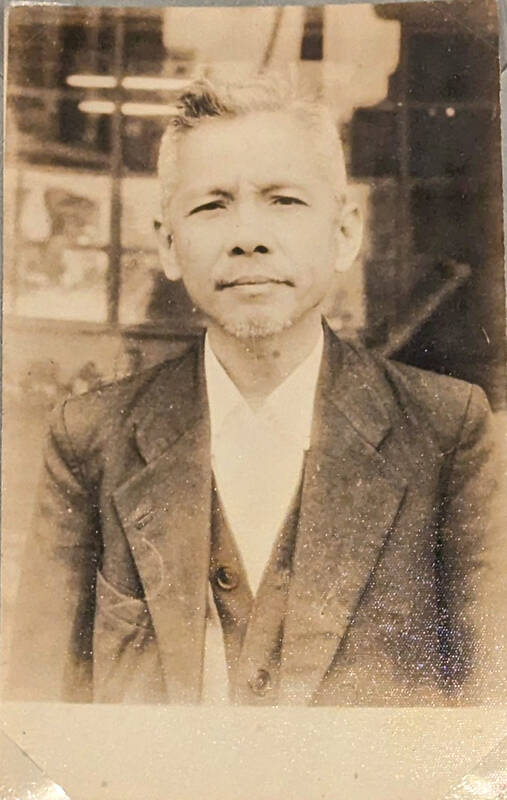
Photo: Han Cheung, Taipei Times
But his songs endure. The best known is Dancing Age (跳舞時代), which opened with the line, “I’m a modern woman, I’m free to go east, west, north or south.” The song later lent its name and served as the theme song for the 2003 documentary Viva Tonal (跳舞時代), which won Best Documentary at that year’s Golden Horse Awards.
Despite not finishing primary school, Chen became a respected and innovative figure in Taipei’s arts and literature scene throughout the 1930s. In 1956, he detailed that era in the journal Taipei Heritage (台北文物), an account still widely cited by researchers today.
ITINERANT YOUTH
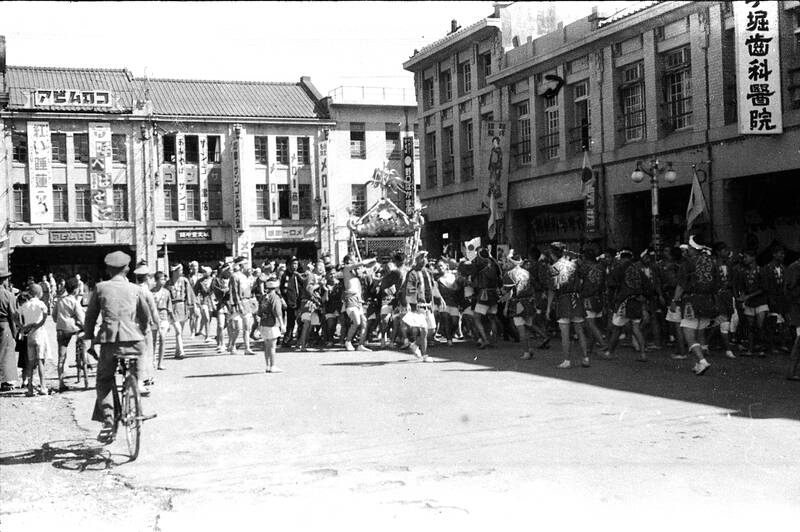
Photo courtesy of Wikimedia Commons
Chen was born in 1906 to a poor family in Taipei’s Dadaocheng area. Historian Chuang Yung-ming (莊永明) writes that Chen dropped out of school at a young age and worked as a street vendor. He also spent some time with a traditional puppet troupe, which may have been his first introduction to music.
As a teenager, Chen traveled to northeast China and worked as a typesetter at a Japanese-language newspaper. He taught himself Mandarin and improved his Chinese reading and writing abilities. The New Culture Movement was taking place in China, part of which advocated for vernacular language in literature over classical forms.
Around age 20, Chen returned to Taiwan and continued working as a typesetter. The Japanese colony was experiencing its own New Literature Movement, where cultural activists sought to reinforce Han Taiwanese culture and identity as a form of passive resistance to colonial rule.
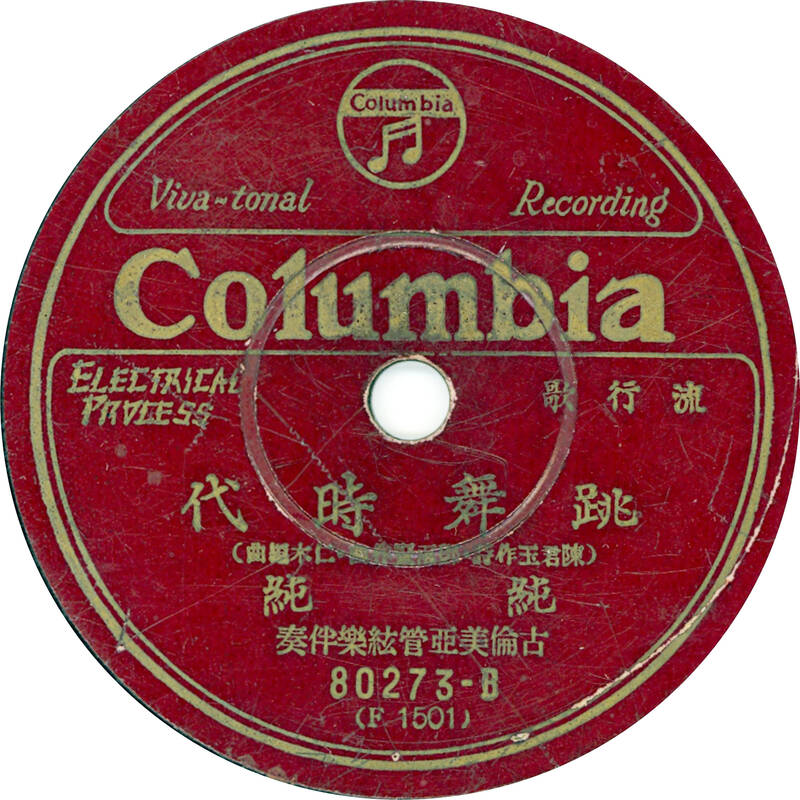
Photo courtesy of Taiwan Culture Memory Bank
Chen began submitting poems and fiction, writes Shih Ching-an (施慶安) in “Chen Chun-yu and Taiwanese popular music under Japanese Rule” (陳君玉與日治時期臺灣的流行音樂). Among his early published works was a romance novel set in a printing factory.
ALL-STAR POP TEAM
As industry competition intensified during the early 1930, Columbia Records’ Taiwan director Shojiro Kashino set out to create a new form of Hoklo (commonly known as Taiwanese) music employing Western instrumentation and composition styles. In 1931, the label released March of the Black Cats (烏貓行進曲) the first song explicitly labeled a “pop song” (see “Taiwan in Time: Taiwan’s first pop song?” March 9, 2025).
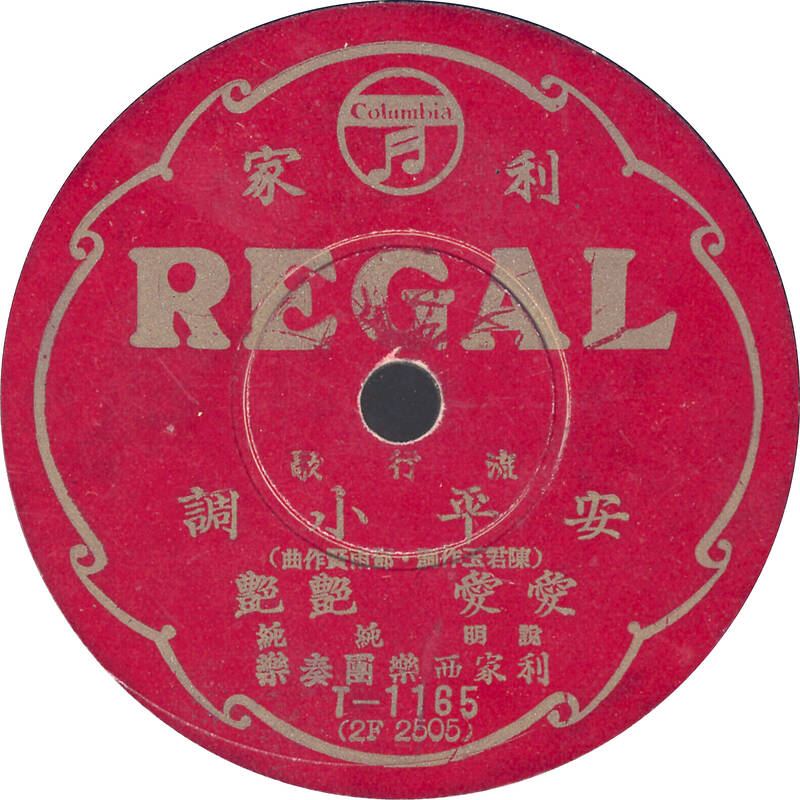
Photo courtesy of Taiwan Culture Memory Bank
The following year, Columbia scored its first major hit with The Peach Girl (桃花泣血記), sung by Chun-chun, often regarded as Taiwan’s first pop star. By early 1933, Kashino decided to fully commit to this new genre.
Shih writes that Chen had been commissioned to pen a few songs for the label, but they were never released. Nevertheless, he was selected to head the newly established arts department.
Chen moved quickly. He poached former public school music teacher Teng Yu-hsien from rival Wensheng Records, brought in former preacher Yao Tsan-fu (姚讚福) and enlisted Su Tung (蘇桐), a traditional opera musician employed by Columbia. They became the label’s principal composers and were also responsible for training the singers.
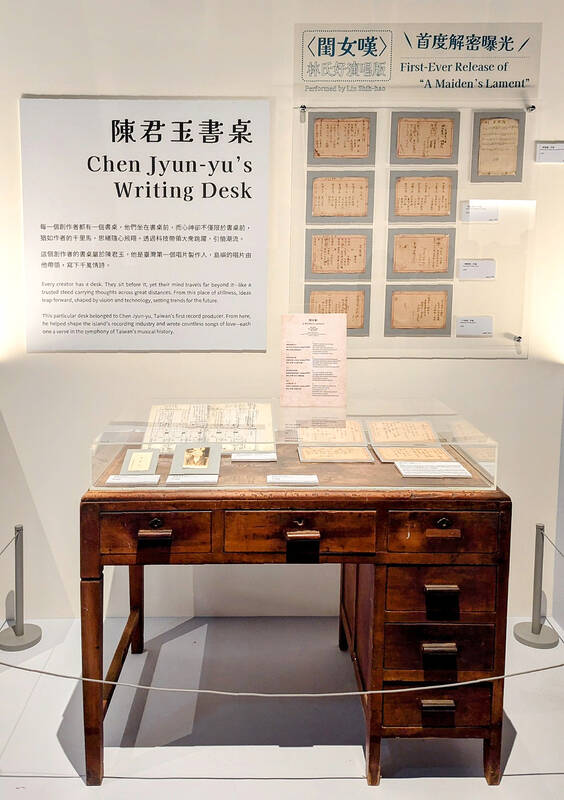
Photo: Han Cheung, Taipei Times
Chen also invited the respected doctor-singer Lin Ching-yue (林清月) to join, along with a number of lyricists in their 20s and 30s, including Chou Tian-wang (周添旺) and Liao Han-chen (廖漢臣). Lee Lin-chiu (李臨秋), who already worked for the label, also contributed.
Vocalists included former Taiwanese opera star Chun-chun, the classically-trained Lin Shih-hao (林氏好) and Peking opera performer Ching Chun Mei (青春美). They recorded a few dozen songs that year, several of them still well-known today. Chen’s Dancing Age stood out for abandoning the “black cat” label to describe fashionable, socially active women, instead simply referring to them as “modern women.”
Chen’s tenure at Columbia only lasted a year, although he continued to write songs for them. Notable works include Moonlight Flower Drum (觀月花鼓), which included in the record sleeve dance steps for what was then the trendiest “flower drum” routine, and Anping Ballad (安平小調), an experimental song about a supernatural romance at the old Anping Fort.
LATER YEARS
In 1934, tea merchant Kuo Po-jung (郭博容) recruited Chen to head the arts department at the new Popular Records. He later also held the same position at the Taika and Nitto labels. In 1936, Chen joined a movement to revamp traditional Han Taiwanese music. Together with composer Chen Chiu-lin (陳秋霖), he modified a nanguan-style pipa, hand-crafting a larger version to serve as a bass. The group later staged a concert using a variety of newly devised instruments at the Taipei Radio Station.
Aside from music, Chen remained active in the literature scene. In 1934, he co-founded the Taiwan Literature and Arts Association (台灣文藝協會) with Liao Han-chen and published an essay outlining his hopes for Taiwanese pop music in the association magazine, Striking Team (先發部隊). In it, he emphasized the social responsibility of popular songs, urged writers to “beautify the hearts” of Taiwanese people rather than producing vulgar material solely to sell records.
The Taiwanese pop industry came to a screeching halt as the Japanese authorities clamped down on local culture during World War II.
“Some writers just could not abandon their craft,” Chen wrote in 1956. “With nowhere to apply their talents, they went to tea parlors and taught waitresses how to sing their new songs. But without the support of record labels, and at a time when everyone was required to speak Japanese, these songs could never become popular.”
To survive, Chen began teaching Mandarin, as translators were in demand for Japan’s war with China. He continued in the field after the war, but went out of business following the government’s push for Mandarin-language education in 1951. In his later years, he worked as a teacher, translated fairy tales for children’s publications and raised chickens. Chen died in 1963 from liver cancer.
Taiwan in Time, a column about Taiwan’s history that is published every Sunday, spotlights important or interesting events around the nation that either have anniversaries this week or are tied to current events.

The People’s Republic of China (PRC) invaded Vietnam in 1979, following a year of increasingly tense relations between the two states. Beijing viewed Vietnam’s close relations with Soviet Russia as a threat. One of the pretexts it used was the alleged mistreatment of the ethnic Chinese in Vietnam. Tension between the ethnic Chinese and governments in Vietnam had been ongoing for decades. The French used to play off the Vietnamese against the Chinese as a divide-and-rule strategy. The Saigon government in 1956 compelled all Vietnam-born Chinese to adopt Vietnamese citizenship. It also banned them from 11 trades they had previously

Growing up in a rural, religious community in western Canada, Kyle McCarthy loved hockey, but once he came out at 19, he quit, convinced being openly gay and an active player was untenable. So the 32-year-old says he is “very surprised” by the runaway success of Heated Rivalry, a Canadian-made series about the romance between two closeted gay players in a sport that has historically made gay men feel unwelcome. Ben Baby, the 43-year-old commissioner of the Toronto Gay Hockey Association (TGHA), calls the success of the show — which has catapulted its young lead actors to stardom -- “shocking,” and says
Jan. 12 to Jan. 18 At the start of an Indigenous heritage tour of Beitou District (北投) in Taipei, I was handed a sheet of paper titled Ritual Song for the Various Peoples of Tamsui (淡水各社祭祀歌). The lyrics were in Chinese with no literal meaning, accompanied by romanized pronunciation that sounded closer to Hoklo (commonly known as Taiwanese) than any Indigenous language. The translation explained that the song offered food and drink to one’s ancestors and wished for a bountiful harvest and deer hunting season. The program moved through sites related to the Ketagalan, a collective term for the

Inside an ordinary-looking townhouse on a narrow road in central Kaohsiung, Tsai A-li (蔡阿李) raised her three children alone for 15 years. As far as the children knew, their father was away working in the US. They were kept in the dark for as long as possible by their mother, for the truth was perhaps too sad and unjust for their young minds to bear. The family home of White Terror victim Ko Chi-hua (柯旗化) is now open to the public. Admission is free and it is just a short walk from the Kaohsiung train station. Walk two blocks south along Jhongshan


 RSS
RSS