


Taiwan has next to no political engagement in Myanmar, either with the ruling military junta nor the dozens of armed groups who’ve in the last five years taken over around two-thirds of the nation’s territory in a sprawling, patchwork civil war.
But early last month, the leader of one relatively minor Burmese revolutionary faction, General Nerdah Bomya, who is also an alleged war criminal, made a low key visit to Taipei, where he met with a member of President William Lai’s (賴清德) staff, a retired Taiwanese military official and several academics.
“I feel like Taiwan is a good example of how to build a country,” said Nerdah, speaking of his Taiwan visit, when interviewed on Feb. 24 by the Taipei Times in Chiang Mai, Thailand.
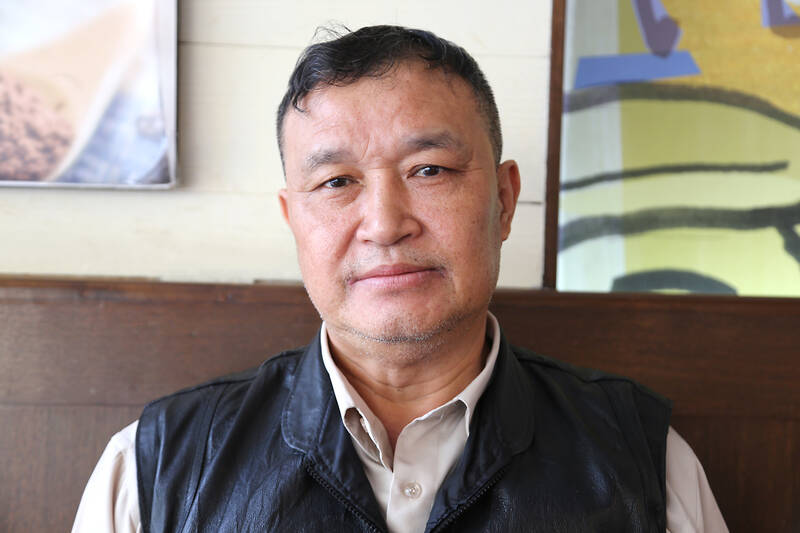
Photo: David Frazier
“They want to be free from China, and we want to be free from the Burmese military regime. So we have similarities,” he said.
Nerdah’s Taiwan visit was in many ways an oddity. Myanmar, formerly known as Burma, is so heavily under China’s sway that it is not only Myanmar’s ruling military regime, the State Administration Council (SAC), that relies on Beijing for support and legitimacy. Resistance groups also frequently look to their northern big brother for arms purchases or approval when they gain ground. Even Myanmar’s democratic government-in-exile, the National Unity Government (NUG), has since 2024 adopted a policy of not recognizing Taiwan out of a desire to win Beijing’s favor.
Ideologically, China insists Myanmar’s government and all other actors under its sway adhere to the “One China” principle, which purports that independent, democratic Taiwan is part of China and subject to forceful “reunification” — a claim rejected by Taiwan’s government and a majority of its people.
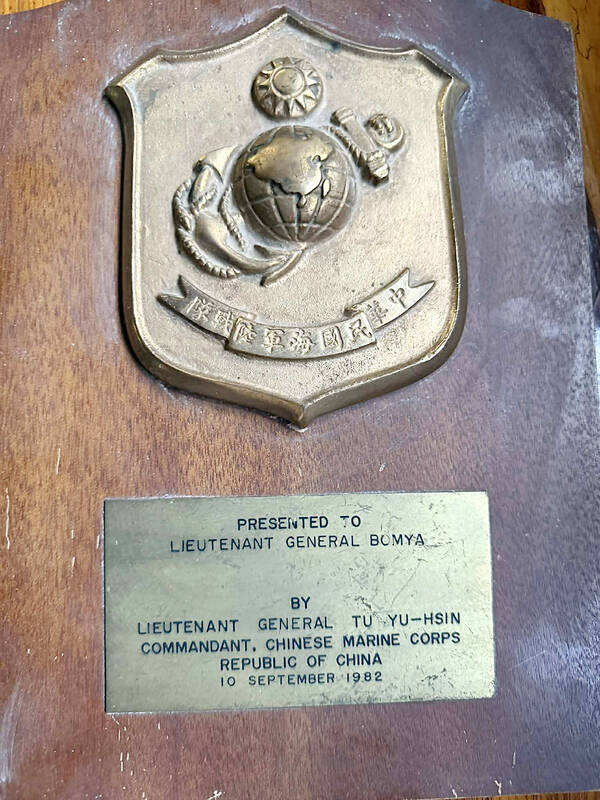
Photo courtesy of William Cox
Nerdah is however a Karen from southern coastal Myanmar, which is far from the Chinese border, and also heir to Cold War ties that link the Karen with Taiwan.
He is also a highly controversial figure. He controls little territory — his stronghold is a bulge along the Thai border of around 200 square kilometers located to the south of the town of Wawlay, he says — but earlier this year made waves by proclaiming a fully independent “Republic of Kawthoolei.”
Though this declaration has been ridiculed as a PR stunt by other Karen groups, it still represents perhaps the first declaration in recent years of full independence by one of Myanmar’s ethnic states.
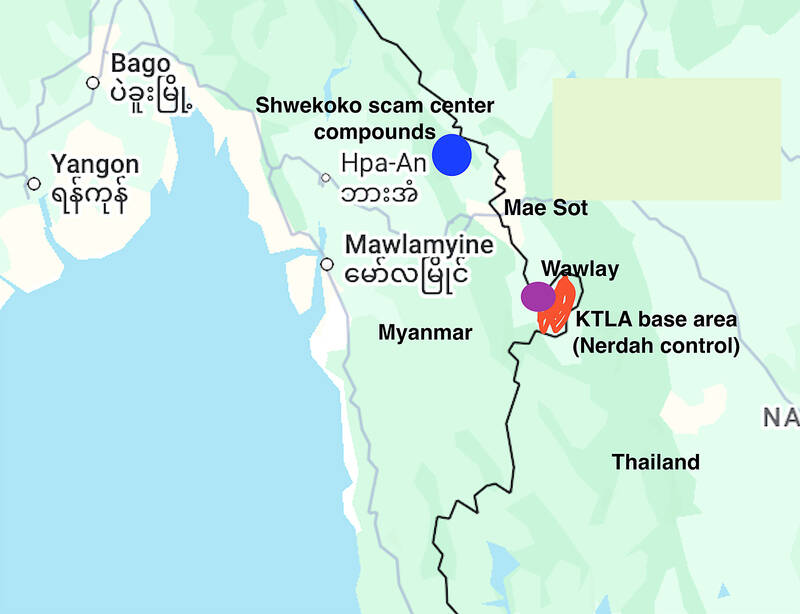
Photo: David Frazier
More controversially still, Nerdah is accused of the unlawful execution of 25 prisoners of war in an incident in June 2021. It’s a charge he denies, but if true would constitute a war crime according to the Geneva Convention.
Nerdah discussed that massacre with the Taipei Times, and his version of events will be reported below.
But first, the more immediate question: what was Nerdah doing in Taiwan in the first place? And why would Taiwan’s presidential staff meet with a small-time and potentially toxic fish in Myanmar’s incredibly complex sea of factional violence and politics?
MEETING WITH A PRESIDENTIAL STAFFER
Nerdah’s Taiwan visit, his first, took place from Feb. 2 to Feb. 4 with an itinerary that included a dinner with Presidential Office Deputy Secretary-General Mark Ho (何志偉), and an unnamed former officer in the Republic of China (ROC) army.
Ho confirmed the dinner meeting but described it as purely “unofficial” and a “private dinner” arranged by friends. Ho “dropped by for 20 or 30 minutes,” he said, claiming discussions mostly covered wine and their shared college experiences in California.
“We don’t want to get involved with other countries’ internal politics or internal issues. That’s something we never would do, and I don’t have the access or the power to do so,” Ho said.
Chao Chung-chi (趙中麒), an Associate Professor at National Chi Nan University Center for Southeast Asian Studies and expert on Myanmar’s Karen State, confirmed that any sort of official meeting would be highly irregular.
“Taiwan cannot conduct exchanges with any of Myanmar’s ethnic armed organizations, as that would confer recognition to rebel groups. For a small country like Taiwan, this could create a lot of problems in terms of international diplomacy,” Chao said.
Nerdah did not discuss his conversation with Ho in detail. Instead he generally described his Taiwan visit as a fact-finding mission focused on economic development, education, ideas of democratic nation building and a shared sense of resistance against Chinese influence.
From interactions with Chinese business people in Myanmar, Nerdah says he’s come to fear for the nation’s future.
“They’re only interested in money and investment and see whether they can make Burma into part of mainland China in the future,” he said, adding that Myanmar could become “a second Hong Kong.”
“That is dangerous for the Burmese people,” he said.
At the dinner with Ho, Nerdah says, they did not discuss political issues, including scam centers or the Chinese weaponry used in Myanmar’s civil war.
The Taiwanese at the dinner talked “more about themselves, their identity. They’re not Chinese. They’re Taiwanese. That’s mostly what they were talking about,” Nerdah said.
Nerdah largely declined to comment on his discussion with an unnamed retired ROC army officer, mentioning only an interest in Karen state’s mineral resources and his own general intention of finding support.
HISTORICAL LINKS
Though Nerdah was visiting Taiwan for the first time, his mission was not without historical precedent.
The Karen are the oldest and best established of Myanmar’s ethnic resistance groups, having fought for independence since 1949, when Burma gained independence from the United Kingdom.
In the early 1950s, Karen insurgents formed a short-lived alliance with the Chinese Nationalist Party (KMT) armies that had retreated into northeastern Burma following the Chinese Civil War. The KMT force, regrouped as an anti-communist army, was supplied with American weapons courtesy of the CIA and sold some of these weapons on to the Karen. KMT and Karen militias fought alongside each other until at least 1954 against both the Burmese government and the Burmese Communist Party.
Throughout the Cold War, the Karen remained staunchly anti-communist, an attitude upheld by Nerdah’s father, General Bo Mya, a revered Karen strongman who served as chairman of the Karen National Union (KNU) from 1976 to 2000. Under the aegis of shared anti-communist ideals, Bo Mya visited Taiwan once in 1982 and received a friendship plaque from an ROC marine corps officer, Lieutenant General Tu Yu-hsin (屠由信).
Nerdah, who studied in the US at Pacific Union College and speaks fluent English, followed in his fathers footsteps to occupy senior positions in the KNU’s two main military branches, the Karen National Liberation Army (KNLA) and the Karen National Defense Organization (KNDO), from 1999 to 2022.
He was however expelled from the KNU after soldiers under his command summarily executed 25 government troops on June 1, 2021 in the Karen State town of Kanele.
THE JUNE, 2021 MASSACRE
According to an investigation of the incident by Fortify Rights, a Western-registered nonprofit organization focused on southeast Asia, in conjunction with the KNU, the executed prisoners were unarmed Myanmar government soldiers engaged in construction work.
The prisoners were detained on May 31, a day before they were executed en masse and buried. Twenty-two others were released. When the Myanmar military later retrieved the soldiers’ remains, some of their hands were tied.
“It is not a crime. It happened in the war zone,” Nerdah says. “They weren’t back to the base camp yet.”
“The reason they executed them is because the Burmese column nearby, they moved up. They tried to attack. And they keep shelling artillery at our base, at the frontline soldiers.”
During the bombardment, the prisoners attempted to flee, and that is why the KNDO troops shot them, Nerdah says.
Nerdah further denies personal responsibility. “I didn’t give the order.”
The Fortify Rights report confirms this, noting that the order came from another unnamed commander.
AFTERMATH
Following the incident, the KNU expelled Nerdah from the Karen military apparatus.
“The KNU, which probably has the most highly regarded insurgent legal system in the country, conducted their own investigation and expelled [Nerdah] after finding him guilty of murder. I think that is important. But no international tribunal or court has investigated that we know of,” said David Mathieson, an independent analyst formerly with Human Rights Watch.
Nerdah reacted to his expulsion by renaming the forces under his command as the Kawthoolei Liberation Army (KTLA). Then last month, he proclaimed his Kawthoolei republic, which, in his telling, includes a huge territory in southern Myanmar, including all or portions of several ethnic states, including Ayeyarwady, Bago, Mon, Kayin and Tanintharyi states.
Mathieson described Nerdah’s declaration as “thoroughly illegitimate,” saying, “He had absolutely zero authority to do that. I think it illustrates his long-standing arrogance.”
In reality, Nerdah controls almost none of that territory and reportedly only commands around 200 to 300 soldiers. Nerdah said those troop numbers are “false” but declined to provide exact figures.
The territory now under his actual control is mainly the small bulge along the Thai border south of Wawlay, a district home to around 20,000 people, many of whom are now displaced, he says. He also claims a military camp near Myanmar’s southernmost point near Kawthoung as well as underground assets throughout the Irrawaddy delta and support among the Karen diaspora in the US.
“I’m using people power to change, not military power,” Nerdah says. “People think only military power can change the situation. But I’m using people power and media. I want to show the world what I can do.”
The KNU were quick to label Nerdah’s Kawthoolei republic a farce.
“He represents no territory and no people. This is nonsense,” KNU spokesperson Taw Nee told Thai media.
“At a time when the KNU is engaged in armed struggle to liberate our people from Myanmar’s military dictatorship, we want the Thai public to understand clearly that the situation in Karen State is about resisting military rule — not about such declarations,” the Karen spokesperson said.
So far, only one of Myanmar’s other micro-factions, the Kachin National Organization (KNO), has supported Nerdah’s declaration. Thai commentator Kannikar Petchkaew has however noted it may signal a new way of thinking about Myanmar’s future, as it rejects the generally accepted goal of Myanmar as a federation of ethnic states.
“Whether the ‘Kawthoolei Republic’ is taken seriously remains uncertain. But something more profound has already happened. For the first time, some Myanmar people have started speaking out loud, saying that Myanmar itself is no longer their future,” Petchkaew wrote.
As for Nerdah’s future relationship with Taiwan, be it official or unofficial, he hopes there’s more to come.
“We will see how it goes. We have to keep up with our relationship with Taiwan,” Nerdah said.

For many people, Bilingual Nation 2030 begins and ends in the classroom. Since the policy was launched in 2018, the debate has centered on students, teachers and the pressure placed on schools. Yet the policy was never solely about English education. The government’s official plan also calls for bilingualization in Taiwan’s government services, laws and regulations, and living environment. The goal is to make Taiwan more inclusive and accessible to international enterprises and talent and better prepared for global economic and trade conditions. After eight years, that grand vision is due for a pulse check. RULES THAT CAN BE READ For Harper Chen (陳虹宇), an adviser
Traditionally, indigenous people in Taiwan’s mountains practice swidden cultivation, or “slash and burn” agriculture, a practice common in human history. According to a 2016 research article in the International Journal of Environmental Sustainability, among the Atayal people, this began with a search for suitable forested slopeland. The trees are burnt for fertilizer and the land cleared of stones. The stones and wood are then piled up to make fences, while both dead and standing trees are retained on the plot. The fences are used to grow climbing crops like squash and beans. The plot itself supports farming for three years.

May 4 to May 10 It was once said that if you hadn’t performed at the Sapphire Grand Cabaret (藍寶石大歌廳), you couldn’t truly be considered a star. Taking the stage at the legendary Kaohsiung club was more than just a concert. Performers were expected to entertain in every sense, wearing outlandish or revealing costumes and staying quick on their feet as sharp-tongued, over-the-top hosts asked questions and delivered jokes that would be seen as vulgar, even offensive, by today’s standards. Opening in May 1967 during a period of strict political and social control, Sapphire offered a rare outlet for audiences in
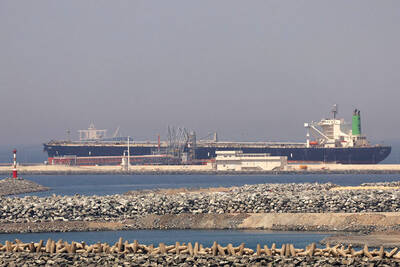
The breakwater stretches out to sea from the sprawling Kaohsiung port in southern Taiwan. Normally, it’s crowded with massive tankers ferrying liquefied natural gas from Qatar to be stored in the bulbous white tanks that dot the shoreline. These are not normal times, though, and not a single shipment from Qatar has docked at the Yongan terminal since early March after the Strait of Hormuz was shuttered. The suspension has provided a realistic preview of a potential Chinese blockade, a move that would throttle an economy anchored by the world’s most advanced and power-hungry semiconductor industry. It is a stark reminder of


 RSS
RSS