


The breakwater stretches out to sea from the sprawling Kaohsiung port in southern Taiwan. Normally, it’s crowded with massive tankers ferrying liquefied natural gas from Qatar to be stored in the bulbous white tanks that dot the shoreline.
These are not normal times, though, and not a single shipment from Qatar has docked at the Yongan terminal since early March after the Strait of Hormuz was shuttered.
The suspension has provided a realistic preview of a potential Chinese blockade, a move that would throttle an economy anchored by the world’s most advanced and power-hungry semiconductor industry. It is a stark reminder of the energy dependency and constant threat facing the nation, which Beijing views as its territory and has vowed to eventually claim — by force if necessary.
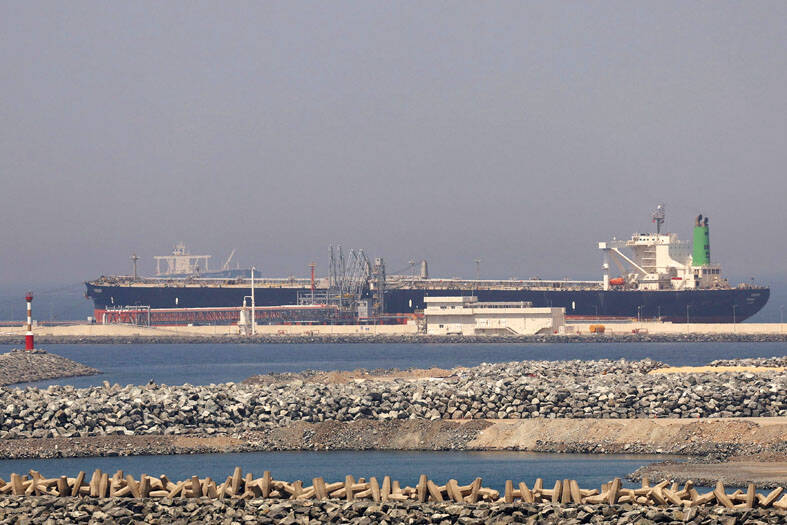
Photo: Reuters
Taiwan currently imports around 96 percent of its energy, with LNG accounting for roughly half its overall power generation. Unlike coal or oil, the gas is difficult to store, and Taiwan maintains just an 11-day reserve. That leaves little margin for error; according to war games by think tanks, a maritime blockade could exhaust Taiwan’s energy within weeks.
“We are learning something from this war,” Chen Chung-hsien (陳崇憲), Deputy Director General of the Energy Administration, said in an interview, adding that Taiwan is aiming for energy self-sufficiency by 2034. “We need our own energy.”
For now, Taiwan is avoiding a crippling fuel shortfall with expensive supply from the spot market, paying more than double the price of long-term contracts. The government says it has secured enough LNG until July. Officials and industry leaders are scrambling to shore up energy security in the meantime.
Yet the factors that made Taiwan an economic powerhouse — its highly successful technology industry and concentration of AI-driven chipmaking by Taiwan Semiconductor Manufacturing Co — are also the ones making it vulnerable. At stake is not just domestic stability, but the world’s chip supply, a vital cog for the global economy.
ENERGY STORAGE
Taiwan produces a staggering 90 percent of the world’s most advanced chips, which are used in everything from iPhones and electric cars to data centers. The Asian Development Bank has projected GDP to grow by around 7.6 percent this year, thanks to strong demand for advanced AI chips.
“They’ve got the good news, bad news of: your GDP has been growing aggressively for 20 years, and it’s just hard for your grid to keep up,” said retired US Rear Admiral Mark Montgomery, now a senior fellow at the Foundation for Defense of Democracies. “Do they wish it was tackled 20 years ago or 15 years ago, 10 years ago? You bet.”
Among companies navigating this is Marsh Risk Consulting, which helps clients, including some of Taiwan’s tier-one companies, prepare business continuity plans. It recommends that clients design factories with redundancies in mind. That means ensuring they have at least a dual feeder into different substations and that backup power is secured. For the latter, many still depend on diesel generators, as fuel cells or battery storage don’t come cheap.
“All those emergency power supplies cannot provide a 100 percent of your power demand, but at least they can support some critical operations in your factory that can protect your operation during a power outage,” said Sean Lin, head of Marsh in Taiwan.
Taipei-based Delta Electronics supplies power and thermal management for industrial clients and makes the hardware required to regulate and convert electricity for data centers. It’s also building hydrogen fuel cells and battery energy storage systems to prepare for sudden outages. However, Eton Lee, vice president and general manager of Delta’s Energy Infrastructure Business Group, warns that there are limits to such contingency plans. Backup power often lasts only a few hours — eight if you really push it.
“Energy storage is not designed to serve as a long-duration power source during extended outages,” Lee said.
Delta has some solar backup, but its primary failsafe is diesel generators. Ultimately, he said, the matter is out of their hands.
“If energy supply relies heavily on imports, there’s little companies can do to help.”
Rather than addressing these vulnerabilities, Taiwan has spent much of the past decade paralyzed by a partisan tug-of-war over its energy policy while its economy has grown more dependent on energy imports. An aggressive nuclear phase-out left a void that wind and solar can’t yet fill, as the green transition trails the tech sector’s growing appetite for power.
With any meaningful fix years away, the country is essentially playing for time: keeping Beijing at bay and hoping any supply disruptions are brief, while it works to diversify its power sources. A US diplomatic official likened this approach to a duck paddling, appearing serene on the surface but working furiously underwater.
The semiconductor industry is the island’s biggest sector in terms of power use, consuming more than 42 billion kilowatt-hours last year, around 18 percent of Taiwan’s total.
“There’s a lot of push for Taiwan to become a much bigger player in the AI space,” said Thomas Liu, managing director for real estate & data centers at Actis, which has invested in a Taipei project currently under development. He noted that power constraints have been a key concern.
“I think in this environment, we have to be much more diligent and disciplined about that when we make those investments.”
FEAR OF OUTAGE
Some smaller companies fear that in the event of a major outage, state-run Taiwan Power Co would prioritize the tech giants. One executive at a textile manufacturer said he worries about potential power rationing. If it comes down to it, the government could ringfence the chip industry, leaving others exposed, he said, asking not to be identified because of the sensitivity of the matter.
Asked about such concerns, Taipower said in a statement that it treats all industrial electricity needs equally and does not prioritize the semiconductor industry. Yet it forecast electricity demand to grow significantly over the next decade, with the average annual increase more than double the rate seen in the previous 10 years. TSMC declined to comment.
“If China were to blockade the island, it could not only block energy, but also inputs necessary for producing high-end semiconductors and prevent those chips from reaching global customers,” said Jennifer Welch, chief geoeconomics analyst at Bloomberg Economics. “The consequences for Taiwan, and the world, would be immense.”
Under a scenario where Taiwan cannot export chips, she forecast a 12.5 percent hit to Taiwan’s GDP.
GRID UNDER STRAIN
Even before the Iran crisis, Taiwan’s grid was under strain and famously brittle. The bulk of the island’s power is generated in the south and funneled to the north, where the capital is located and high-tech facilities in Hsinchu are densely clustered. This system has been prone to cascading failures, and the last major blackout in 2022, caused by a mishap at a single power plant, left millions of households in the dark. Surveys by the American Chamber of Commerce routinely show electricity supply as a top concern among its members.
The AI boom, which has led to surging demand from data centers, has pushed the system closer to breaking point. In August 2024, state-run Taipower announced a moratorium on new data centers in the north with a capacity exceeding 5 MW. This was designed to force hyperscalers to move south, closer to its power sources, but it runs counter to the logistical preferences of the industry.
The grid also faces the risk of “grey zone” attacks, hostile maneuvers designed to destabilize a target but fall short of open warfare, according to think tanks including the Washington, DC-based Foundation for Defense of Democracies, which works with Taiwan officials. In the first quarter of this year, government sites were hit by around 173 million cyberattacks. Officials are racing to protect the system, moving substations underground and putting critical infrastructure in general on a higher state of alert, including the introduction of new civil defense units.
Now, with LNG shipments from the Middle East halted, and forced to rely on costly imports, Taiwan is reconsidering its environmental goals.
“For the power sector, there is the unwelcome reality that if LNG supply comes under pressure, there is always a backup plan in Asia to go back to coal,” said Kaho Yu, head of natural resources and energy at Verisk Maplecroft in Singapore. “If economies face serious strain, I believe they will just restart some of that capacity.”
This potential retreat to fossil fuels highlights the urgency and difficulty of developing a green, self-sufficient grid. While there has been some progress, with the share of power generation from renewable sources rising to around 15 percent from 5 percent a decade ago, efforts to scale up wind and solar energy have been mired in friction,?including local land disputes.
“The last few years have been particularly challenging for our industry,” said Leo Seewald, chairman of BlackRock-owned solar energy developer New Green Power.
Fishermen would claim that having solar panels on fish farms might damage their catch, or local politicians would object to solar farms, particularly in scenic areas, he said.
Meanwhile, plans to restart the island’s mothballed nuclear plants won’t bear fruit until around 2028. Officials say plans won’t easily be accelerated, aware that many still remember Japan’s Fukushima disaster.
For the officials, the strategy has narrowed to one thing: buy time. The prevailing hope has long been the “Silicon Shield” — the idea that Taiwan’s dominance in chipmaking makes it too important for the world to lose. That shield, though, is showing cracks.
TRUMP-XI SUMMIT
With US President Donald Trump prioritizing his relationship with Xi Jinping (習近平) ahead of their upcoming summit, anxiety is mounting that the US might try to use Taiwan as a bargaining chip. Washington’s official view is that Taiwan should diversify and scale up its energy sources, including more US oil and LNG, as well as US nuclear power technology, according to a senior administration official.
“The shield is still there, but it is so thin that it probably can be broken more easily than before,” said Alexander Huang (黃介正), former director of international affairs for the opposition Chinese Nationalist Party (KMT). “The critical infrastructure in a general sense has been very fragile — even without a war.”
In the absence of quick fixes, Taipei is looking to improve its capabilities in modern warfare. The government is maintaining active backchannels with Ukraine, including via Estonia, to study how drones can be used to attack and protect energy nodes. These lessons are being integrated into a new coordination effort between the military and police to protect physical infrastructure.
Some officials, though, are taking heart from Iran’s apparent resilience, even if they don’t support the regime.
“Even facing a very strong military power like the United States, Iran can still manage to survive and also to fight back,” Deputy Minister of Foreign Affairs Chen Ming-chi (陳明祺) said in an interview.
He added that the US shouldn’t bear the sole responsibility for stopping Iran’s nuclear program and drew a parallel to the dangers of ignoring any potential move by China Xi meeting, including announcing plans to boost purchases of US LNG to 25 percent by 2029. Taiwanese buyers have signed preliminary pacts for a $44 billion Alaskan LNG project that Trump favors, though it has struggled for decades to get off the ground. The government has signed a contract with Westinghouse to check the status of the third nuclear power plant’s generators, according to media reports.
Still, politics continue to get in the way, with the Democratic Progressive Party government led by President Lai Ching-te regularly colliding with the KMT-controlled parliament. A NT$1.25 trillion special defense budget, including funds for domestic production of drones, has stalled for months in parliament.
KMT Chair Cheng Li-wun (鄭麗文) recently met with Xi in Beijing, where the Chinese president reaffirmed claims to sovereignty over the self-governing democracy and noted cross-strait relations should be “firmly in the hands of the Chinese people.”
The atmosphere may grow fraught ahead of local elections in November and presidential elections in 2028, making it more difficult to secure a consensus.
The gridlock isn’t just about partisan disagreements; it reflects uncertainty over which nightmare scenario Taiwan should be ready for.
Retired admiral Lee Hsi-ming (李喜明), former chief of the general staff from 2017 to 2019, thinks that Beijing is likely to avoid a slow-motion blockade as it would allow Taiwan to rally international support. He forecasts any move to be a so-called fast war, such as a blockade paired with air strikes, aimed at a quick surrender.
Johanna Yang, from the FDD’s Center on Cyber and Technology Innovation, thinks China is more likely to opt for cyber attacks or pressure other countries to stop selling LNG to Taiwan.
“In terms of China’s decision calculus and what’s going to be the most economical both in terms of resources and personnel, that’s going to be a cyber campaign,” she said.
The FDD’s tabletop exercise last year in Taipei showed that the island’s infrastructure cannot support both residential power and semiconductor production during a crisis. It’s holding a follow-up exercise this year, focusing on communications infrastructure.
While debates and simulations continue in the capital, the reality of Taiwan’s energy security lies 200 miles south in Kaohsiung. Here, about a year ago, China conducted drills that simulated attacks. Footage broadcast by state-run CCTV showed long-range rocket artillery targeting the very terminal where Qatar’s LNG tankers usually dock. Two months later, Taiwan’s Coast Guard Administration held its own exercise, simulating a hijacked tourist cruise ship attempting to attack the same terminal.
President Lai has visited Kaohsiung several times in recent months. In March, he boarded Taiwan’s first homegrown submarine, and in April, he visited a military training center where he said, “Only through constant preparedness can threats be deterred.”
The most striking reminder of Taiwan’s precarious position, however, lies just a few miles inland. There, on the site of a former refinery, TSMC is in the midst of constructing new fabrication plants — multi-billion-dollar bets on a high-tech future, dependent on the energy resilience that officials are trying to secure.
Ajay Verma, a consultant gastroenterologist at Kettering general hospital in Northamptonshire, says our gut is a “complex machine.” “It is constantly providing us with the nutrition we need, initially to grow and develop, and then for us to survive, thrive and repair from injury and illness.” How can we keep it functioning well? Put simply: “Make sure what you put into it is balanced, and that you clear out its waste products adequately,” Verma says. “In a general gastroenterology clinic, the most common conditions we see are irritable bowel syndrome (IBS), gastroesophageal reflux disease, inflammatory bowel disease and constipation,” says Nisha
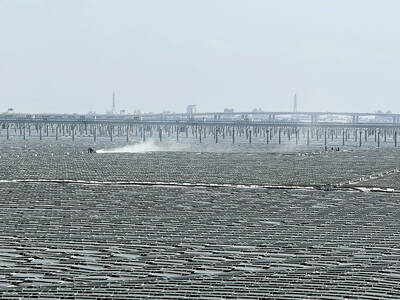
The arithmetic is straightforward and uncomfortable. By the end of 2025, Taiwan had committed itself to a 50-30-20 electricity mix — half natural gas, 30 per cent coal, 20 per cent renewables. The Ministry of Economic Affairs’s (MOEA) own monthly energy reports tell a different story. Natural gas reached 47.8 per cent of generation last year. Coal stood at 35.4 per cent, comfortably above its target ceiling. Renewables came in at 13.1 per cent, well short of the 20 per cent Taipei had pledged a decade earlier. Installed renewable capacity reached roughly half of the 12 gigawatts (GW) the government

Last week US President Donald Trump was asked by a reporter whether he would speak on the phone to the President of Taiwan. “l’ll speak to him. I speak to everybody. We have that situation very well in hand,” Trump said. This marked the second time in a couple of weeks he had said he would talk to the President of Taiwan. In 2016 he famously took a call from then-president Tsai Ing-wen (蔡英文), when he was president-elect. Despite warnings that the apocalypse was nigh because of a phone call, the world quickly forgot about the conversation between two democratically-elected presidents.

May 25 to May 31 Few believed that apples could be cultivated on a commercial scale in Taiwan’s high mountains. When horticulturalist Cheng Chao-hsiung (程兆熊) first proposed the idea in 1955, both American and Taiwanese colleagues dismissed it as implausible, arguing that temperate fruit could not be reliably grown on a subtropical island, especially on rugged terrain. However, it was this terrain in the Central Mountain Range where many Chinese Civil War veterans were resettled in the late 1950s. With limited job prospects and no family in Taiwan, they were placed on cooperative farms aimed toward self-sufficiency. Some say the conditions


 RSS
RSS