


President Willaim Lai (賴清德) yesterday arrived in Eswatini, more than a week after his planned visit to Taiwan’s sole African ally was suspended because of revoked overflight permits.
“The visit, originally scheduled for April 22, was postponed due to unforeseen external factors,” Lai wrote on social media. “After several days of careful arrangements by our diplomatic and national security teams, we successfully arrived today.”
Lai said he looked forward to further deepening Taiwan-Eswatini relations through closer cooperation in the economy, agriculture, culture and education, as well as advancing the nation’s international partnerships.
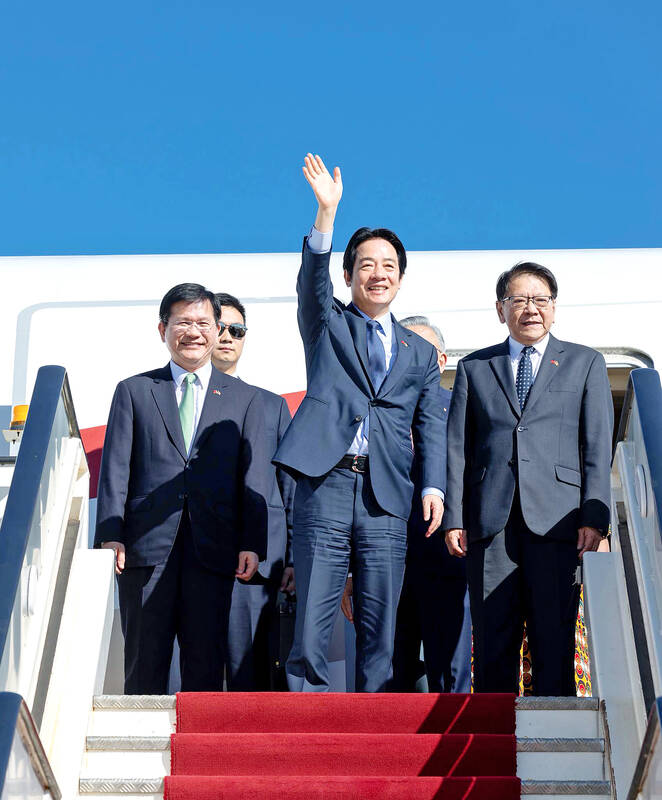
Photo: Screen grab from Lai’s Facebook page
The president was initially scheduled to arrive in time to celebrate the 40th anniversary of King Mswati III’s accession to the throne and his 58th birthday.
“On behalf of the people of Taiwan, I will express my sincere gratitude to His Majesty King Mswati III and the government of Eswatini,” Lai wrote. “Engaging with the world and working hand in hand with every force for good is an inalienable right of the Taiwanese people, and it is also our commitment to the international community.”
“When confronted with unfair suppression, we will respond with justice and reason,” Lai wrote. “As a people who cherish freedom and peace, we do not seek confrontation, but we will never give up our path toward the world.”
The Presidential Office on April 21 announced that the planned visit had been suspended, because the Seychelles, Mauritius and Madagascar, countries along the flight path of Lai’s chartered plane, had unexpectedly rescinded overflight permits.
The office cited China’s “economic coercion” of the three states as the reason for the revocation of the permits.
Presidential Office spokeswoman Karen Kuo (郭雅慧) said that after the delegation arrived in Eswatini yesterday, Ambassador to Eswatini Jeremy Liang (梁洪昇) and Eswatini Chief Protocol Officer Khandlela Mdluli welcomed Lai aboard the plane.
Eswatini Prime Minister Russell Dlamini and Eswatini Minister of Foreign Affairs and International Cooperation Pholile Shakantu also greeted Lai and accompanied him as he inspected the Eswatini Guard of Honor, Kuo said, adding that the president also warmly greeted personnel from the Taipei mission, technical team members and their families who had come to welcome him.
Lai was set to hold bilateral talks with the king, and witness the signing of the Customs Mutual Assistance Agreement between Taiwan and Eswatini, as well as the signing of a joint communique, she added.
In Taipei, Premier Cho Jung-tai (卓榮泰) said the government was “deeply grateful for the long-standing and strong friendship between Eswatini and the Republic of China [Taiwan], which has made President Lai’s visit possible.”
“This also demonstrates that Taiwan has the right and the freedom to engage with the world, and that the world is welcoming us with open arms,” he said. “We will continue to strengthen cooperation with countries that share our democratic values and remain a reliable partner to all our international allies.”
Democratic Progressive Party Legislator Chiu Chih-wei (邱志偉) said Lai’s breakthrough carries significant implications for Taiwan’s diplomatic ties in Africa, demonstrating that China cannot define the nation’s status.
The Chinese Nationalist Party (KMT) said it wishes Lai a smooth visit in Eswatini and hopes it would help deepen bilateral ties.
Lai’s national security and foreign affairs teams should learn from the previous mission, when a planned trip to Eswatini was canceled due to a serious misjudgement of the international situation, it said, adding that “they must thoroughly review and reflect on that experience to ensure such mistakes are not repeated, so as to safeguard the Republic of China’s national dignity and standing.”
Additional reporting by Chung Li-hua, Chen Cheng-yu and Lo Kuo-chia
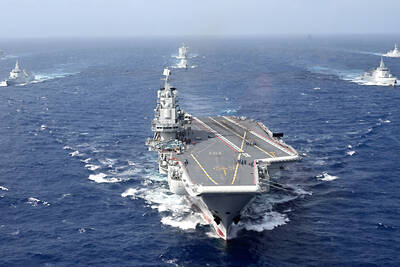
PROVOCATIVE: Chinese Deputy Ambassador to the UN Sun Lei accused Japan of sending military vessels to deliberately provoke tensions in the Taiwan Strait China denounced remarks by Japan and the EU about the South China Sea at a UN Security Council meeting on Monday, and accused Tokyo of provocative behavior in the Taiwan Strait and planning military expansion. Ayano Kunimitsu, a Japanese vice foreign minister, told the Council meeting on maritime security that Tokyo was seriously concerned about the situation in the East China and South China seas, and reiterated Japan’s opposition to any attempt to change the “status quo” by force, and obstruction of freedom of navigation and overflight. Stavros Lambrinidis, head of the EU delegation to the UN, also highlighted South China Sea
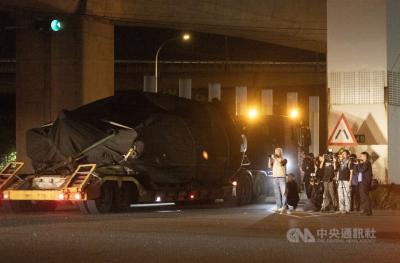
The final batch of 28 M1A2T Abrams tanks purchased from the US arrived at Taipei Port last night and were transported to the Armor Training Command in Hsinchu County’s Hukou Township (湖口), completing the military’s multi-year procurement of 108 of the tanks. Starting at 12:10am today, reporters observed more than a dozen civilian flatbed trailers departing from Taipei Port, each carrying an M1A2T tank covered with black waterproof tarps. Escorted by military vehicles, the convoy traveled via the West Coast Expressway to the Armor Training Command, with police implementing traffic control. The army operates about 1,000 tanks, including CM-11 Brave Tiger
Taiwan Semiconductor Manufacturing Co (TSMC, 台積電), the world’s largest contract chipmaker, said it expects its 2-nanometer (2nm) chip capacity to grow at a compound annual rate of 70 percent from this year to 2028. The projection comes as five fabs begin volume production of 2-nanometer chips this year — two in Hsinchu and three in Kaohsiung — TSMC senior vice president and deputy cochief operating officer Cliff Hou (侯永清) said at the company’s annual technology symposium in Silicon Valley, California, last week. Output in the first year of 2-nanometer production, which began in the fourth quarter of last year, is expected to
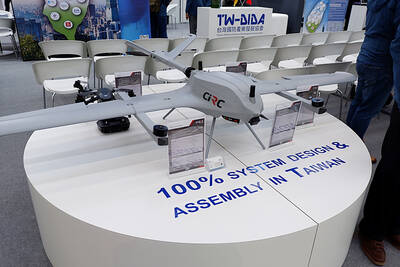
Taiwan’s drone exports surged past US$100 million in the first quarter, exceeding last year’s full-year total, with the Czech Republic emerging as the largest buyer, the Ministry of Economic Affairs said. Exports of complete drones reached US$115.85 million in the period, about 1.2 times the total recorded for all of last year, the ministry said in a report. Exports to the Czech Republic accounted for about US$100 million, far outpacing other markets. Poland, last year’s top destination, recorded about US$11.75 million in the first quarter. Taiwan’s drone exports have expanded rapidly in the past few years, with last year’s total


 RSS
RSS