


China denounced remarks by Japan and the EU about the South China Sea at a UN Security Council meeting on Monday, and accused Tokyo of provocative behavior in the Taiwan Strait and planning military expansion.
Ayano Kunimitsu, a Japanese vice foreign minister, told the Council meeting on maritime security that Tokyo was seriously concerned about the situation in the East China and South China seas, and reiterated Japan’s opposition to any attempt to change the “status quo” by force, and obstruction of freedom of navigation and overflight.
Stavros Lambrinidis, head of the EU delegation to the UN, also highlighted South China Sea tensions, saying they hindered a critical shipping route and challenged the rules-based international order. Neither mentioned China — which claims most of the South China Sea and disputes territory with Japan and in the East China Sea — by name.
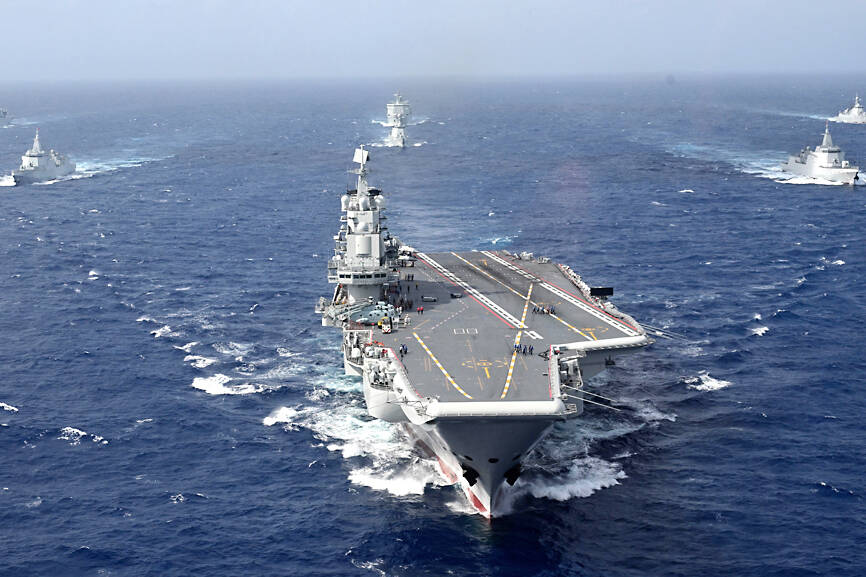
Photo: Xinhua via AP
Chinese Deputy Ambassador to the UN Sun Lei (孫磊) called the Japanese remarks “unwarranted,” saying they “completely confound black and white.”
He added that the EU representative should “refrain from issuing unsubstantiated and irresponsible remarks on the South China Sea issue.”
“In reality, the situation in the East and South China seas remains stable overall and the South China Sea stands as one of the freest shipping lanes in the world,” Sun said.
He accused Japan of sending vessels “to flex their muscles and deliberately provoke tensions in the Taiwan Strait,” saying this sent a “gravely erroneous signal” to separatists in Taiwan.
Sun also referred to “erroneous remarks” on Taiwan by Japanese Prime Minister Sanae Takaichi last year, saying these “have dealt a severe blow to China-Japan relations.”
Ties between Japan and China sank to their worst level in years after Takaichi in November last year said that a hypothetical Chinese attack on Taiwan could bring about a Japanese military response.
Sun charged that “right-wing forces are steering Japan’s security policy towards an offensive and expansionist posture,” and that 80 years after World War II, “a new militarism is resurging in Japan.”
He said Japan’s relaxation of restrictions on the export of lethal weapons, its deployment of offensive missiles, and increased military spending “laid bare” Japan’s intention “to pave the way for military expansion.”
Japanese destroyer JS Ikazuchi transited the Taiwan Strait this month, a move China called “a deliberate provocation.”
China has embarked on a massive expansion of its armed forces, militarized disputed reefs in the South China Sea and engaged in repeated large-scale military exercises around Taiwan, sparking concern among nations in the Asia-Pacific region and beyond.
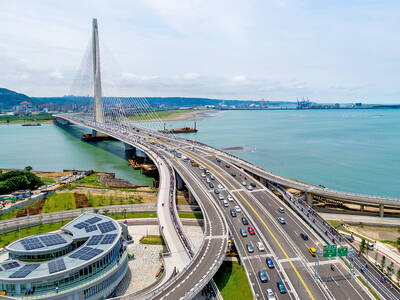
The Ministry of Transportation and Communications yesterday inaugurated the Danjiang Bridge across the Tamsui River in New Taipei City, saying that the structure would be an architectural icon and traffic artery for Taiwan. Feted as a major engineering achievement, the Danjiang Bridge is 920m long, 211m tall at the top of its pylon, and is the longest single-pylon asymmetric cable-stayed bridge in the world, the government’s Web site for the structure said. It was designed by late Iraqi-British architect Zaha Hadid. The structure, with a maximum deck of 70m, accommodates road and light rail traffic, and affords a 200m navigation channel for boats,
Taiwan Semiconductor Manufacturing Co (TSMC, 台積電), the world’s largest foundry service provider, yesterday said that global semiconductor revenue is projected to hit US$1.5 trillion in 2030, after the figure exceeds US$1 trillion this year, as artificial intelligence (AI) demand boosts consumption of token and compute power. “We are still at the beginning of the AI revolution, but we already see a significant impact across the whole semiconductor ecosystem,” TSMC deputy cochief operating officer Kevin Zhang (張曉強) said at the company’s annual technology symposium in Hsinchu City. “It is fair to say that in the past decade, smartphones and other mobile devices were
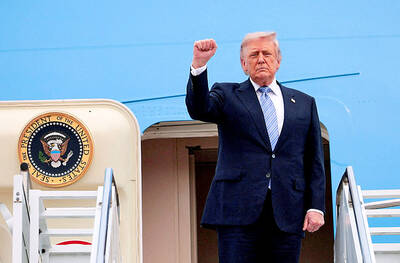
US-CHINA SUMMIT: MOFA welcomed US reassurance of no change in its Taiwan policy; Trump said he did not comment when Xi talked of opposing independence US President Donald Trump yesterday said he has not made a decision on whether to move forward with a major arms package for Taiwan after hearing concerns about it from Chinese President Xi Jinping (習近平). Trump’s comments on Taiwan came as he flew back to Washington after wrapping up critical talks in which both leaders said important progress was made in stabilizing US-China relations even as deep differences persist between the world’s two biggest powers on Iran and Taiwan. “I will make a determination,” Trump said, adding: “I’ll be making decisions. But, you know, I think the last thing we need right
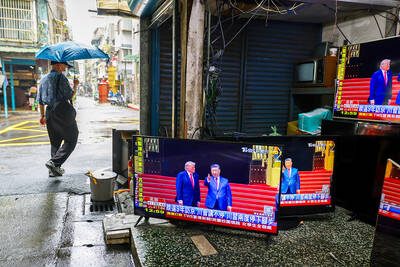
TAIWAN ISSUE: US treasury secretary Scott Bessent said on the first day of meetings that ‘it wouldn’t be a US-China summit without the Taiwan issue coming up’ There were no surprises on the first day of the summit between US President Donald Trump and Chinese President Xi Jinping (習近平), the Mainland Affairs Council (MAC) said yesterday, as the government reiterated that cross-strait stability is crucial to the Asia-Pacific region, as well as the world. As the two presidents met for a highly anticipated summit yesterday, Chinese state media reported that Xi warned Trump that missteps regarding Taiwan could push their two countries into “conflict.” Trump arrived in China with accolades for his host, calling Xi a “great leader” and “friend,” and extending an invitation to visit the White House


 RSS
RSS