


May 4 to May 10
It was once said that if you hadn’t performed at the Sapphire Grand Cabaret (藍寶石大歌廳), you couldn’t truly be considered a star.
Taking the stage at the legendary Kaohsiung club was more than just a concert. Performers were expected to entertain in every sense, wearing outlandish or revealing costumes and staying quick on their feet as sharp-tongued, over-the-top hosts asked questions and delivered jokes that would be seen as vulgar, even offensive, by today’s standards.
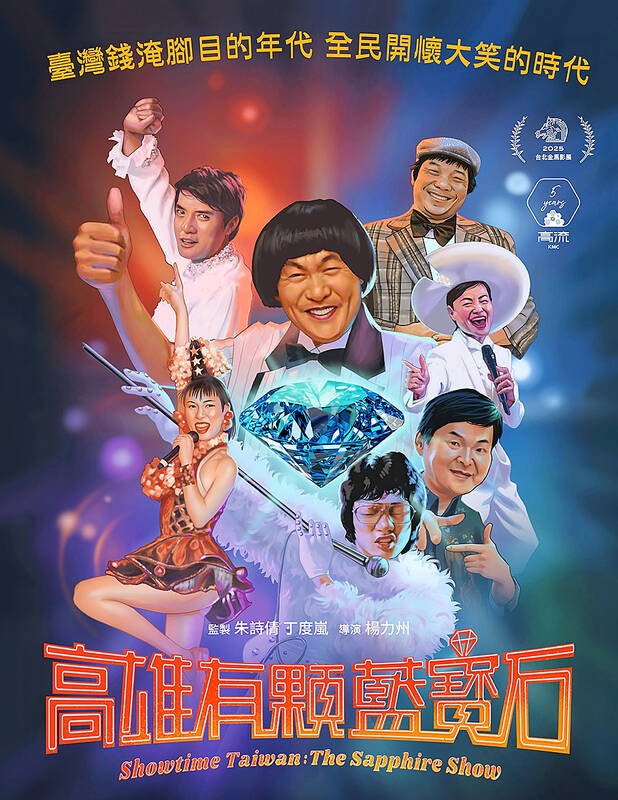
Photo courtesy of Activator Marketing Co
Opening in May 1967 during a period of strict political and social control, Sapphire offered a rare outlet for audiences in southern Taiwan. In contrast to Taipei’s polished, tightly-scripted Mandarin variety shows, its performances were often improvisational and delivered mostly in Hoklo (commonly known as Taiwanese).
Despite its success, the club was plagued by scandals and underworld ties, with several hosts being shot in incidents that shocked the nation. It shut its doors in 1991.
Interest in Sapphire has resurfaced in recent years. An annual tribute concert was launched in 2022, and a new book by Chiu Tzu-yin (邱祖胤) and documentary by Yang Li-chou (楊力州), Showtime Taiwan: The Sapphire Show (高雄有顆藍寶石), were released earlier this year. The film is still showing in select theaters.
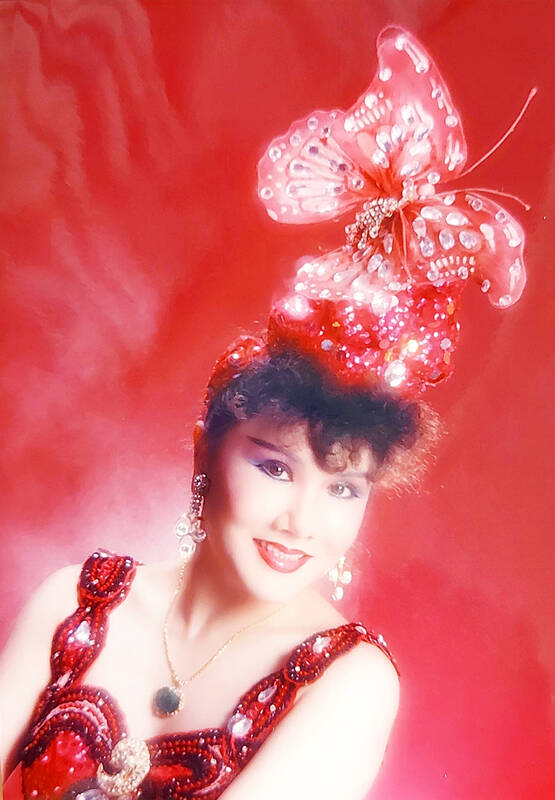
Photo: CNA
LANDMARK VENUE
In the 1960s, Tsai You-wang (蔡有望) arrived in Kaohsiung from Ligang Township (里港) in Pingtung County and began investing in hotels, restaurants and bars. Chiu writes that Tsai quickly built a strong reputation in the city’s entertainment industry and came to know popular singer Lin Shih-fang (林世芳).
During this time, Taiwan Television launched in 1962, and its hit singing show Stars Gathering (群星會) greatly boosted the visibility of performers, turning them into major live draws. While Taipei had many “singing halls” for these acts, Kaohsiung’s live entertainment scene was still largely centered on open-air tea stands and eateries.
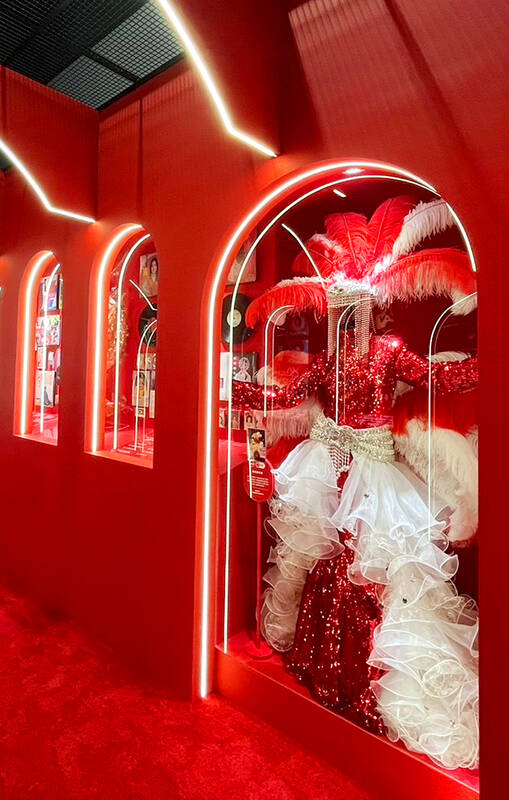
Photo: CNA
Lin had an idea for Tsai: open a comfortable indoor singing hall and invite stars from the TV show to perform. For just NT$20 (about NT$150 today), customers got a cup of hot tea and saw their favorite stars up close in the 600-seat venue.
The opening night was a modest affair with many empty seats. But soon, crowds began pouring in. Not only did Taiwan’s top stars frequently appear, Tsai also brought in overseas talent, including Hong Kong opera diva Ling Po (凌波) whom he reportedly paid NT$1 million (NT$7.6 million today) for a month-long run.
When A-listers couldn’t appear, the club became a platform for lesser-known singers, who often performed Taiwanese songs beloved in southern Taiwan. The surrounding area developed into a bustling commercial district filled with vendors, eateries and movie theaters. Stalls lined both sides of the canal and bridges until 4am or 5am.
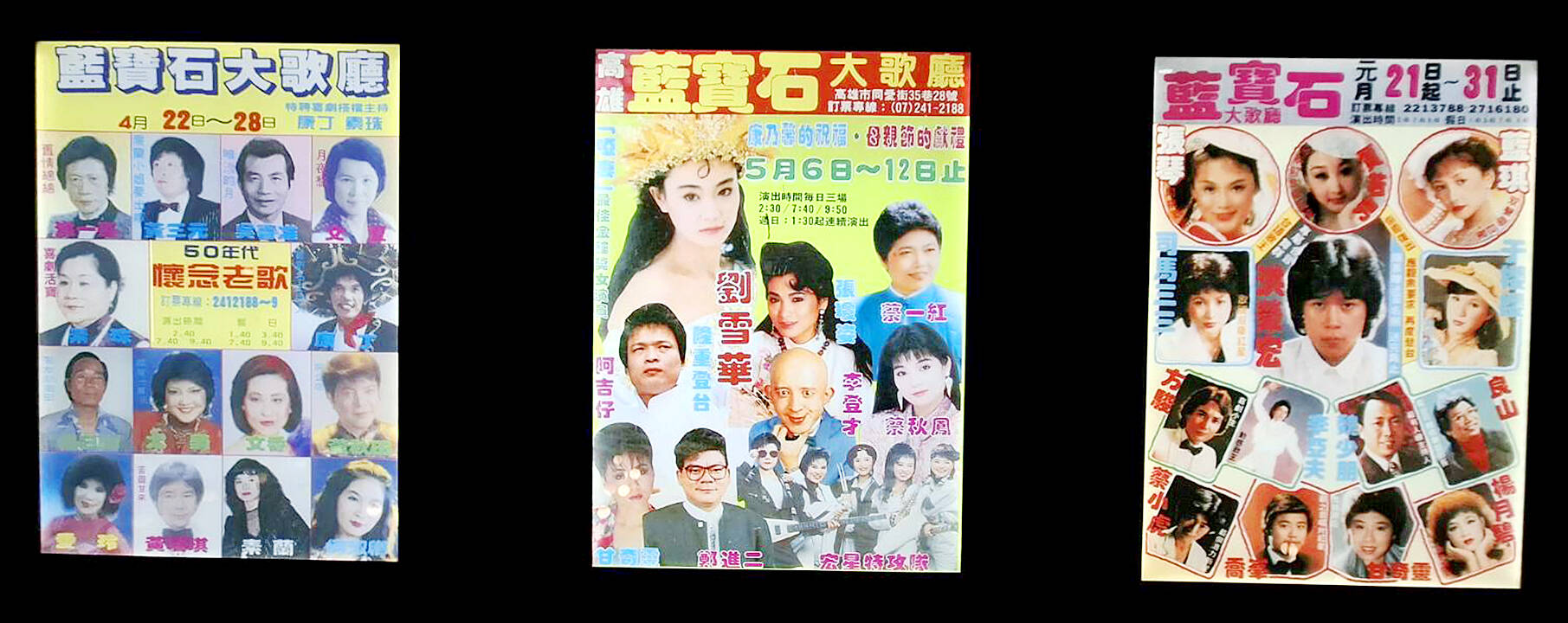
Photo: Su Fu-nan, Taipei Times
LOUD AND UNRESTRAINED
At Sapphire, the program evolved into a distinctive format with strong grassroots appeal, mixing singing with slapstick skits and other variety acts.
The show’s irreverent spirit was embodied by host Chu Ko-liang (豬哥亮), whose infamous catchphrase lin-nia-khah-ho (恁娘卡好, “your mother is better”) was a lightly-censored swear term turned crowd-pleasing punchline. With his signature bowl cut, suit jacket and shorts, Chu shifted between mock-serious interrogation, self-deprecation and absurd antics, often laced with bawdy humor and provocative exchanges with female singers. Much of the appeal came from unscripted interactions with guests, and even the live band was pulled into the chaos as impromptu actors.
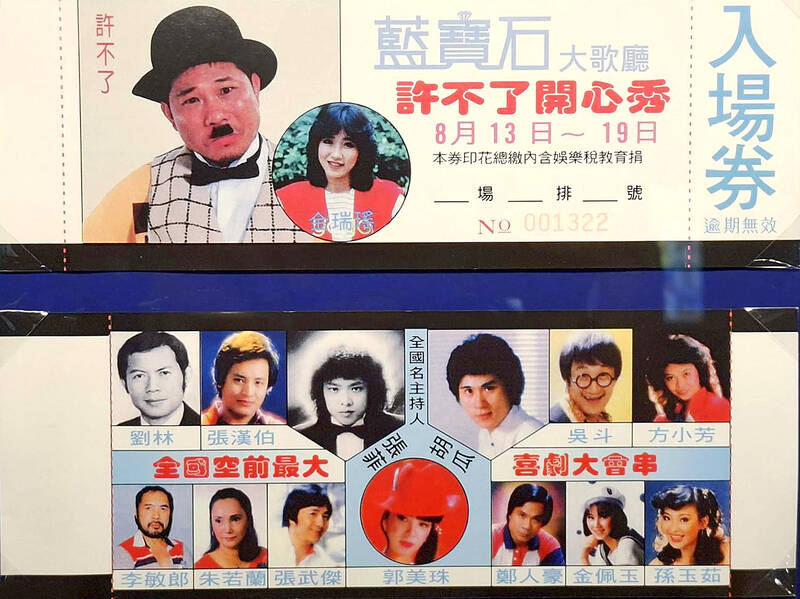
Photo: Su Fu-nan, Taipei Times
“Stars couldn’t just show up and sing; they were expected to take on the hosts’ challenges and think on their feet,” says show business historian Liu Kuo-wei (劉國煒). “On the surface, the Sapphire stage could be brutal. But it also forced performers to give everything they had. Once on stage, there was no room to hold back,”
The costumes were equally outrageous and flamboyant. Tsui Tai-ching (崔苔青) was known for her homemade silver tube dress with tassels, and Chen Mei-feng (陳美鳳) for her red-and-white feathered headpiece and long gown encrusted in red sequins, its skirt layered with cascading white chiffon ruffles. Lo Pi-ling (羅碧玲) frequently wore revealing two-piece outfits. Among male performers, Kao Ling-feng (高凌風) stood out in tight trousers, exaggerated padded-shoulder jackets and deep V-neck floral shirts — sometimes appearing dressed as an Arabian prince.
Spectacle and stimulation were what kept audiences returning, Chiu wrote. Pure singers like Teresa Teng (鄧麗君) could draw crowds for a few days, but weren’t enough to keep them coming back night after night.
RIVALS AND GUNSHOTS
Numerous competitors tried to unseat Sapphire over the years, but Tsai guided it through a successful first decade. However, in October 1979, Hsi Hsiang Feng (喜相逢) burst onto the scene, poaching Sapphire’s program manager, one of its top hosts and paying top dollar to sign exclusive contracts with much of its leading talent.
Sapphire briefly closed and reopened a month later. Things picked up again, but the industry was plagued by soaring and inconsistent singer fees, contract scandals and lawsuits between rival venues.
Organized crime became increasingly involved in operations, with Kao stabbed in 1978 and manager Lin Kuang-ning (林光寧) attacked in 1982. Combined with fines for lewd content, Sapphire’s public reputation began to decline.
Tsai died in 1982, and his successor Tsai Sung-hsiung (蔡松雄) lasted only two years. In 1983, Kao was shot in a case that drew nationwide attention, and Yang Teng-kui (楊登魁) took over a year later. A former gangster-turned-businessman, he leveraged wide-ranging connections and invested heavily to overhaul the club.
After helping actor Hsu Pu-liao (許不了, see “Taiwan in Time: Taiwan’s tragic Charlie Chaplin,” June 2, 2023) resist gang pressure to star in films, Hsu repaid Yang by hosting a 21-day run at Sapphire. It became the most financially successful stretch in the club’s history.
Yang was soon arrested in an islandwide crackdown on organized crime, marking the beginning of the end for Sapphire. Its last hurrah was in 1989, when it paid a record price for Hong Kong star Cherie Chung (鍾楚紅) to perform for a week.
Ironically, the club’s fame grew as attendance declined due to the rise of the VHS industry. Performances were being shown across Taiwan on tour buses, in restaurants, hotels, arcades and private homes. By 1991, however, Sapphire could no longer keep up with rapidly changing entertainment trends and closed down for good.
Taiwan in Time, a column about Taiwan’s history that is published every Sunday, spotlights important or interesting events around the nation that either have anniversaries this week or are tied to current events.

If one asks Taiwanese why house prices are so high or why the nation is so built up or why certain policies cannot be carried out, one common answer is that “Taiwan is too small.” This is actually true, though not in the way people think. The National Property Administration (NPA), responsible for tracking and managing the government’s real estate assets, maintains statistics on how much land the government owns. As of the end of last year, land for official use constituted 293,655 hectares, for public use 1,732,513 hectares, for non-public use 216,972 hectares and for state enterprises 34 hectares, yielding

The small platform at Duoliang Train Station in Taitung County’s Taimali Township (太麻里) served villagers from 1992 to 2006, but was eventually shut down due to lack of use. Just 10 years later, the abandoned train station had become widely known as the most beautiful station in Taiwan, and visitors were so frequent that the village had to start restricting traffic. Nowadays, Duoliang Village (多良) is known as a bit of a tourist trap, with a mandatory, albeit modest, admission fee of NT$10 giving access to a crowded lane of vendors with a mediocre view of the ocean and the trains

The March/April volume of Foreign Affairs, long a purveyor of pro-China pablum, offered up another irksome Beijing-speak on the issues and solutions for the problems vexing the People’s Republic of China (PRC) and the US: “America and China at the Edge of Ruin: A Last Chance to Step Back From the Brink” rang the provocative title, by David M. Lampton and Wang Jisi (王緝思). If one ever wants to describe what went wrong with US-PRC relations, the career of Wang Jisi is a good place to start. Wang has extensive experience in the US and the West. He was a visiting

One of the challenges with the sheer availability of food in today’s world is that lots of us end up spending many of our waking hours eating. Whether it’s full meals, snacks or desserts, scientists have found that it’s not uncommon for us to be mindlessly grazing at some point during all of our 16 or so waking hours. The problem? As soon as this food hits the bloodstream in the form of glucose, it initiates the release of the hormone insulin. This in turn activates a switch present in every one of our cells, which is responsible for driving cell


 RSS
RSS