


The March/April volume of Foreign Affairs, long a purveyor of pro-China pablum, offered up another irksome Beijing-speak on the issues and solutions for the problems vexing the People’s Republic of China (PRC) and the US: “America and China at the Edge of Ruin: A Last Chance to Step Back From the Brink” rang the provocative title, by David M. Lampton and Wang Jisi (王緝思).
If one ever wants to describe what went wrong with US-PRC relations, the career of Wang Jisi is a good place to start. Wang has extensive experience in the US and the West. He was a visiting academic at Oxford University, the University of California, Berkeley, the University of Michigan and Claremont McKenna College. He was Global Scholar at Princeton University 2011-2015, including 9 months at the Woodrow Wilson School of Public and International Affairs. He also served on the board of trustees of the International Crisis Group.
These experiences, however, are just the shiny Western outcroppings of a life spent inside the PRC security state. Wang was director of the Institute of International Strategic Studies at the Central Party School of the Chinese Communist Party from 2001 to 2009. From 2008 to 2016, he served on the Foreign Policy Advisory Committee of the PRC’s Ministry of Foreign Affairs. According to intelligence researcher Alex Joske (周安瀾), Wang has been “closely associated with China’s Ministry of State Security for decades.”
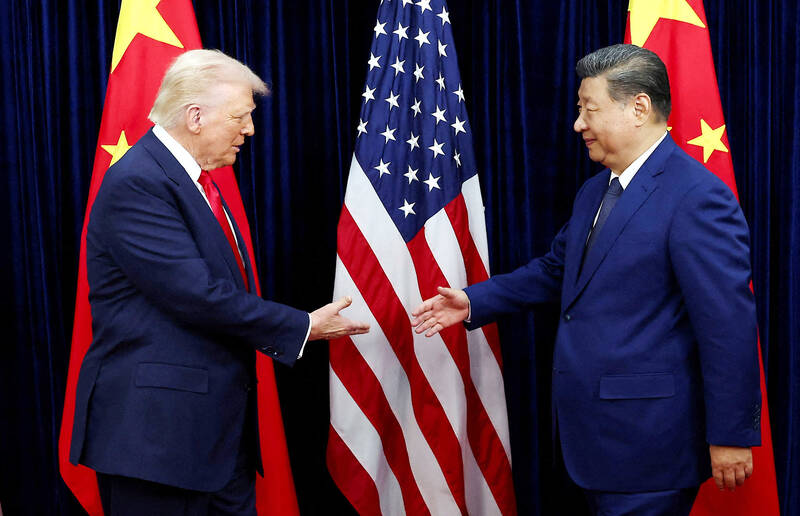
Photo: Reuters
An operative of the PRC security state held positions in ranking public universities in the West? Yes, of course the universities knew, and shrugged. It goes without saying that no high-ranking intelligence professional in the West has such access to Chinese academia, or is able to publish freely in prestigious PRC magazines. Note also that despite these very obvious security state commitments, Wang is still feted as a “scholar” by Western scholars.
As for Lampton, in 2015 he was named the most influential China watcher by the Institute of International Relations at the China Foreign Affairs University in Beijing. Such an accolade could never go to someone the PRC disliked.
Before the meeting in October last year between US President Donald Trump and Chinese leader Xi Jinping (習近平) there was a months-long campaign to push PRC views in the US media (“Notes from Central Taiwan: The emerging argument to sell out Taiwan,” Nov. 3, 2025). Once again we have a Trump-Xi meeting coming, and once again we have “academics” calling for the US to embrace PRC positions on Taiwan.
Photo: AFP
PARROTING THE PRC’S POSITION
The Foreign Affairs piece starts with a robust commitment to PRC positions, reviews the “hostility” between the two states and then claims that the “best place to begin stabilizing the relationship is, perhaps counterintuitively, with its most dangerous dimension: the long-simmering issue of Taiwan.” The Taiwan issue, apparently, simmers all by itself. Nothing drives the tension. PRC expansionism? What’s that?
With that, the reader enters the world of familiar pro-PRC tropes: if we just say some words that are concessions to China, everything will be fine. What words should we say?
Sure enough, the Foreign Affairs piece (co-written, recall, by a PRC security state stalwart) says that “it is in Washington’s interest to reinstate its previous position that it ‘does not support Taiwan independence’.” Sound familiar? It’s a refrain throughout pro-PRC pieces for the last several years.
Stephen Wertheim last year: “Washington will not support Taiwan’s independence or rule out peaceful unification with the mainland, and in return, Beijing will avoid the use of force and ease its military intimidation of Taiwan.”
This demand was also the centerpiece of a 2023 Foreign Affairs essay, “Taiwan and the True Sources of Deterrence,” co-authored by Bonnie Glaser, Jessica Chen Weiss (白潔曦) and Thomas Christensen. In all three cases, in return, Washington gets nothing concrete in return.
Like the Lampton and Wang piece, those essays used some variant of the phrase “Taiwan’s permanent separation from China.” That phrase is a tell-tale sign that the writer is parroting PRC propaganda. Taiwan is not, and has never been, part of China, except in Chinese expansionist fever-dreams.
As many have observed, accepting the position that Washington does not support independence would render its position on Taiwan incoherent. If the US does not accept the possibility that Taiwan can go its own way, there is no point in defending Taiwan. Because “does not support independence” is the first step in dismantling Washington’s support of Taiwan, pro-PRC voices argue for it.
Further, the demand that Washington does something about Taiwan independence is merely a reframing of the old PRC goal of transferring tension between Taiwan and the PRC to the Washington-Taipei relationship. After all, if the PRC truly wanted to reduce tension, it could stop its cyberwarfare, cable cutting, arrest warrants for Taiwanese, theft of Taiwanese technology, “gray zone” intimidation, all on its own. No need for Washington to lift a finger.
Lampton and Wang even write sympathetically of the poor, put-upon PRC’s warmongering, saying “the Chinese government continues to reaffirm its preference for peaceful unification, insisting that it is stepping up full-scale deterrence, such as encircling the island with extensive live-fire exercises, only to prevent secession.” Help! Stop me before I live-fire again!
DOES TAIWAN HAVE A VOICE?
That bizarre sympathy for the aggressor is fallout from another tactic pro-PRC pieces like Lampton and Wang’s: Taiwan disappears, except as an “issue” between the US and the PRC, an abstraction devoid of its own agency. The people of Taiwan and their century-old desire for independence are never mentioned or consulted. Making Taiwan an abstraction also renders PRC expansionism invisible.
Again AWOL are US allies in the region. The creation of a bubble world in which the rest of the region does not exist is a common pro-PRC propaganda move. Japan appears only as a source of friction, due, of course, to Prime Minister Sanae Takaichi’s statement that a PRC invasion of Taiwan would constitute an existential threat to Japan, longstanding Japanese policy.
“The Chinese-Japanese relationship has deteriorated significantly since then,” Lampton and Wang write, “with China applying economic and diplomatic pressure on Japan.”
Then comes the implied threat that if the US would follow PRC wishes on Taiwan independence, it would “show Tokyo that Washington wants to lower the temperature in the region.” That would isolate Tokyo from Washington, a goal of Beijing’s. Of course, the implication is that the PRC will treat Washington like Tokyo if the US does not play ball.
Lampton and Wang go further, implying that Taiwan independence is of foreign manufacture, a staple of PRC propaganda. Note the phrase “external pressure” in this statement of theirs: “In some Chinese circles, for instance, there is a lack of confidence about China’s ability to resist external pressure in support of Taiwan’s separation from China.”
As JRR Tolkien wrote in The Lord of the Rings: “For yet another weapon, swifter than hunger, the Lord of the Dark Tower had: dread and despair.” The PRC wants Washington to say it does not support Taiwan independence because that will induce feelings of resignation and hopelessness in Taiwan. Skepticism of US commitments to Taiwan is already widespread, and the Chinese Nationalist Party (KMT) is constantly stoking that feeling. Lampton and Wang are right about one thing: the PRC would rather annex Taiwan without fighting, if it can.
Last time around this campaign did not achieve its goal, but then Trump was not engaged in a war that will give the PRC immense leverage, while distancing the US from its allies in the Pacific. The PRC and its numerous interlocutors may now feel that the time is ripe.
Let us pray that they are always wrong.
Notes from Central Taiwan is a column written by long-term resident Michael Turton, who provides incisive commentary informed by three decades of living in and writing about his adoptive country. The views expressed here are his own.

Yesterday, the Democratic Progressive Party (DPP) nominated legislator Puma Shen (沈伯洋) as their Taipei mayoral candidate, the Chinese Nationalist Party (KMT) put their stamp of approval on Wei Ping-cheng (魏平政) as their candidate for Changhua County commissioner and former legislator Tsai Pi-ru (蔡壁如) of the Taiwan People’s Party (TPP) has begun the process to also run in Changhua, though she has not yet been formally nominated. All three news items are bizarre. The DPP has struggled with settling on a Taipei nominee. The only candidate who declared interest was Enoch Wu (吳怡農), but the party seemed determined to nominate anyone
In a sudden move last week, opposition lawmakers of the Chinese Nationalist Party (KMT) and Taiwan People’s Party (TPP) passed a NT$780 billion special defense budget as a preemptive measure to stop either Chinese leader Xi Jinping (習近平) or US President Donald Trump from blocking US arms sales to Taiwan at their summit in Beijing, said KMT heavyweight Jaw Shaw-kong (趙少康), speaking to the Taipei Foreign Correspondents Club on Wednesday night in Taipei. The 76-year-old Jaw, a political talk show host who ran as the KMT’s vice presidential candidate in 2024, says that he personally brokered the deal to resolve
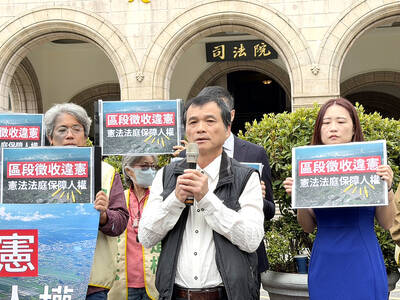
What government project has expropriated the most land in Taiwan? According to local media reports, it is the Taoyuan Aerotropolis, eating 2,500 hectares of land in its first phase, with more to come. Forty thousand people are expected to be displaced by the project. Naturally that enormous land grab is generating powerful pushback. Last week Chen Chien-ho (陳健和), a local resident of Jhuwei Borough (竹圍) in Taoyuan City’s Dayuan District (大園) filed a petition for constitutional review of the project after losing his case at the Taipei Administrative Court. The Administrative Court found in favor of nine other local landowners, but

The Chinese Nationalist Party (KMT) and its sock puppet, the Taiwan People’s Party (TPP), passed their version of the government’s proposed supplementary defense spending bill last week, engendering much commentary. While all eyes were on the defense budget, the PRC’s assault on Taiwan was advancing on other fronts. The removal of domestic drone production and other technologies critical to the nation’s asymmetrical defenses from the list of items purchased in the “compromise” bill shows how the KMT-TPP alliance appears to be serving the People’s Republic of China (PRC). Ironically, the cuts will impact industries heavily represented by tech firms in areas run


 RSS
RSS