


The Chinese Nationalist Party (KMT) and its sock puppet, the Taiwan People’s Party (TPP), passed their version of the government’s proposed supplementary defense spending bill last week, engendering much commentary. While all eyes were on the defense budget, the PRC’s assault on Taiwan was advancing on other fronts.
The removal of domestic drone production and other technologies critical to the nation’s asymmetrical defenses from the list of items purchased in the “compromise” bill shows how the KMT-TPP alliance appears to be serving the People’s Republic of China (PRC).
Ironically, the cuts will impact industries heavily represented by tech firms in areas run by KMT politicians, including Taipei, Taoyuan and Taichung. Most of these firms have historically supported the KMT. They have made investments in tooling, production and R&D for the defense drone programs. Their stocks have taken a beating. With the drone programs in full gear, Taiwan was poised not only to enhance its own defense, but to form the basis of a non-PRC drone supply chain and compete with PRC drone exporters. No wonder the PRC wanted those programs killed.
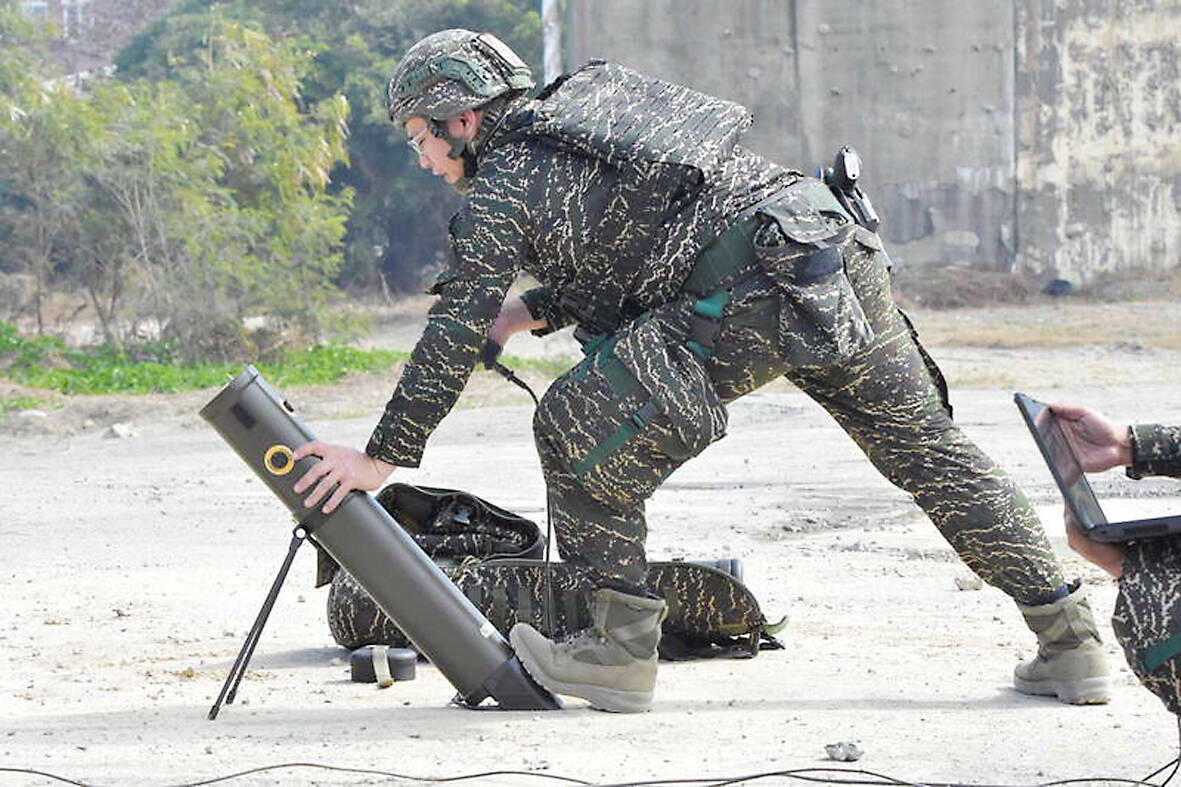
Photo: TT file photo
Taichung Mayor Lu Shiow-yen (盧秀燕), whose city is at the forefront of the drone manufacturing wave, had just promised last month to make drones one of the region’s top 10 industries. Her own party undercut her to please the PRC. Already, local media are reporting, the cuts have become an issue in the local elections for next year, with Democratic Progressive Party (DPP) candidates already attacking their KMT counterparts.
OFFSHORE ISLANDS THREAT
Widely reported on domestically but ignored in the international media, on May 8 the proposed amendment to the Offshore Islands Development Act (離島建設條例) proposed by KMT legislator Chen Yu-chen (陳玉珍) was sent to its second reading. These amendments are just as threatening to Taiwan as the cuts in the defense budget.
The proposed law makes radical, pro-PRC changes to the existing law. It allows the power grids of offshore islands to be connected to the PRC, and allows their citizens to purchase property with the consent of the county government and exempts them from central government regulatory powers blocking such actions. It also permits PRC entities to invest in medical institutions in the outlying islands. Many observes are interpreting that as permitting doctors and nurses from the PRC to practice in the outlying islands. That would give them access to Taiwan’s health care system and all its data.
The amendments also establish Free Trade Demonstration Zones in the offshore islands. The new law stipulates that their rules and regulations will be controlled solely by local county governments. This has long been criticized as a gate that will flood Taiwan with PRC labor and smuggled goods.
The KMT administration in April 2013 proposed “free economic pilot zones.” In that program Kinmen and the other islands were the second phase. The first phase was to be implemented at the six free trade ports, the Taoyuan airport free trade zone, and the Pingtung Agricultural Biotechnology Park. Kinmen was slated for education, healthcare and agricultural links. This plan was killed in 2016. But the KMT is still trying.
Moreover, Kinmen is merely the appetizer: all this applies to the Penghu islands as well. Penghu contains an excellent port, Makung (馬公), and offers its owner control of the Taiwan Strait and a base for threatening Taiwan.
DEFENSE BUDGET
As for the defense budget, as many have reported, the KMT-TPP budget is not an appropriation, but an authorization. It requires the Executive Yuan to submit a report within a month. Only after approval of the report by the Legislature can the Executive than draft a budget. It must then be sent to the Legislature for review within two months. This gives the pro-PRC parties in the legislature numerous opportunities for mischief. The authorization bill also stipulates that each budget must be annual, meaning that the KMT can do this every year.
Note again: the budget for this year has still not been reviewed by the legislature. What stops them from simply not reviewing the supplemental defense budget once it has gone through the processes specified above? Nothing. There is no guarantee anywhere in there that any proposed supplemental defense budget will pass. The KMT can play the blocking game forever.
The US also has its budgetary and political gears to grind. As these two systems intermesh, some friction is inevitable. The State Department Web site on Foreign Military Sales (FMS) observes that “processing times for FMS cases vary, but they may take months to define and approve.” The KMT late last month added a new condition to the budget debate: the special defense budget could only be approved after Taiwan receives an official Letter of Offer and Acceptance (LOA) from the US. This will add further delays to any proposed military spending. The KMT can then claim it is acting in the security interests of Taiwan, while actually doing nothing, just as it is right now.
UNDERMINING TAIWAN’S SECURITY
The key point about never reviewing the budget is that once the review is performed, the KMT has to take political responsibility for whatever cuts it proposes. By never reviewing, it never has to propose specific cuts and justify them, saving itself much public criticism.
The KMT-TPP supplementary defense authorization bill also requires that social spending not be lowered, via a clause that stipulates that budgets may not be transferred between different entities without the consent of the Legislative Yuan. This requirement appears to be unconstitutional. Since nobody is proposing new taxes, and the amount of debt the government can take on is limited by law, the inference is obvious: the money for defense will not be provided and cannot be taken from somewhere else in the budget.
The clause blocking budgetary transfers also preserves the KMT’s redistribution of funds from the central government to the local governments. Taken as a whole, it is easy to see how the KMT’s policy program defeats defense spending and undermines Taiwan’s security. Recall that the pro-PRC parties have blocked scores of bills that prevent high-ranking officials from attending Chinese Communist Party (CCP) events, ban disinformation and polls influencing elections and party primaries, and so forth.
In Frank Herbert’s Dune, after Paul Atreides defeats Emperor Shaddam IV, he sentences the former ruler to retire on Salusa Secundus, the brutal prison planet the Emperor had been using to train his feared elite troops, the Sardaukar. Paul promises to transform that world into “a garden world, full of gentle things.”
Similarly, in her recent interview with CNN, KMT Chair Cheng Li-wun (鄭麗文) said that the Cold War first island chain should become a “chain of peace and prosperity.”
As my friend Ben Goren remarked on X, “all that’s missing is who exactly gets the peace, who gets the prosperity and who gets the chain.”
Notes from Central Taiwan is a column written by long-term resident Michael Turton, who provides incisive commentary informed by three decades of living in and writing about his adoptive country. The views expressed here are his own.

Taiwan’s English education system is being pulled apart by three opposing forces. Bilingual Nation 2030 pulls students toward English and global communication. Artificial Intelligence (AI) readiness pulls them toward digital judgment, verification and AI-mediated work. But Taiwan’s old exam culture pulls them back toward memorization, grammar drills, timed reading and correct answers. If the education system keeps using old exams to define success, it risks producing graduates who are neither genuinely bilingual nor genuinely AI-ready, but trained for tasks machines can already perform. The first force is Bilingual Nation 2030. Launched in 2018, the policy aimed to “help Taiwan’s workforce connect

It seems every few days one bumps into one of those “real man” comments in which Taiwan is urged to “face reality” or similar, and “make a deal,” with the speaker implying that soon it will be too late. “Deal” advocates always present themselves as having a superior grip on reality, and the manly ability to make the “hard choice.” Their testosterone-laden language often echoes that of Taiwan sellout advocates. Note that such commentary always specifies a process (“make a deal, work with, make progress”), never the end state of what occupation by a violent authoritarian colonialist state will entail. In
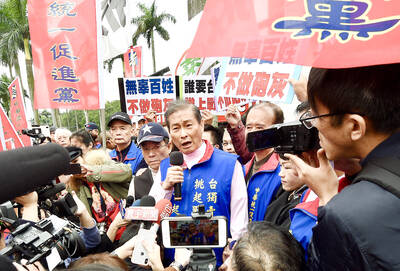
There are shadowy cabals plotting to sell out Taiwan to be annexed by China, by invasion if necessary. Fortunately, they are buffoons. In 2019, former Bamboo Union gangster and founder of the China Unification Promotion Party (CUPP), Chang An-le (張安樂, colorfully known as “White Wolf”), led a protest at the Legislative Yuan against comments made by then-premier Su Tseng-chang (蘇貞昌) that in the event of an attack by China, he would never surrender, but would protect the nation by fighting to the end, even if he only had a broom. Chang had party members bring a wooden casket that they
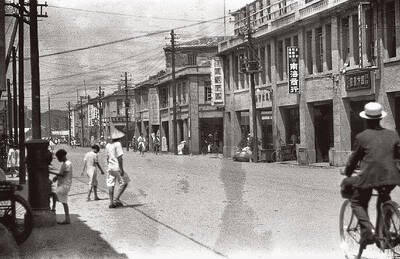
June 1 to June 7 "If all Taiwanese were as afraid of dying as you, then what would happen?” Physician Shih Chiang-nan (施江南) reportedly said this to his wife Chen Chiao-tung (陳焦桐) after she urged him to stop intervening on behalf of Taiwanese soldiers stranded overseas after serving in the Japanese Army during World War II. Shih had clashed with high-ranking officials over the issue, engaged in several heated arguments with Taiwan governor-general Chen Yi (陳儀) and allegedly shouted at general Ko Yuan-fen (柯遠芬), chief of staff of the Taiwan Garrison Command, over


 RSS
RSS