


Before the last section of the round-the-island railway was electrified, one old blue train still chugged back and forth between Pingtung County’s Fangliao (枋寮) and Taitung (台東) stations once a day. It was so slow, was so hot (it had no air conditioning) and covered such a short distance, that the low fare still failed to attract many riders. This relic of the past was finally retired when the South Link Line was fully electrified on Dec. 23, 2020.
A wave of nostalgia surrounded the termination of the Ordinary Train service, as these train carriages had been in use for decades all over Taiwan and were memories from the formative years of many Taiwanese. Lion Travel Service saw an opportunity and secured the rights to continue operating them as part of a tour package.
The carriages were freshened up inside and out but kept faithful to the original design. The only cooling still comes from the open windows or the rotating ceiling fans, hence the new nickname for the train, Breezy Blue (藍皮解憂號). It is also still pulled by a diesel locomotive, adding to the nostalgic, if not aromatic, value of the tour. The main difference is that, now, the seats are frequently sold out.
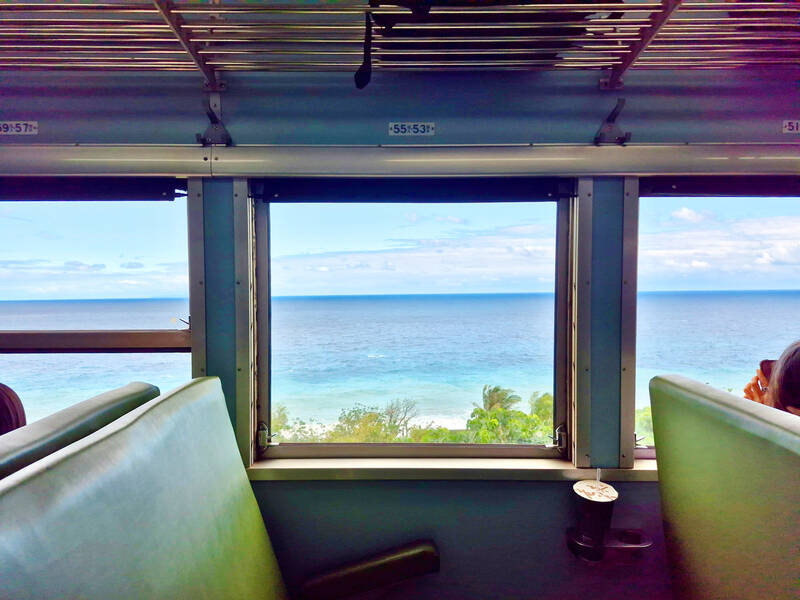
Photo: Tyler Cottenie
RIDING BREEZY BLUE
You cannot simply buy a ticket for this train at the Taiwan Railway counter. It must be booked at least one week in advance through Lion Travel. When checking in at the travel agency’s desk, you will be issued an envelope with a boarding pass, a commemorative Ordinary Train ticket designed to resemble the older magnetic Taiwan Railway tickets of 2020, a lanyard for hanging a cell phone or audio guide around your neck and a set of earphones, all of which you can take home after the tour.
Boarding consists of entering the carriage number indicated on one’s boarding pass, but once inside, there are no assigned seats, so boarding early to get a seat on the ocean side is recommended. Once everyone has boarded, audio receivers are handed out and the journey begins.
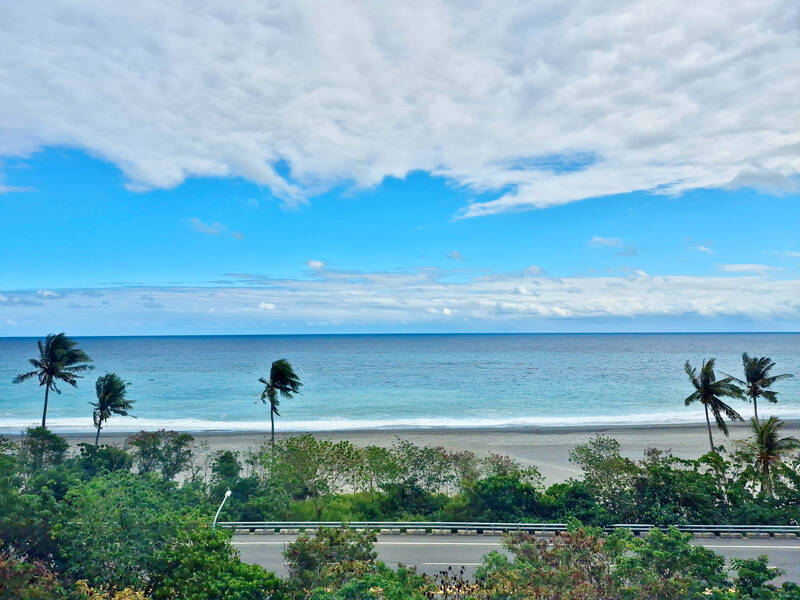
Photo: Tyler Cottenie
There is a guide stationed in each carriage to narrate the journey via radio to the receivers, and in typical Taiwanese tour fashion, the guide never really stops talking. He or she is a performer filling the silence and helping take photographs, rather than someone with whom guests can expect genuine interaction.
If you can’t understand Chinese, you’re not missing much. Just sit back and enjoy the scenery, as the South Link boasts some of the most scenic stretches of Taiwanese railway. Before long, the train will make its first stop in Taitung County’s Jinlun Village (金崙), anyway.
MORE THAN JUST A TRAIN RIDE
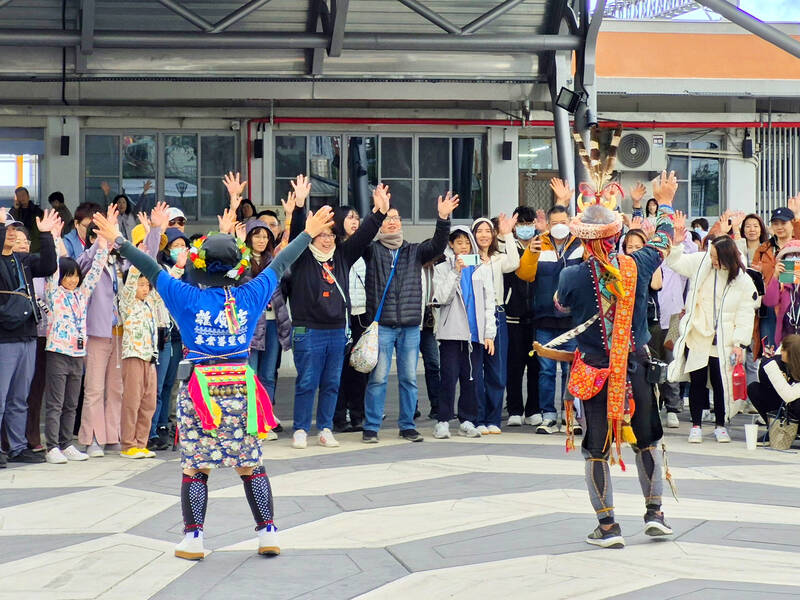
Photo: Tyler Cottenie
Our train stopped first in the hot spring village of Jinlun and each carriage was assigned a local guide from the Paiwan indigenous community. We were taken down to the beach to learn a bit about local fishing practices and edible plants, both wild and cultivated. Next, we were given a demonstration of a bamboo tool for scaring birds away and of how the Paiwan grind millet in a mortar and pestle (it’s different for men and women).
Lastly, we joined hands and were taught how to do the traditional eight-step circle dance of the Paiwan people. Overcoming the mild social awkwardness of holding hands with strangers and dancing in public had everyone smiling by the end.
Back in front of the station, the three Paiwan guides led the group in a song and hand-waving exercise that seemed mostly performative rather than intended to impart any cultural understanding to the visitors.
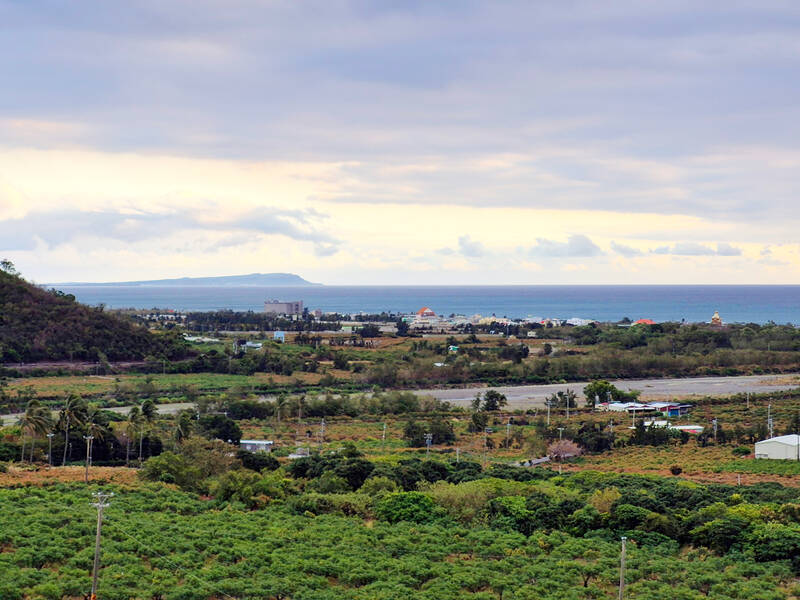
Photo: Tyler Cottenie
Overall, this was a carefully planned, professional and well-executed yet highly cursory and superficial introduction to local culture. Though a bit disappointing to this author, one can hardly expect more in a large tour group encompassing all ages.
Back on the train, we were served our snack: a delicious millet donut and a bottle of roselle tea, both made from local ingredients, which we enjoyed as we rode through the gorgeous Duoliang (多良) section of the railway. We waved to the crowd of people waiting for us on the platform of the old Duoliang Station, and continued onto a newly built section of track that has abandoned older tunnels in favor of a more coastal route.
From the right angle inside, the train appears to be floating in the air above the water. On a clear day, when the ocean glows turquoise in the sunlight, the view is postcard-perfect. Breezy Blue has permission to slow down to a crawl here, allowing for extra time to enjoy the view.
A PHOTOGENIC RIDE
At Dawu Station (大武), the train makes another stop to allow other train traffic to pass and for passengers to get out on the platform and take photos of their friends or family on the train looking out the open windows. The guide is happy to help any solo travelers.
After Dawu, the train enters a series of tunnels, including the 8km tunnel under the Central Mountain Range, and this is where the real difference between these train cars and more modern ones becomes apparent. The open windows make this a very loud experience, so much so that the tour guide actually stops talking for a while. One car is also dedicated to the sale of Breezy Blue merchandise and opens for business at this time.
The next stop is Fangshan Station (枋山), the first one in Pingtung County and Taiwan’s southernmost train station. With only three trains making regular stops here in each direction each day, it is one of the most seldom visited stations in Taiwan, so having some time to explore this station is an opportunity not easily available to regular rail passengers.
Besides the southernmost railway station sign and the novelty of seeing an unmanned station, the main attraction here is the expansive view over the Fangshan River valley and Taiwan Strait. The train arrives in the late afternoon near sunset when the lighting is at its most beautiful. It’s an ideal welcome to western Taiwan and a pleasant final break before reaching the terminal station of Fangliao just 15 minutes ahead.
PLANNING YOUR TRIP
If you happen to be traveling the South Link Line and have some extra time on your hands, booking the Taitung to Fangliao section on Breezy Blue is a great option. A fast local train for this section would cost NT$201, or NT$313 for the express. For NT$799, you can get from Point A to Point B in a retro train car, with more time to appreciate the scenery, a brief introduction to Paiwan culture and a snack.
However, for those who rode the Ordinary Train back when it cost NT$104, those who are already quite familiar with Paiwan culture or Jinlun Village, those who would prefer a tour guide that is more accessible for questions and deeper discussion, and those who are looking for a quiet, comfortable ride, this might not be the trip for you.
The trip can also be booked in the opposite direction. Breezy Blue leaves Fangliao each morning at 10:25am and arrives in Taitung at 1:35pm. It stops at more stations but does not include the Paiwan experience in Jinlun. The return trip leaves Taitung at 2:10pm and arrives in Fangliao at 5:38pm, in time to catch a connecting fast local train to points further north.
Tickets can be booked at event.liontravel.com/en-us/railtour/breezyblue/products, though the interface’s English is quite poor and incomplete. Use the Chinese interface if at all possible.

It seems every few days one bumps into one of those “real man” comments in which Taiwan is urged to “face reality” or similar, and “make a deal,” with the speaker implying that soon it will be too late. “Deal” advocates always present themselves as having a superior grip on reality, and the manly ability to make the “hard choice.” Their testosterone-laden language often echoes that of Taiwan sellout advocates. Note that such commentary always specifies a process (“make a deal, work with, make progress”), never the end state of what occupation by a violent authoritarian colonialist state will entail. In

There are shadowy cabals plotting to sell out Taiwan to be annexed by China, by invasion if necessary. Fortunately, they are buffoons. In 2019, former Bamboo Union gangster and founder of the China Unification Promotion Party (CUPP), Chang An-le (張安樂, colorfully known as “White Wolf”), led a protest at the Legislative Yuan against comments made by then-premier Su Tseng-chang (蘇貞昌) that in the event of an attack by China, he would never surrender, but would protect the nation by fighting to the end, even if he only had a broom. Chang had party members bring a wooden casket that they
June 1 to June 7 "If all Taiwanese were as afraid of dying as you, then what would happen?” Physician Shih Chiang-nan (施江南) reportedly said this to his wife Chen Chiao-tung (陳焦桐) after she urged him to stop intervening on behalf of Taiwanese soldiers stranded overseas after serving in the Japanese Army during World War II. Shih had clashed with high-ranking officials over the issue, engaged in several heated arguments with Taiwan governor-general Chen Yi (陳儀) and allegedly shouted at general Ko Yuan-fen (柯遠芬), chief of staff of the Taiwan Garrison Command, over

Food prices have often played a major role in Taiwan’s history. The first major wave of migration from China occurred in 1628. A moderate drought, the Ming Dynasty maritime ban that prohibited fishing and trading (intended to reduce piracy) and a temporary tax, conspired to exhaust local resources, leading to famine in Fujian Province. The famed pirate and trader Zheng Zhilong (鄭芝龍), scooped up starving people from Fujian and transported them across the Taiwan Strait, where they settled under the Dutch. Two factors enabled Zheng. First, by 1624 he had settlements around today’s Beigang (北港) in Yunlin County with a small


 RSS
RSS