


The 2018 nine-in-one local elections were a wild ride that no one saw coming.
Entering that year, the Chinese Nationalist Party (KMT) was demoralized and in disarray — and fearing an existential crisis. By the end of the year, the party was riding high and swept most of the country in a landslide, including toppling the Democratic Progressive Party (DPP) in their Kaohsiung stronghold.
Could something like that happen again on the DPP side in this year’s nine-in-one elections?

Photo: Chang Chung-yi, Taipei Times
The short answer is not exactly; the conditions were very specific. However, it does illustrate how swiftly every assumption early in an election cycle can be turned on its head.
BOLT OUT OF THE BLUE
The first inkling I had that something was up was in the summer of 2018. I got curious as to why the then-KMT caucus convener and former legislative speaker Wang Jin-pyng (王金平) did not seem to be in the news. He was a powerful figure. Why was he so quiet?
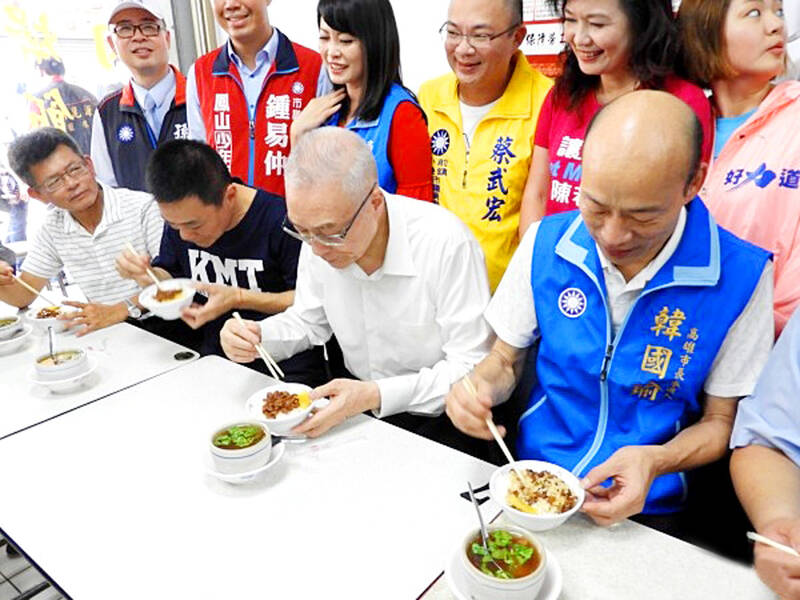
Photo: Ko Yu-hao, Taipei Times
Doing some searches, it turned out that he was still making news, but on the local level, visiting temples and local politicians. It occurred to me then that he might be trying to unite the KMT’s local patronage factions to uniformly back the party’s candidates regardless of faction. This had never been attempted before. I thought this was interesting, and excitedly messaged Michael Turton about my hunch, but we had no idea if Wang would be successful or not. It turned out that hunch was correct, and Wang was successful.
But Wang was only getting started, and what happened next was so improbable it boggled the mind.
In 2017, a relative nobody named Han Kuo-yu (韓國瑜), currently the legislative speaker, had the temerity to run for KMT chair. Han had been a lawmaker in the 1990s, a period he was mostly remembered for being the target of an unsuccessful recall attempt, and for beating up and hospitalizing fellow lawmaker and future DPP president Chen Shui-bian (陳水扁) after Chen said insulting things about the military. It seems distant today, but back then, the KMT were big supporters of the military, and the DPP loathed them for their role in imposing martial law.
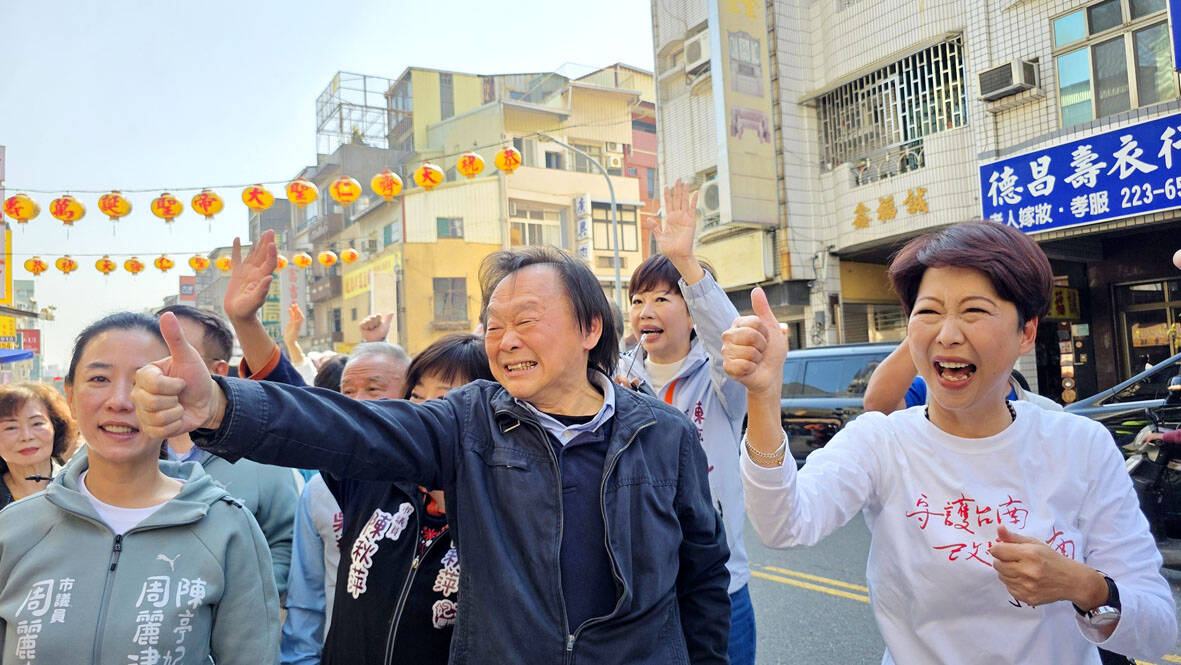
Photo: Hung Jui-chin, Taipei Times
Han came in a dismal fourth, despite the backing of the powerful Yunlin Chang clan. Former vice president Wu Den-yih (吳敦義) won, and in 2018, banished the cheeky Han to the seemingly hopeless task of running for mayor of Kaohsiung.
Wang is from the Kaohsiung White Faction and took Han under his wing. Under Wang’s tutelage, Han started to gain some traction in the late summer, and by September, he was attracting national attention.
Some attribute his rise to backing from Beijing. Last month, reporting from Japan’s Yomiuri Shimbun alleged that a recording surfaced of a People’s Liberation Army officer that reportedly included mention of a 20 million yuan (US$2.85 million) budget to help Han’s campaign.
There were rampant suspicions of Chinese involvement in 2018, and I witnessed a woman from Han’s team on live television touting how fast his LINE following was growing by showing a series of slides, which included a spike on one day that was so high it was clearly improbable without outside interference. The woman noticed that and quickly hid that slide, brushing it aside.
Han emphatically denies that his campaign took any money from China. However, there was interference in other ways, including online and via local radio stations, which were taking large sums of money in Chinese advertising.
Though Chinese support might have helped, the primary reasons for the “Han wave” mania that spread throughout the country that autumn were due to Wang’s strategic brilliance and Han’s remarkable charisma.
Han’s family fled the Chinese Civil War, and in videos from the 1990s, he acted and carried himself with the swaggering confidence that was associated with that privileged class at the time. However, he married a woman from Yunlin County and moved there, and they opened a language school.
While there, Han changed. He picked up the more self-effacing style and mannerisms more associated with Taiwanese.
He weaved this into a unique charisma that was — and still is — quite powerful. He comes across as an everyman sort of guy, funny, charming and even sometimes whimsical.
His campaign style was unique, emphasizing his guy-next-door you could have a drink with. He also leaned heavily into 1980s boom-era nostalgia. He was also relentlessly positive and optimistic, and refused to run a negative campaign. His ideas were sometimes unrealistic and wildly impractical, but he gave people hope.
His rallies were a sea of Republic of China (ROC) flags, and his fans loved him passionately. However, his leaning into the 1980s and ROC patriotism led to concerns that his real intent was to return to the martial law era, especially among the young.
He hooked up with the candidates for New Taipei City and Taichung — Hou You-yi (侯友宜) and Lu Shiow-yen (盧秀燕) — and together they barnstormed the country, drawing enormous, wildly enthusiastic crowds.
WANG’S DASHED DREAMS
In the process, Wang managed to sideline party chairman Wu, who campaigned with candidates more aligned with him, like Ting Shou-chung (丁守中) in Taipei and some other minor figures. The difference between the Wang-Han juggernaut and their Han Wave and the limp, stale Wu-Ting campaigns was stark.
Widely credited within the KMT for saving the party and engineering a landslide victory, Wang looked set to ride the Han wave into the national elections — a little over 13 months away — as the KMT’s presidential candidate.
Then it all began to fall apart. Wu successfully enticed Han into running for president, changing the rules to make it happen. Wang lacked the charisma and passionate fan base of Han, and with Han’s betrayal, Wang’s dreams were dashed. Wang needed Han’s backing to win, so Han’s betrayal must have cut deep.
Just as Han had a passionate fan base, his detractors just as passionately loathed him. Having jumped ship so quickly after being elected mayor to run for president, the ranks of his detractors grew.
The pressure of being treated like a god at his rallies — and like a monster by others — clearly got to him. He lost the positivity and optimism that characterized his Kaohsiung run, and his presidential campaign was noticeably darker and angrier. He lost in a landslide, and, adding insult to injury, he was recalled as mayor of Kaohsiung soon after.
After a dark period of reflection, he regained his cheerful, optimistic tone and is now the legislative speaker — ironically, Wang’s old job. The animosity that he once attracted has largely faded, and he is again on the list of prospective presidential candidates for 2028, though he remains a long shot.
BOLT OUT OF THE GREEN?
Though not facing the degree of existential crisis the KMT was in 2018, this year the DPP is facing many of the same problems. Young voters have abandoned the party in droves, and the sense that people are tired of the DPP is palpable. The party feels old, stale, out of touch and uninspiring.
Could a DPP candidate break out and draw excited, passionate crowds like Han? It is hard to see how, and who that candidate would be, but then at this point in 2018, no one saw the Han Wave coming either.
The only character on the DPP side that jumps to mind with the uniqueness of character and personality that might inspire people is Wang Shih-cheng (王世堅), who, like Han, could run a long-shot underdog race for Taipei mayor, but he insists he has no plans to run.
But who knows? The lesson of 2018 is that anything can happen, even something as seemingly improbable as the Han Wave.
Donovan’s Deep Dives is a regular column by Courtney Donovan Smith (石東文) who writes in-depth analysis on everything about Taiwan’s political scene and geopolitics. Donovan is also the central Taiwan correspondent at ICRT FM100 Radio News, co-publisher of Compass Magazine, co-founder Taiwan Report (report.tw) and former chair of the Taichung American Chamber of Commerce. Follow him on X: @donovan_smith.
The small platform at Duoliang Train Station in Taitung County’s Taimali Township (太麻里) served villagers from 1992 to 2006, but was eventually shut down due to lack of use. Just 10 years later, the abandoned train station had become widely known as the most beautiful station in Taiwan, and visitors were so frequent that the village had to start restricting traffic. Nowadays, Duoliang Village (多良) is known as a bit of a tourist trap, with a mandatory, albeit modest, admission fee of NT$10 giving access to a crowded lane of vendors with a mediocre view of the ocean and the trains
For many people, Bilingual Nation 2030 begins and ends in the classroom. Since the policy was launched in 2018, the debate has centered on students, teachers and the pressure placed on schools. Yet the policy was never solely about English education. The government’s official plan also calls for bilingualization in Taiwan’s government services, laws and regulations, and living environment. The goal is to make Taiwan more inclusive and accessible to international enterprises and talent and better prepared for global economic and trade conditions. After eight years, that grand vision is due for a pulse check. RULES THAT CAN BE READ For Harper Chen (陳虹宇), an adviser
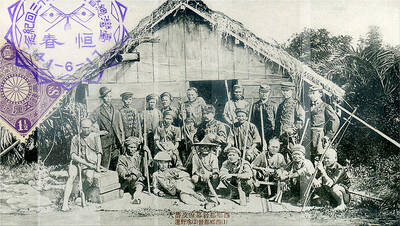
Traditionally, indigenous people in Taiwan’s mountains practice swidden cultivation, or “slash and burn” agriculture, a practice common in human history. According to a 2016 research article in the International Journal of Environmental Sustainability, among the Atayal people, this began with a search for suitable forested slopeland. The trees are burnt for fertilizer and the land cleared of stones. The stones and wood are then piled up to make fences, while both dead and standing trees are retained on the plot. The fences are used to grow climbing crops like squash and beans. The plot itself supports farming for three years.
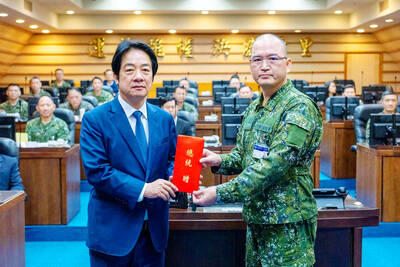
President William Lai (賴清德) on Nov. 25 last year announced in a Washington Post op-ed that “my government will introduce a historic US$40 billion supplementary defense budget, an investment that underscores our commitment to defending Taiwan’s democracy.” Lai promised “significant new arms acquisitions from the United States” and to “invest in cutting-edge technologies and expand Taiwan’s defense industrial base,” to “bolster deterrence by inserting greater costs and uncertainties into Beijing’s decision-making on the use of force.” Announcing it in the Washington Post was a strategic gamble, both geopolitically and domestically, with Taiwan’s international credibility at stake. But Lai’s message was exactly


 RSS
RSS