


The US government on Thursday announced a possible sale to Taiwan of fighter jet parts, which was estimated to cost about US$330 million, in a move that an expert said “sends a clear message of support for Taiwan” amid fears that Washington might be wavering in its attitude toward Taipei.
It was the first announcement of an arms sale to Taiwan since US President Donald Trump returned to the White House earlier this year.
The proposed package includes non-standard components, spare and repair parts, consumables and accessories, as well repair and return support for the F-16, C-130 and Indigenous Defense Fighter aircraft, the US Defense Security Cooperation Agency (DSCA) said.
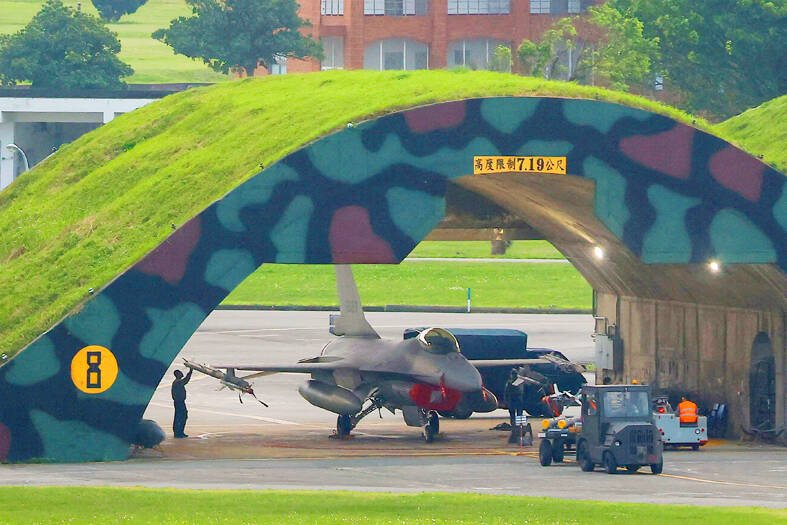
Photo: Ann Wang, Reuters
It also includes technical and logistical support, the DSCA added.
The agency said it notified the US Congress of the proposed sale after the plan was approved by the US Department of State.
“This proposed sale serves US national, economic and security interests by supporting the recipient’s continuing efforts to modernize its armed forces and to maintain a credible defensive capability,” the DSCA said. “The proposed sale will help improve the security of the recipient and assist in maintaining political stability, military balance and economic progress in the region.”
The Ministry of National Defense thanked the US for its continued efforts to help Taiwan maintain adequate self-defense capabilities under the Taiwan Relations Act and the “six assurances.”
The arms sale would help the air force maintain combat readiness and bolster the nation’s air defense, while also boosting defense resilience and Taiwan’s ability to respond to China’s “gray zone” coercion, the ministry said.
Before Trump’s meeting with Chinese President Xi Jinping (習近平) last month, the US president said that “Taiwan is Taiwan,” adding that he has great respect for Taiwan, Institute for National Defense and Security Research research fellow Su Tzu-yun (蘇紫雲) said.
The sale sends a clear message of support for Taiwan, dispeling rumors that Trump could have “sold out” the nation’s interests in a potential deal with China, he said.
Institute associate research fellow Shu Hsiao-huang (舒孝煌) said the arms sale aims to ensure the Taiwanese military is able to maintain proper readiness of its aircraft.
Spare parts are just as important as major equipment, because without them, the operational capability of weapons platforms cannot be maintained, Shu said.
With China’s threats against Taiwan becoming more intense, systems must be capable of countering emerging forms of warfare, he said, adding that the nation needs to assess its equipment requirements carefully and be clear about “what kind of war it is preparing to fight.”

The National Chungshan Institute of Science and Technology yesterday showcased its locally developed variants of the Vision 60 robotic patrol dog, which it plans to deploy on the nation’s outlying territories in the South China Sea. The variants were produced under the Joint Lab project — created by the institute and domestic companies — and assembled with domestically produced motors, lenses and artificial intelligence (AI) systems alongside licensed tech from the US, Missile and Rocket Systems Research Division deputy director Jen Kuo-kang (任國光) told the media event at a military base in Taipei’s Dazhi (大直) area. Taiwan has built up its strengths

RIGHT DIRECTION: Taiwan’s efforts to prevent forced labor include a proposal to ‘fully prohibit’ employers from withholding workers’ documents, an official said Taiwan is to establish a mechanism to restrict imports of goods linked to forced labor, the Executive Yuan said yesterday, after the US proposed imposing additional tariffs on Taiwanese goods over labor concerns. “The Ministry of Labor and the Ministry of Economic Affairs are to establish an interministerial review procedure,” Executive Yuan spokesperson Michelle Lee (李慧芝) said at a news briefing in Taipei. “The government is to use the Foreign Trade Act [貿易法] as the legal basis to restrict imports of goods produced with forced labor” and bring its supply chain governance more in line with international standards on human rights, resilience

NOT IMMEDIATE: Taiwan has a chance to appeal the proposed 10 percent tariff before it starts, while other countries face a 12.5 percent tariff from the trade office Taiwan is among 60 economies determined by the US to have failed to impose or enforce a ban on the importation of goods produced with forced labor, according to a notice released on Tuesday by the Office of the US Trade Representative (USTR), which proposed imposing an additional 10 percent or more tariff on them. The USTR in a statement said that following an investigation, it had determined under Section 301 of the Trade Act of 1974 that the failure of the 60 economies to impose and effectively enforce a prohibition on the importation of goods produced with forced labor is
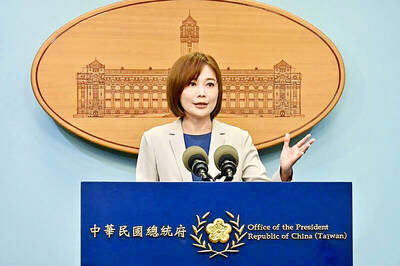
TIT-FOR-TAT: The US allegedly revoked the visa of a Chinese national working at Xinhua News Agency in the US in response to Beijing’s expulsion of Vivian Wang The Presidential Office yesterday condemned China for expelling a New York Times correspondent from Beijing following the newspaper’s interview with President William Lai (賴清德), saying the move highlighted Beijing’s suppression of press freedom and its threat to international news media. Taiwan has noted a series of recent incidents in which Beijing used similar tactics to “threaten and pressure international media outlets and journalists,” Presidential Office spokeswoman Karen Kuo (郭雅慧) said in a statement. “This concerns not only press freedom and freedom of expression, but also the safety of journalists, and Taiwan and relevant partners are paying close attention to the situation,” she


 RSS
RSS