


With their distinctive shaggy orange manes, pale blue faces and dense fur covering their hands and feet, it is hard to mistake China’s endangered golden snub-nosed monkeys for any other animal.
These rare and charismatic monkeys, unique to the frigid mountains of central China, have recently joined the country’s famous pandas as furry envoys to zoos in Europe for the first time — on loan for 10 years from the same government-overseen group that coordinates official panda exchanges.
As with “panda diplomacy,” some observers cheer new opportunities for scientific and conservation collaboration, while others raise concerns about the welfare of individual animal ambassadors transported around the world.
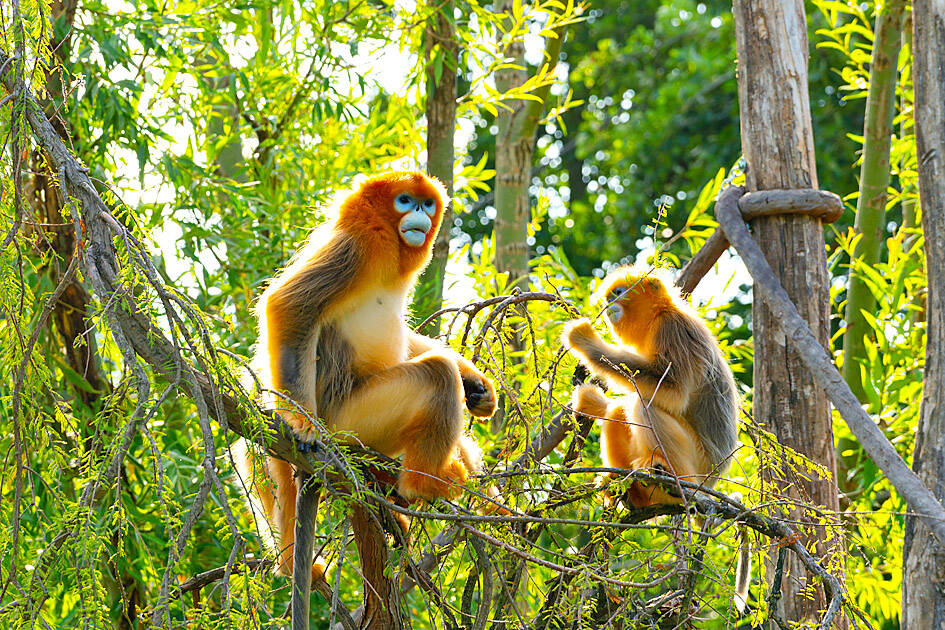
Photo: Pairi Daiza via AP
Three golden monkeys arrived at Beauval Zoo Saint-Aignan, France in April, following an agreement to mark the 60th anniversary of the establishment of diplomatic relations between China and France.
Another trio of golden monkeys arrived at the Pairi Daiza zoo in Brugelette, Belgium, in May.
After a monthlong quarantine, the two sets of monkeys made their public debuts.
So far, they appear to be in good health, adapting to new climates outside Asia for the first time, the zoos said.
At Pairi Daiza, the enclosure for the monkeys includes traditional Chinese gazebos with red columns and gray-tiled roofs, where the monkeys spend much of their time jumping between logs and rope ladders, and scrambling over roofs.
The hope is to build longstanding scientific exchanges between the zoos and Chinese authorities, Beauval Zoo communications director Anais Maury said.
The zoo is in discussions with China to launch joint research and conservation programs “similar to those already in place for other emblematic species like pandas,” Maury added.
Giant pandas and golden snub-nosed monkeys are endangered animals that are unique to China and can only be moved outside the country with approval from the central government, environmental historian Elena Songster said.
When pandas stepped, rolled, scratched and stumbled onto the world stage, they quickly became symbols of modern China — in part to due to their “cuddly cuteness” and deft diplomatic presentation, China historian Susan Brownell said.
The original soft power couple from from China was a pair of giant pandas sent to the Soviet Union in 1957 to celebrate the 40th anniversary of the October Revolution, which led to the establishment of the world’s first Communist state.
In 1972, a pair of pandas was sent to the US, following then-US president Richard Nixon’s historic visit to Beijing.
In 1984, China switched from gifting pandas to loaning them.
Following outcry from animal rights activists, China ended the practice of short-term loans and began longer leases, usually about a decade.
In an era of rising global tensions, “I think pandas are a really useful entryway,” China historian James Carter said. “Pandas open up an opportunity for people to think something positive about China — they’re cute, they don’t do anything bad.”
The golden snub-nosed monkeys now at zoos in France and Belgium are so far the only ones outside of Asia.
Brownell said that “China’s golden snub-nosed monkeys aren’t globally iconic yet, but there may be potential for them to be in the future.”

An American scientist convicted of lying to US authorities about payments from China while he was at Harvard University has rebuilt his research lab in Shenzhen, China, to pursue technology the Chinese government has identified as a national priority: embedding electronics into the human brain. Charles Lieber, 67, is among the world’s leading researchers in brain-computer interfaces. The technology has shown promise in treating conditions such as amyotrophic lateral sclerosis and restoring movement in paralyzed people. It also has potential military applications: Scientists at the Chinese People’s Liberation Army have investigated brain interfaces as a way to engineer super soldiers by boosting

Indonesian police have arrested 13 people after shocking images of alleged abuse against small children at a daycare center went viral, sparking outrage across the nation, officials said on Monday. Police on Friday last week raided Little Aresha, a daycare center in Yogyakarta on Java island, following a report from a former employee. CCTV footage circulating on social media showed children, most younger than two, lying on the floor wearing only diapers, their hands and feet bound with rags. The police have confirmed that the footage is authentic. Police said they also found 20 children crammed into a room just 3m by 3m. “So

A highway bomb attack in a restive region of southwestern Colombia on Saturday killed 14 people and injured at least 38, the latest spate of violence ahead of next month’s presidential election. Authorities blamed the attack in the Cauca department — a conflict-ridden, coca-growing region — on dissidents of the now-disbanded FARC guerrilla army, who have been sowing violence across the country. “Those who carried out this attack ... are terrorists, fascists and drug traffickers,” Colombian President Gustavo Petro said on social media. “I want our very best soldiers to confront them,” he added. The leftist leader blamed the bombing
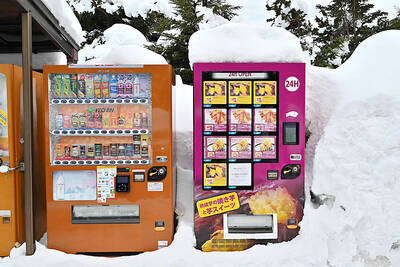
From post offices and parks to stations and even the summit of Mount Fuji, Japan’s vending machines are ubiquitous, but with the rapid pace of inflation cooling demand for their drinks, operators are being forced to rethink the business. Last month beverage giant DyDo Group Holdings announced it would remove about 20,000 vending machines — about 7 percent of their stock nationwide — by January next year, to “reconstruct a profitable network.” Pokka Sapporo Food & Beverage, based in Nagoya, also said last month it would sell its 40,000-machine operation to Osaka-based Lifedrink Co. “The strength of the vending machine


 RSS
RSS