


South Korea yesterday commenced its first large-scale military parade in a decade, with weapons ranging from ballistic missiles to attack helicopters due to roll through Seoul in a show of force as it takes a tougher stance against North Korea.
The parade marks the nation’s Armed Forces Day, normally a muted event relative to the massive events North Korea has staged under leader Kim Jong-un that include strategic weapons such as intercontinental ballistic missiles.
In a speech at Seoul Air Base, South Korean President Yoon Suk-yeol warned Pyongyang against the use of nuclear weapons, and pledged to ramp up support for the military and the defense industry.
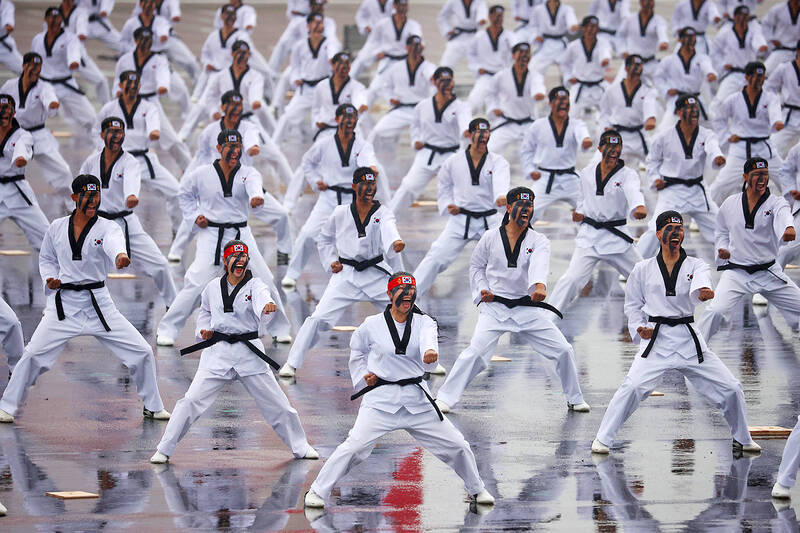
Photo: EPA-EFE
“If North Korea uses nuclear weapons, its regime will be brought to an end by an overwhelming response from the ROK-US alliance,” Yoon said while addressing troops in the rain.
The full-day event was to feature thousands of troops and South Korea’s home-grown tanks and self-propelled artillery, as well as attack aircraft and drones, joined by 300 of the 28,500 US troops based in the nation, the South Korean Ministry of National Defense said.
The highlight was to be a 2km parade through Seoul’s main commercial and business district to the bustling Gwanghwamun area that is the gate to a sprawling palace in the heart of Seoul.
South Korea last held a military street parade in 2013. The Armed Forces Day event and parade are being held before the actual day on Sunday, as it overlaps with a major national holiday this year.
The event comes as Yoon has taken a hawkish stance on North Korea, making displays of weapons and military drills a cornerstone of his strategy to counter North Korea’s evolving nuclear and missile programs.
Yoon has promised a swift and overwhelming response against any aggression by Pyongyang, and has actively reinforced a military alliance with Washington and Tokyo since taking office last year.
Yesterday’s parade began at the air base in Seongnam on the outskirts of Seoul, where Hyunmoo missiles, L-SAM missile interceptors and reconnaissance drones were among military hardware on display.
A flypast of F-35 jets and the nation’s first domestically developed fighter, the KF-21, was scrapped because of poor weather, the presidential office said.
Hyunmoo is one of South Korea’s latest missiles, which analysts say is an integral part of Seoul’s plans for striking North Korea during a conflict, while the L-SAM is designed to hit incoming missiles at altitudes of 50km to 60km.
The event was also to feature a joint flyover by South Korean and US military aircraft to demonstrate an “upgraded” combined defense posture, the ministry said.
The parade comes a week after Kim returned from a trip to Russia, during which he and Russian President Vladimir Putin agreed to boost military cooperation.
Yoon has said that if Russia helped North Korea enhance its weapons programs in return for assistance for its war in Ukraine, it would be “a direct provocation.”

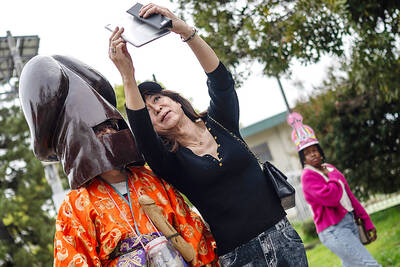
Showcasing phallus-shaped portable shrines and pink penis candies, Japan’s annual fertility festival yesterday teemed with tourists, couples and families elated by its open display of sex. The spring Kanamara Matsuri near Tokyo features colorfully dressed worshipers carrying a trio of giant phallic-shaped objects as they parade through the street with glee. The festival, as legend has it, honors a local blacksmith in the Edo Period (1603-1868) who forged an iron dildo to break the teeth of a sharp-toothed demon inhabiting a woman’s vagina that had been castrating young men on their wedding nights. A 1m black steel phallus sits in the courtyard of
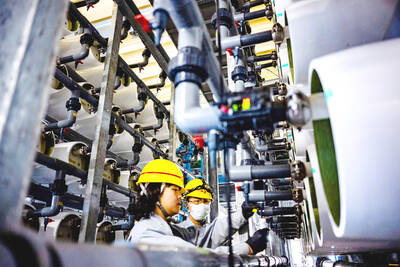
HIGH HOPES: The power source is expected to have a future, as it is not dependent on the weather or light, and could be useful for places with large desalination facilities A Japanese water plant is harnessing the natural process of osmosis to generate renewable energy that could one day become a common power source. The possibility of generating power from osmosis — when water molecules pass from a less salty solution to a more salty one — has long been known. However, actually generating energy from that has proved more complicated, in part due the difficulty of designing the membrane through which the molecules pass. Engineers in Fukuoka, Japan, and their private partners think they might have cracked it, and have opened what is only the world’s second osmotic power plant. It generates
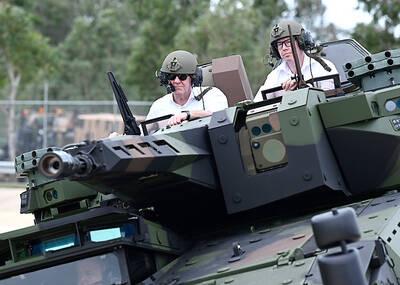
JAN. 1 CLAUSE: As military service is voluntary, applications for permission to stay abroad for over three months for men up to age 45 must, in principle, be granted A little-noticed clause in sweeping changes to Germany’s military service policy has triggered an uproar after it emerged that the law requires men aged up to 45 to get permission from the armed forces before any significant stay abroad, even in peacetime. The legislation, which went into effect on Jan. 1 aims to bolster the military and demands all 18-year-old men fill out a questionnaire to gauge their suitability to serve in the armed forces, but stops short of conscription. If the “modernized” model fails to pull in enough recruits, parliament will be compelled to discuss the reintroduction of compulsory service, German

Hundreds of Filipinos and tourists flocked to a sun-bleached field north of Manila yesterday, on Good Friday, to witness one of the country’s most blood-soaked displays of religious fervor, undeterred by rising fuel prices. Scores of bare-chested flagellants with covered faces walked barefoot through the dusty streets of Pampanga Province’s San Fernando as they flogged their backs with bamboo whips in the scorching heat. Agence France-Presse (AFP) journalists said they saw devotees deliberately puncturing their skin with glass shards attached to a small wooden paddle to ensure their bleeding during the ritual, a way to atone for sins and seek miracles from


 RSS
RSS