


China has reserved offshore airspace in the Yellow Sea and East China Sea from March 27 to May 6, issuing alerts usually used to warn of military exercises, although no such exercises have been announced, the Wall Street Journal (WSJ) reported yesterday.
Reserving such a large area for 40 days without explanation is an “unusual step,” as military exercises normally only last a few days, the paper said.
These alerts, known as Notice to Air Missions (Notams), “are intended to inform pilots and aviation authorities of temporary airspace hazards or restrictions,” the article said.
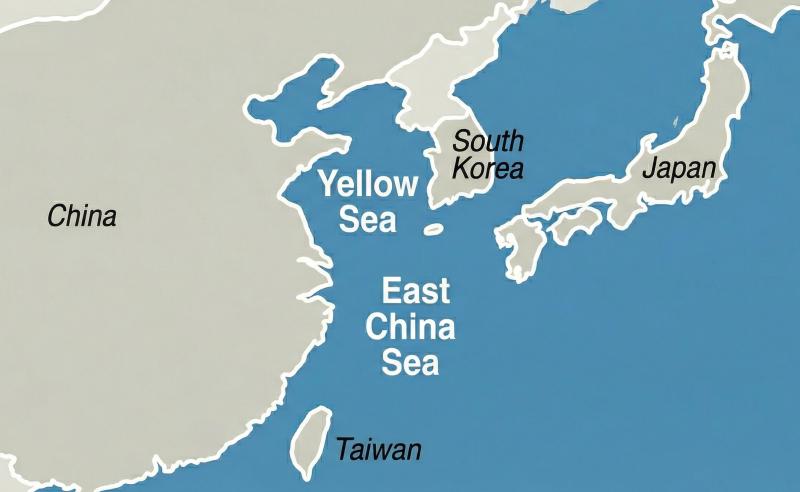
The airspace reserved in the alert is hundreds of kilometers north of Taiwan and extends south from the Yellow Sea facing South Korea, to waters of the East China Sea facing Japan, it said citing information from the US Federal Aviation Administration.
The reserved airspace has no vertical ceiling, which is designated within Notams as SFC-UNL.
While civil aviation seems unaffected, it would take coordination for aircraft to transit such areas, the report said.
“What makes this especially notable is the combination of SFC-UNL with an extraordinary 40-day duration — and no announced exercise,” said Ray Powell, director of Stanford University’s SeaLight Project, which tracks Chinese maritime activity.
“That suggests not a discrete exercise, but a sustained operational readiness posture — and one that China apparently doesn’t feel the need to explain,” Powell told the WSJ.
If the reserved airspace is in fact linked to exercises, it “would represent a meaningful shift in how Beijing uses airspace control as a tool of military signaling,” he said.
China’s Ministry of National Defense and Civil Aviation Administration have not issued statements about the Notams and did not respond to requests for comment, the report said, adding this is not unusual.
Past Chinese drills have focused on controlling routes that could be used by the US military in the event of a conflict over Taiwan, it said.
The reserved airspace could “provide an opportunity to practice the kinds of air combat maneuvers that would be required in such a scenario,” US Naval War College China Maritime Studies Institute director Christopher Sharman told the WSJ.
China could be increasing its active military presence while US attention is focused on the conflict in the Middle East, the article said, citing a senior Taiwanese security official.
The airspace reservation is “clearly aimed at Japan,” as China attempts to deter US allies and erode US military influence in the Indo-Pacific region, the official told the paper.
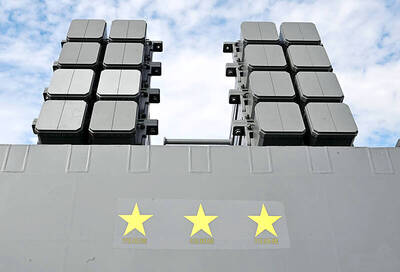
UPGRADE: The Kang Ding-class frigate is replacing its Chaparall missiles with Tien Chien II and Hua Yang VLS, which would provide it with long-range, 360° air defense Taiwan plans to produce 1,200 to 1,376 Hai Chien II missiles (海劍二, Sea Sword II) — also known as TC-2N — to serve as the standard air defense system of the navy’s surface combatant fleet, a source said yesterday. Last week, the Hai Chien II, the naval version of the Tien Kung II missile (天劍二, Sky Sword II), completed a live-fire test in waters off the National Chungshan Institute of Science and Technology’s Jiupeng facility (九鵬) in Pingtung County’s Manjhou Township (滿州). The MIM72 Chaparral and other dated air defense missiles that currently arm Taiwanese ships have inadequate range to combat Chinese

REASONS FOR TRAVEL: An assistant professor said that proposed amendments to penalize drivers if they used drugs overseas would not deter people from traveling People who operate a motor vehicle under the influence of marijuana would have their driver’s license revoked, even if they used the substance while overseas, the Ministry of Transportation and Communications said yesterday, citing proposed amendments to the Road Traffic Management and Penalty Act (道路交通管理處罰條例). The amendments would also authorize the government to revoke the licenses of people determined to have used Category 1 or Category 2 narcotics, even if they were not operating a vehicle while under the influence of drugs, as well as ban them from taking the license test for three years, the ministry said. People aged 18 or

GLOBALGIVING: ‘ Caving to external pressure is not acceptable for an organization that has cultivated justice reform and human rights for 30 years,’ one NGO said A slew of non-government organizations (NGOs) have withdrawn from the GlobalGiving fundraising platform after it announced it would use “Chinese Taipei” instead of “Taiwan” from next month. The Taiwan Good Rice Association wrote on Facebook on Friday that it was informed on April 28 via a teleconference call of the change, which was made because the platform wanted to operate in China. Taiwan Good Rice is to terminate all cooperative relationships with GlobalGiving in response to the platform’s “unilateral and non-negotiable” decision to remove references to Taiwan, the NGO said. “Taiwan is in the official name of Taiwan Good Rice Association and the

HEAVY WEATHER: Typhoon Jangmi is due to crash straight into the Ryukyus as airlines look to shift flights to larger aircraft or cancel flights to Okinawa entirely Taiwan’s international air carriers announced flight adjustments over the weekend as Typhoon Jangmi is forecast to hit the Ryukyu Islands today and tomorrow. The Central Weather Administration (CWA) upgraded Jangmi from a tropical storm to a typhoon at 8am yesterday, with the eye located 580km south of Naha city. It was moving north at 19kph. Today, China Airlines’ CI-120, CI-121, CI-122 and CI-123 flights between Taoyuan and Naha, Okinawa, have been canceled as well as CI-132 and CI-133 between Kaohsiung and Naha. EVA Air’s BR-112, BR-113, BR-186 and BR-185 flights between Taoyuan and Naha are also canceled. Low-cost carrier Tigerair Taiwan canceled IT-230,


 RSS
RSS