


Showcasing phallus-shaped portable shrines and pink penis candies, Japan’s annual fertility festival yesterday teemed with tourists, couples and families elated by its open display of sex.
The spring Kanamara Matsuri near Tokyo features colorfully dressed worshipers carrying a trio of giant phallic-shaped objects as they parade through the street with glee.
The festival, as legend has it, honors a local blacksmith in the Edo Period (1603-1868) who forged an iron dildo to break the teeth of a sharp-toothed demon inhabiting a woman’s vagina that had been castrating young men on their wedding nights.

Photo: AFP
A 1m black steel phallus sits in the courtyard of the Kanayama Shrine honoring the Shinto deities of fertility, childbirth and protection from sexually transmitted infections.
Over the centuries, sex workers pilgrimaged to the shrine to seek its powers of protection before the festival evolved into a broader fertility rite seeking to destigmatize sex.
“I hope the festival can help disabuse people of the notion that sex is a bad, dirty thing,” said Hiroyuki Nakamura, chief priest at a shrine that hosts the festival.

Photo: AFP
In February, preliminary data released by the Japanese Ministry of Health, Labor and Welfare showed that the nation’s birthrate last year had fallen for the 10th consecutive year.
The open-minded, all-inclusive annual event attracts everyone from tourists to families with children and LGBTQ supporters sporting rainbow outfits.
“It feels like it’s more than just ha-ha sex. There’s a whole understanding behind it,” said Jimmy Hsu, 32, a tourist from San Francisco, referring to the event’s underlying fertility theme.
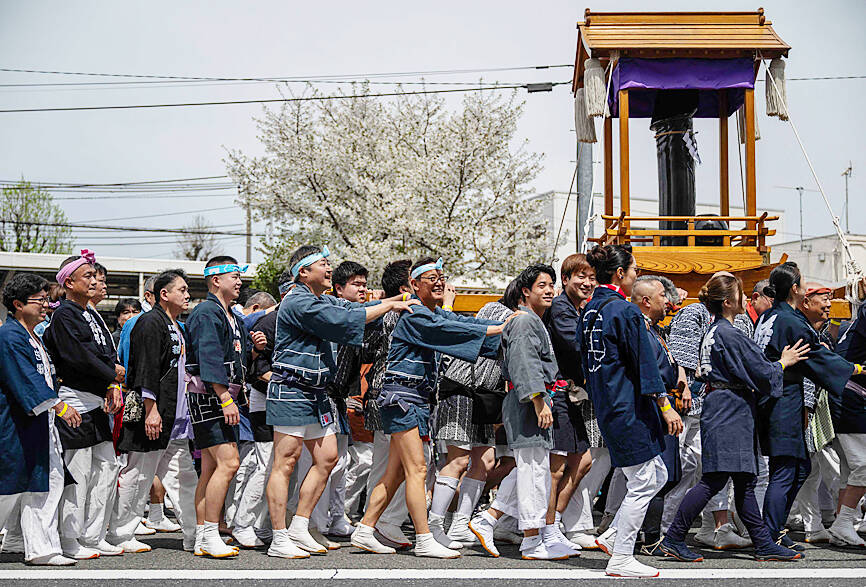
Photo: AFP
Despite the penis-themed T-shirts, toys and candies galore, “I think by American standards, this is so wholesome,” he said.
The view was echoed by Julie Ibach, 58.
“There was one little boy who had two penis stickers, and he’s just going back and forth, and we just were laughing,” the tourist from San Diego said.
“Everyone is embracing it and making fun of it,” she said. “You don’t see that anywhere else.”

Young Chinese, many who fear age discrimination in their workplace after turning 35, are increasingly starting “one-person companies” that have artificial intelligence (AI) do most of the work. Smaller start-ups are already in vogue in Silicon Valley and elsewhere, with rapidly advancing AI tools seen as a welcome teammate even as they threaten layoffs at existing firms. More young people in China are subscribing to the model, as cities pledge millions of dollars in funding and rent subsidies for such ventures, in alignment with Beijing’s political goal of “technological self-reliance.” “The one-person company is a product of the AI era,” said Karen Dai

South Korea’s air force yesterday apologized for a 2021 midair collision involving two fighter jets, a day after auditors said the pilots were taking selfies and filming during the flight and held them responsible for the accident. “We sincerely apologize to the public for the concern caused by the accident that occurred in 2021,” an air force spokesman told a news conference, adding that one of the pilots involved had been suspended from flying duties, received severe disciplinary action and has since left the military. The apology followed a report released on Wednesday by the South Korean Board of Audit and Inspection,

About 240 Indians claiming descent from a Biblical tribe landed at Tel Aviv airport on Thursday as part of a government operation to relocate them to Israel. The newcomers passed under a balloon arch in blue and white, the colors of the Israeli flag, as dozens of well-wishers welcomed them with a traditional Jewish song. They were the first “bnei Menashe” (“sons of Manasseh”) to arrive in Israel since the government in November last year announced funding for the immigration of about 6,000 members of the community from the states of Manipur and Mizoram in northeast India. The community claims to descend from

‘TROUBLING’: The firing of Phelan, who was an adviser to a nonprofit that supported the defense of Taiwan, was another example of ‘dysfunction’ under Trump, a US senator said US Secretary of the Navy John Phelan has been fired, a US official and a person familiar with the matter said on Wednesday, in another wartime shakeup at the Pentagon coming just weeks after US Secretary of Defense Pete Hegseth ousted the Army’s top general. The Pentagon announced his departure in a brief statement, saying he was leaving the administration “effective immediately,” but it did not provide a reason or say whether it was his decision to go. The sources, who spoke on condition of anonymity, said Phelan was dismissed in part because he was moving too slowly to implement reforms to


 RSS
RSS