


China on Wednesday teased in a video an aircraft carrier that could be its fourth, and the first using nuclear power, while making an allusion to Taiwan and vowing to further build up its islands, as it looks to boost maritime power, secure resources and bolster territorial claims.
The video, issued on the eve of the 77th founding anniversary of the Chinese People’s Liberation Army Navy, featured fictional officers with names that are homophones of three commissioned aircraft carriers, the Liaoning (遼寧), Shandong (山東) and Fujian (福建).
Titled Into the Deep, it showed a 19-year-old named “Hejian” (何劍) joining the group, sparking public speculation that it was referring to a nuclear-powered aircraft carrier, as the navy recruit’s name is a homophone of “nuclear vessel” (hejian, 核艦) in Mandarin.
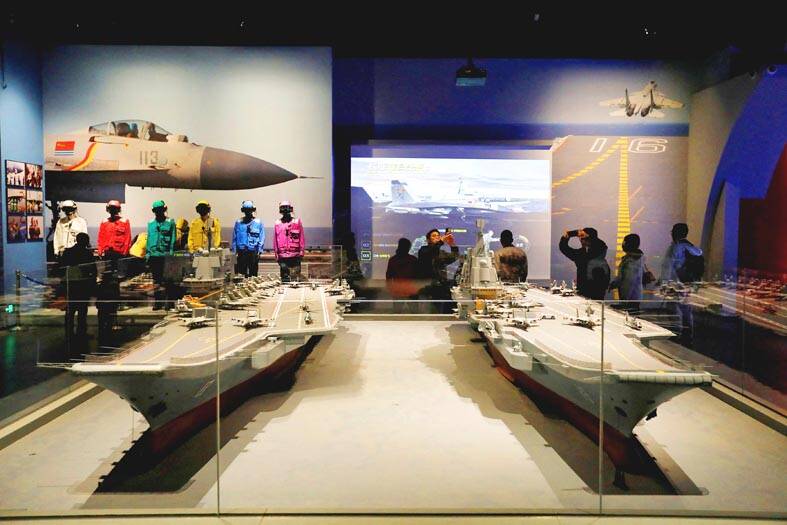
Photo: Reuters
The three aircraft carriers in service are all conventionally powered, carrying sequential pennant numbers 16, 17 and 18. The new recruit’s age, 19, suggests “Hejian” would conform to the numbering convention.
The Chinese Ministry of National Defense did not immediately respond to requests for comment on the video.
Beijing is spending billions of dollars to build a “bluewater navy” allowing it to project power far from its shores, a goal dating from 2012, when Chinese President Xi Jinping (習近平) became leader of the Chinese Communist Party.
Action sequences in the video featured military drills and strikes in the Pacific, but it also sent a message to Taiwan.
The video showed an exchange between a naval officer and his son “Xiaowan” (小灣), the latter’s name an allusion to Taiwan.
“I don’t want to go home just yet. I want to play out a little longer,” the boy says.
His father responds: “Xiaowan, don’t be difficult. Mom is waiting for you at home. Let’s go home.”
The Chinese Ministry of Natural Resources, in an article published in the official People’s Daily, urged greater efforts to “protect” the more than 11,000 islands China claims.
The vast majority of them are within 100km of the coast, with nearly 60 percent in the East China Sea, about 30 percent in the South China Sea and the rest in the Bohai and Yellow seas, an official Chinese tally showed in 2018.
China has built artificial islands, airstrips and military facilities during extensive land reclamation efforts over the years in disputed waters in the South China Sea.
Beijing in September last year declared a national nature reserve at the disputed Scarborough Shoal (Huangyan Island, 黃岩島), claimed by Taiwan and the Philippines, to assert its claim to the atoll, a long-time flash point with the Philippines.
“The facilities on its artificial island bases have allowed Chinese law enforcement, naval and militia vessels to spend every day of the year patrolling the waters of its neighbors up to 1,000 nautical miles (1,852km) from the Chinese coastline,” said Gregory Poling, director of the Southeast Asia Program and the Asia Maritime Transparency Initiative at the US-based Center for Strategic and International Studies.
The Philippines, the US and partner nations started military drills this week, including maritime operations, across the Philippine archipelago.
The exercises project a multinational front against China in a region that is a conduit for more than US$3 trillion in annual ship-borne commerce.
“Beijing seems to have hit a point of diminished returns,” Poling said.
“It has not succeeded in stopping a single Southeast Asian energy project, resupply or construction mission, or the like, in at least four years,” he said.

‘NO SECURITY RISK’: The Railway Bureau reassured the public that the technicians’ activities were limited to technical guidance and did not involve sensitive systems The Railway Bureau yesterday said it had invited eight Chinese technicians to assist with an airport MRT construction project. The bureau issued the confirmation after an Internet user said Chinese nationals had entered the construction zone of Taiwan Taoyuan International Airport’s Terminal 3 project. They asked why “individuals from an enemy state” were allowed access to such a major national infrastructure project, which raised serious concerns over Taiwan’s industrial safety, sensitive systems and information security. The bureau’s Northern Region Engineering Branch Office said subcontractor Taiwan Handle Industrial Co (台灣手把工業) of the Taoyuan airport MRT’s “Contract No. CU05 Project A14 Station Civil, MEP &

A US uncrewed surface vessel (USV) encountered multiple Chinese warships during an autonomous transit of the Taiwan Strait, US defense company Seasats said in a statement on Wednesday. Seasats announced that a Lightfish USV had completed the first autonomous transit of the Taiwan Strait. Over five days, the USV traversed the entire length of the Strait while constantly monitoring surface vessel traffic, the company said. The Lightfish encountered multiple Chinese warships, one of which was a Chinese People’s Liberation Army Navy (PLAN) Type 056 corvette, it said. The Chinese vessels were operating “well within Taiwan’s exclusive economic zone without transmitting their identity via the
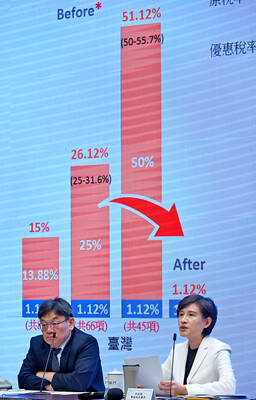
GREATER REACH? Auto parts and wood products would face tariffs of up to 15%, matching those targeting the EU, Japan and South Korea, Vice Premier said The US has announced that preferential tariff treatment for Taiwan’s non-semiconductor Section 232 goods would take effect retroactively from May 1, the Executive Yuan said yesterday. The US government yesterday posted a notice on the Federal Register’s public inspection Web site previewing tariff concessions for Taiwan under a memorandum of understanding (MOU) on Taiwan-US investment after two months of negotiations. The MOU signed on Jan. 15 stipulated three major preferential tariff arrangements: a 15 percent “reciprocal” tariff rate for Taiwan without stacking most-favored nation (MFN) rates; preferential Section 232 treatment for semiconductors and related products; and preferential Section 232 treatment for non-semiconductor

TIT-FOR-TAT: The US allegedly revoked the visa of a Chinese national working at Xinhua News Agency in the US in response to Beijing’s expulsion of Vivian Wang The Presidential Office yesterday condemned China for expelling a New York Times correspondent from Beijing following the newspaper’s interview with President William Lai (賴清德), saying the move highlighted Beijing’s suppression of press freedom and its threat to international news media. Taiwan has noted a series of recent incidents in which Beijing used similar tactics to “threaten and pressure international media outlets and journalists,” Presidential Office spokeswoman Karen Kuo (郭雅慧) said in a statement. “This concerns not only press freedom and freedom of expression, but also the safety of journalists, and Taiwan and relevant partners are paying close attention to the situation,” she


 RSS
RSS