


A Japanese water plant is harnessing the natural process of osmosis to generate renewable energy that could one day become a common power source.
The possibility of generating power from osmosis — when water molecules pass from a less salty solution to a more salty one — has long been known. However, actually generating energy from that has proved more complicated, in part due the difficulty of designing the membrane through which the molecules pass.
Engineers in Fukuoka, Japan, and their private partners think they might have cracked it, and have opened what is only the world’s second osmotic power plant.
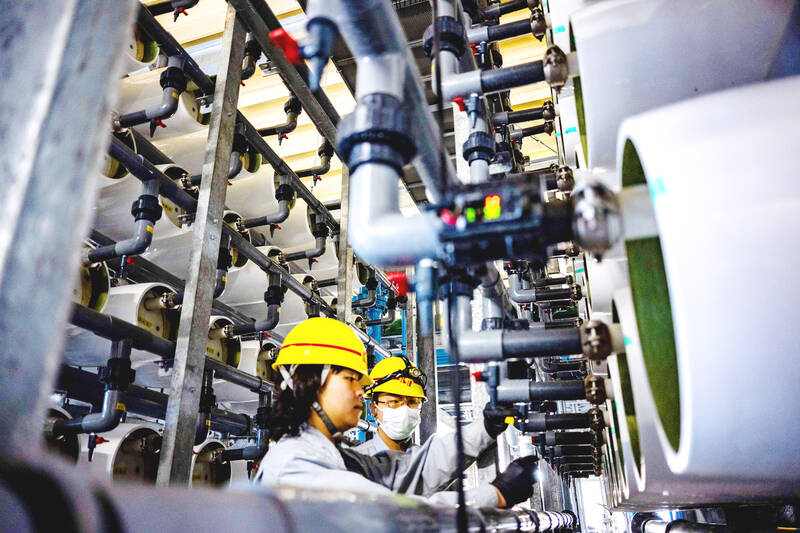
Photo: AFP
It generates power from the transfer of molecules between treated sewage water and concentrated seawater, a waste product from the city’s desalination plant.
“If osmotic power generation technology advances to the point where it can be practically used with ordinary seawater... this, in turn, would represent a major contribution to efforts against global warming,” Sea Water Desalination Plant manager Kenji Hirokawa said.
Fukuoka is particularly well-placed to benefit from the technology, because it has a readily available source of extremely salty water — the brine leftover from desalination.
With no major rivers to sufficiently source its water, the city and the wider Fukuoka region have relied on a major desalination plant to produce drinking water since 2005. That left the city with large quantities of concentrated saline waste water to deal with.
Ordinarily it is diluted and released back to the sea. Previous attempts to find alternatives, including salt making, failed to gain traction.
Then, engineering firm Kyowakiden Industry approached the city about harnessing the salty wastewater for osmotic power.
“When our company rolls this out as a business, we aim to build plants roughly five to 10 times the scale of this current facility,” Kyowakiden research and development manager Tetsuro Ueyama said.
In Fukuoka’s system, a generator is attached to a local desalination plant located near a sewage treatment facility.
It draws in highly saline wastewater from the desalination plant and receives treated sewage.
The two separate streams of liquid go through a number of chambers separated by semi-permeable membranes through which water molecules travel from the treated sewage toward the salty water.
That process increases the volume, pressure and speed of the saline water flow, spinning a turbine that generates electricity before the now-diluted mixture is discharged to sea.
The ¥700 million (US$4.38 million) power generation system came online in August last year, and once running at full capacity, it should generate up to 880,000 kilowatts annually, equivalent to the electricity consumption of 300 households.
It would remain devoted to supplying the power-thirsty facility, although it covers just a tiny fraction of its energy needs.
However, the engineers involved are dreaming big.
The system would go through a five-year test to monitor its performance, including costs and maintenance, particularly for the membrane and other parts exposed to salt.
Financial details of the project have not been disclosed, but engineers said that for now, the system’s power costs “a lot more” than either fossil fuel or renewable energy.
Pumping the water into the system also uses energy itself, and scaling up osmotic power for grid-level energy production has not yet been done anywhere in the world.
Still, officials and experts believe the power source has a future, saying that unlike solar and wind, it is not dependent on weather or light.
And the current high costs are partly because the company had to build a one-of-a-kind power plant, Ueyama said.
Osmotic power has often been seen as primarily useful for estuary areas, where freshwater river flows meet the salty ocean.
However, Ueyama said the technique being used in Japan could be useful for countries with large desalination facilities such as Saudi Arabia and other Middle Eastern nations.
Kyowakiden is also working on technology that could generate similar power levels from less salty regular seawater.

SPEAKING OUT: After Siranudh Scott’s allegations surfaced, celebrities and public figures took to social media to share their own experiences of sexual misconduct and abuse A high-profile alleged sexual abuse case within a wealthy Thai beer brewing family has prompted a wave of painful accounts from survivors of unconnected abuse in the conservative nation. Siranudh Scott, a member of the billionaire Thai family that founded the ubiquitous Singha beer brand, posted an emotional video this month accusing his elder brother Sunit of repeatedly abusing him when he was a teenager. Sunit, who is in his 30s, later denied the allegations in a video posted online, but Singha parent Boonrawd dismissed him from his executive role with the company on Tuesday last week. “I felt I needed to speak

SEEKING ORDER: Rodrigo Paz said that ‘anyone who wants to destroy the nation will have to deal with this president and the full force of the constitution’ Bolivian President Rodrigo Paz on Wednesday said that the nation was at a “breaking point” after nearly a month of protests that have caused shortages of food, fuel and medicine. Paz, who took office six months ago amid the worst economic crisis there in four decades, is battling a groundswell of fury over his policies. The political capital, La Paz, has been besieged by low-income workers and members of the indigenous majority calling for his resignation. “The country needs order and is reaching breaking point,” the 58-year-old said at a public event in La Paz, renewing his appeal for dialogue. On Tuesday, the Bolivian

‘CROSSING THE LINE’: China’s embassy in Seoul criticized US Forces Korea Commander General Xavier Brunson, asking if his ‘hostile’ remarks were authorized by Washington South Korea and the US are in talks over recent public remarks by the commander of US Forces Korea, Seoul’s presidential office said yesterday, after the comments drew sharp criticism from China. In a recent podcast interview, US Forces Korea Commander General Xavier Brunson described South Korea as “the dagger in the heart of Asia” from China’s east coast, prompting the Chinese embassy in Seoul to say that he had “truly crossed the line.” The interview came amid growing speculation that Washington might seek to expand the role of US Forces Korea in countering the growing regional influence of China, a key

Forecasters in Europe yesterday warned of exceptional heat as record temperatures driven by a “heat dome” push temperatures well above seasonal norms across the continent. The surge follows a record-breaking Monday, with France logging its hottest day in the month of May on record, its weather agency said, and the UK also posting unprecedented highs. A so-called “heat dome” of warm air from northern Africa trapped under a high-pressure system over western Europe is behind the high temperatures not usually seen until high summer. Restrictions on outdoor work were imposed in parts of Italy, beaches in southwest France filled earlier than usual and


 RSS
RSS