


More than 6,000 Taiwanese students have participated in exchange programs in China over the past two years, despite the Mainland Affairs Council’s (MAC) “orange light” travel advisory, government records showed.
The MAC’s publicly available registry showed that Taiwanese college and university students who went on exchange programs across the Strait numbered 3,592 and 2,966 people respectively.
The National Immigration Agency data revealed that 2,296 and 2,551 Chinese students visited Taiwan for study in the same two years.
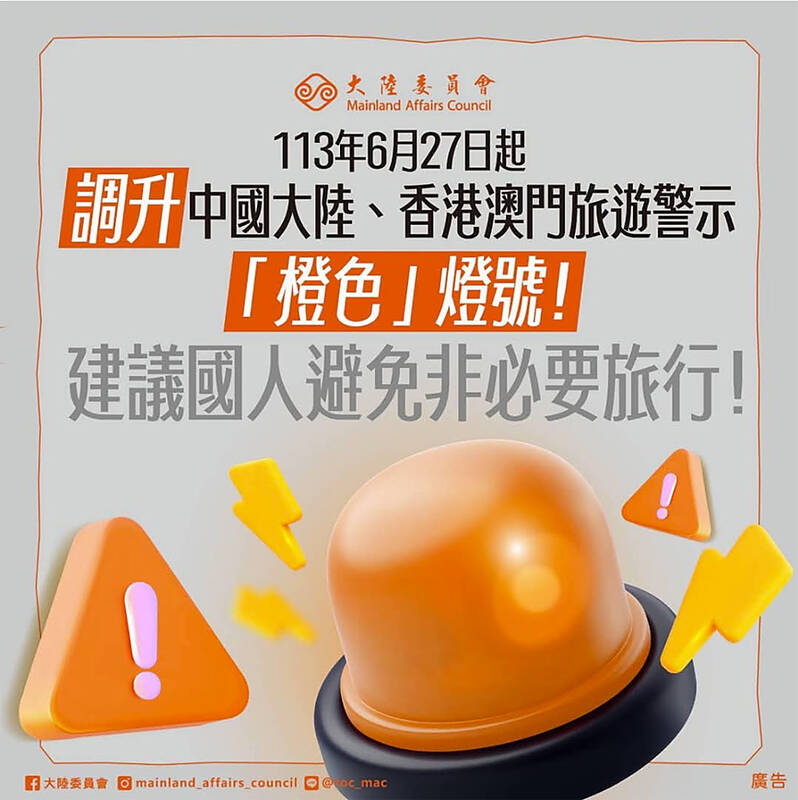
Photo: Screen grab from the MAC’s Facebook page
A review of the Web sites of publicly-run universities and colleges showed that Taiwanese higher education institutions continued to recruit students for Chinese educational programs without posting government warnings of the dangers to Taiwanese nationals.
For example, National Chengchi University (NCCU) not only launched an all-university recruiting initiative to send students to China, but also offered scholarships and held three workshops with returning students to boost recruitment to the program.
The privately-owned Kainan University was more circumspect and its Web site did not neglect to include the council’s travel advisory and safety guidelines to warn students of running afoul of China’s national security laws.
In response, NCCU said its study abroad programs have always prioritized student safety and complied with government laws and regulations, and that students are briefed on safety tips and advisories before leaving.
The university emphasized that it sends 300 students to sister schools across the globe a year, far more than the 20 to 30 students who go to China.
The school’s administration continues to work with the government to enhance student safety without contravening the autonomy of students with regard to making decisions about their academic careers, it said.
When asked, an official speaking for the Ministry of Education said it has repeatedly warned universities and colleges about the dangers of sending students to China as part of a collaboration with the MAC.
The ministry has created an online platform for higher education institutions to regularly report on their academic exchange programs in China to mitigate the risks to national security, confidential research and student safety, they said.
Taiwanese educators are urged to keep their guard up when it comes to being invited to events that could be turned into propaganda or create an opening for the infiltration of Taiwan, they said.

Yangmingshan National Park authorities yesterday urged visitors to respect public spaces and obey the law after a couple was caught on a camera livestream having sex at the park’s Qingtiangang (擎天崗) earlier in the day. The Shilin Police Precinct in Taipei said it has identified a suspect and his vehicle registration number, and would summon him for questioning. The case would be handled in accordance with public indecency charges, it added. The couple entered the park at about 11pm on Thursday and began fooling around by 1am yesterday, the police said, adding that the two were unaware of the park’s all-day live

Fast food chain McDonald's is to raise prices by up to NT$5 on some products at its restaurants across Taiwan, starting on Wednesday next week, the company announced today. The prices of all extra value meals and sharing boxes are to increase by NT$5, while breakfast combos and creamy corn soup would go up by NT$3, the company said in a statement. The price of the main items of those meals, if ordered individually, would remain the same. Meanwhile, the price of a medium-sized lemon iced tea and hot cappuccino would rise by NT$3, extra dipping sauces for chicken nuggets would go up
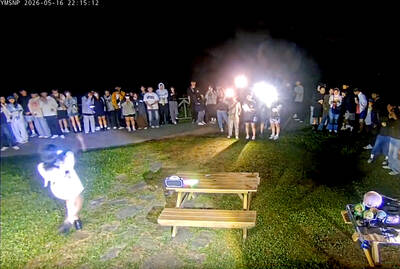
Yangmingshan National Park’s Qingtiangang (擎天崗) nature area has gone viral after a park livestream camera observed a couple in the throes of intimate congress, which was broadcast live on YouTube, drawing large late-night crowds and sparking a backlash over noise, bright lights and disruption to wildlife habitat. The area’s livestream footage appeared to show a couple engaging in sexual activity on a picnic table in the park on Friday last week, with the uncensored footage streamed publicly online. The footage quickly spread across social media, prompting a tide of visitors to travel to the site to “check in” and recreate the

Minister of Digital Affairs Lin Yi-ching (林宜敬) yesterday cited regulatory issues and national security concerns as an expert said that Taiwan is among the few Asian regions without Starlink. Lin made the remarks on Facebook after funP Innovation Group chief executive officer Nathan Chiu (邱繼弘) on Friday said Taiwan and four other countries in Asia — China, North Korea, Afghanistan and Syria — have no access to Starlink. Starlink has become available in 166 countries worldwide, including Ukraine, Malaysia, the Philippines and Vietnam, in the six years since it became commercial, he said. While China and North Korea block Starlink, Syria is not


 RSS
RSS