


Hundreds of Filipinos and tourists flocked to a sun-bleached field north of Manila yesterday, on Good Friday, to witness one of the country’s most blood-soaked displays of religious fervor, undeterred by rising fuel prices.
Scores of bare-chested flagellants with covered faces walked barefoot through the dusty streets of Pampanga Province’s San Fernando as they flogged their backs with bamboo whips in the scorching heat.
Agence France-Presse (AFP) journalists said they saw devotees deliberately puncturing their skin with glass shards attached to a small wooden paddle to ensure their bleeding during the ritual, a way to atone for sins and seek miracles from God.
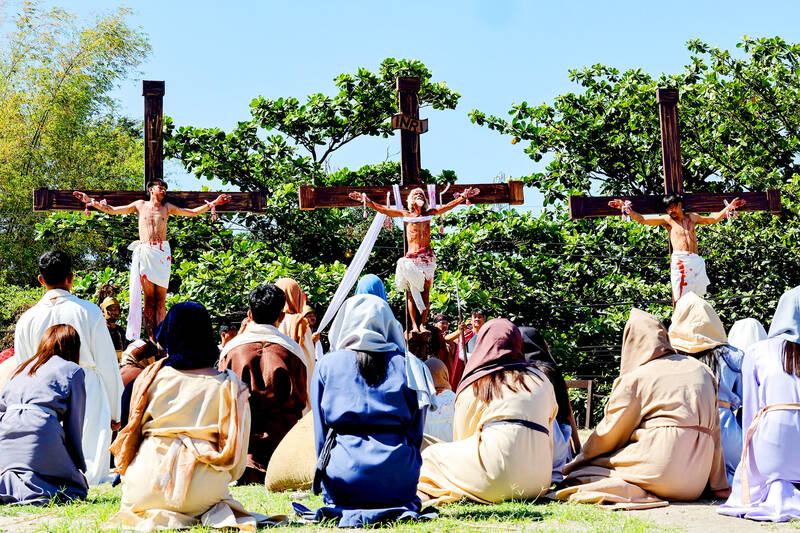
Photo: EPA
“I’m doing this to pray for the healing of my seven-month-old baby, who is suffering from pneumonia,” flagellant John David said.
“My grandfather started this, then my father, and now it’s my turn,” he said. “I have been witnessing miracles of healing through the years because of this act of faith.”
The Catholic-majority country’s annual spectacle re-enacting the last moments of Jesus Christ typically draws up to 12,000 local and foreign tourists.
Many in the crowd had driven for hours to witness the play’s climax, in which devotees allow three-inch nails to be driven into their palms before they are hoisted upright on crosses.
Ricky Margate, 57, told AFP he had driven a motorcycle to the site this year instead of his car, because it consumes less fuel.
“I think that the high fuel prices that I have to pay to be here are just part of my sacrifices this Holy Week,” Margate said
Fuel prices have hit historic highs in the country since the US and Israel launched their attack on Iran, prompting Philippine President Ferdinand Marcos to declare a “national energy emergency.”
Businesswoman Gina Villanueva said she had driven 70km from Manila to “experience seeing this devotion firsthand.”
“[I am praying] for good health and also for the fuel prices to go down, because many are already suffering,” Villanueva said.
Snack vendor Mhekyle Salazar said she was relieved that pilgrims were showing up despite higher transportation costs.
“I guess fuel prices are no match for the strength of our faith and tradition,” she said.

SPEAKING OUT: After Siranudh Scott’s allegations surfaced, celebrities and public figures took to social media to share their own experiences of sexual misconduct and abuse A high-profile alleged sexual abuse case within a wealthy Thai beer brewing family has prompted a wave of painful accounts from survivors of unconnected abuse in the conservative nation. Siranudh Scott, a member of the billionaire Thai family that founded the ubiquitous Singha beer brand, posted an emotional video this month accusing his elder brother Sunit of repeatedly abusing him when he was a teenager. Sunit, who is in his 30s, later denied the allegations in a video posted online, but Singha parent Boonrawd dismissed him from his executive role with the company on Tuesday last week. “I felt I needed to speak

SEEKING ORDER: Rodrigo Paz said that ‘anyone who wants to destroy the nation will have to deal with this president and the full force of the constitution’ Bolivian President Rodrigo Paz on Wednesday said that the nation was at a “breaking point” after nearly a month of protests that have caused shortages of food, fuel and medicine. Paz, who took office six months ago amid the worst economic crisis there in four decades, is battling a groundswell of fury over his policies. The political capital, La Paz, has been besieged by low-income workers and members of the indigenous majority calling for his resignation. “The country needs order and is reaching breaking point,” the 58-year-old said at a public event in La Paz, renewing his appeal for dialogue. On Tuesday, the Bolivian
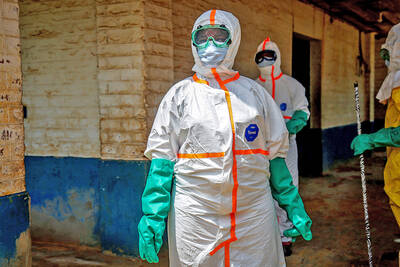
COMMUNITY CONFLICT: Concerns about disease spread from corpses has run up against friends and families’ desire to bury their dead as infection spreads in the area Angry residents of a town at the epicenter of the Ebola outbreak in the Democratic Republic of the Congo (DR Congo) attacked and burned a tent that was part of a health center where people are being treated for the virus, the staff there said Saturday. It was the second such attack in the region in a week. No one was hurt in the attack, according to reports but as patients ran out to escape the fire, 18 people with suspected Ebola infections fled the facility and are unaccounted for, a hospital director said. Angry residents arrived at the clinic in the

Forecasters in Europe yesterday warned of exceptional heat as record temperatures driven by a “heat dome” push temperatures well above seasonal norms across the continent. The surge follows a record-breaking Monday, with France logging its hottest day in the month of May on record, its weather agency said, and the UK also posting unprecedented highs. A so-called “heat dome” of warm air from northern Africa trapped under a high-pressure system over western Europe is behind the high temperatures not usually seen until high summer. Restrictions on outdoor work were imposed in parts of Italy, beaches in southwest France filled earlier than usual and


 RSS
RSS