


Siswanto was a down-on-his-luck mechanic until his improbable pivot to Internet videos turned his neighbors into stars and vaulted his poor farming community into the limelight as Indonesia’s “YouTube Village.”
The rags-to-riches tale begins four years ago, as he struggled to keep his auto shop business afloat in Kasegeran — a remote town in Java that most Indonesians would struggle to find on a map. He was cash-strapped and desperate for extra income to feed his growing family, but side jobs scavenging junk and soybean farming were not earning enough to pay the bills.
Siswanto eventually tried publishing short comedy routines over Kasegeran’s glacial Internet connection after watching a TV show about an Indonesian influencer who made big money through online videos.
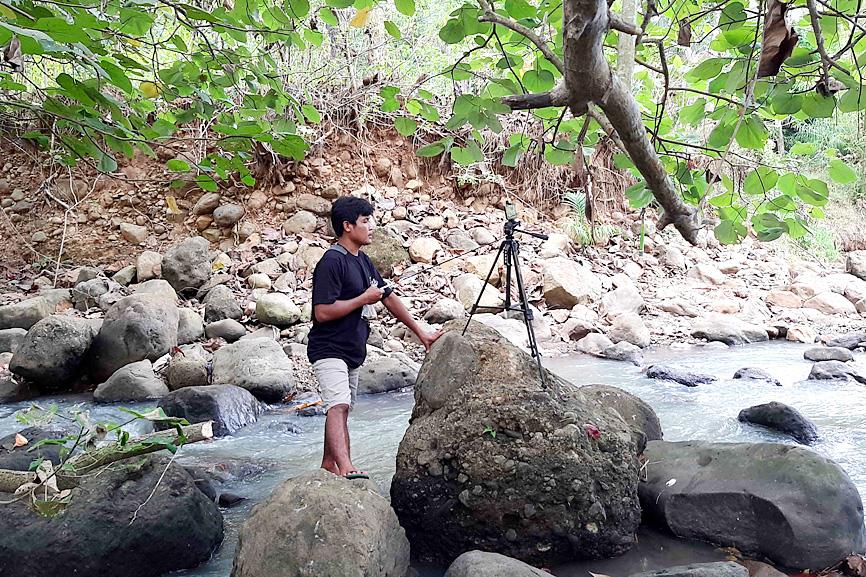
Photo: AFP
“But nobody watched them so I stopped,” said the 38-year-old, who like many Indonesians goes by one name.
He decided that it was not his “fate to earn a living” that way until, one day, he was struggling to fix a customer’s pricey motorbike and turned to online videos for help.
“Even as a mechanic I couldn’t understand them,” he said. “They were too complicated.”
A light bulb went off — Siswanto decided to make his own easy to follow fix-it videos.
Pawning the cellphone he shared with his pregnant wife, the mechanic upgraded and started filming non-stop.
“I was shaking and talking gibberish,” he said of his early videos — but after a few years, Siswanto had built up an audience of more than 2 million YouTube subscribers.
He keeps up a hectic schedule with a small editing team, pumping out videos of him fixing bikes or idyllic fishing trips at a local river.
Siswanto’s booming business, which he said can make his family up to 150 million rupiah (US$10,000) each month, did not go unnoticed for long in the village.
Rumors swirled that the cashed-up mechanic was dealing in black magic, and some parents barred their kids from his shop fearing they would be sacrificed for the dark arts.
“So there was a sit-down in the village meeting hall and I explained that I have this business called YouTube,” Siswanto said.
“Most of them had never heard of it,” he said.
He offered free lessons to prove his story, and now at least 30 others in Kasegeran have built their own channels, some with hundreds of thousands of viewers.
Among them was Tirwan, a 45-year-old snack seller who used to make 50,000 rupiah a day hawking doughy dumplings known as cilok.
These days, he films himself showing off his cooking skills or hunting for graveyard ghosts, a big hit in the Southeast Asian archipelago where supernatural beliefs are widespread.
However, he did not immediately take to the spooky job.
“I was scared to go to the cemetery even during the day, let alone at night,” Tirwan said.
The extra earnings bought a faster Internet connection for Kasegeran, helping kids take classes online after Indonesia closed its schools to fight the COVID-19 pandemic. It has also been a big boost for local pride.
“Kasegeran was the poorest village in the whole subdistrict, but now we’re able to compete with other villages,” said community head Saifuddin, who also goes by one name.
“It’s an inspiration for the young people too. They’re not using their cellphones for useless things anymore. They can earn money from them,” he added.
Kasegeran’s homegrown heroes say there’s no magic to their success.
“It’s not an empty dream as long are you’re willing to learn and work hard,” Siswanto said. “And you have to be consistent.”


Showcasing phallus-shaped portable shrines and pink penis candies, Japan’s annual fertility festival yesterday teemed with tourists, couples and families elated by its open display of sex. The spring Kanamara Matsuri near Tokyo features colorfully dressed worshipers carrying a trio of giant phallic-shaped objects as they parade through the street with glee. The festival, as legend has it, honors a local blacksmith in the Edo Period (1603-1868) who forged an iron dildo to break the teeth of a sharp-toothed demon inhabiting a woman’s vagina that had been castrating young men on their wedding nights. A 1m black steel phallus sits in the courtyard of

HIGH HOPES: The power source is expected to have a future, as it is not dependent on the weather or light, and could be useful for places with large desalination facilities A Japanese water plant is harnessing the natural process of osmosis to generate renewable energy that could one day become a common power source. The possibility of generating power from osmosis — when water molecules pass from a less salty solution to a more salty one — has long been known. However, actually generating energy from that has proved more complicated, in part due the difficulty of designing the membrane through which the molecules pass. Engineers in Fukuoka, Japan, and their private partners think they might have cracked it, and have opened what is only the world’s second osmotic power plant. It generates

JAN. 1 CLAUSE: As military service is voluntary, applications for permission to stay abroad for over three months for men up to age 45 must, in principle, be granted A little-noticed clause in sweeping changes to Germany’s military service policy has triggered an uproar after it emerged that the law requires men aged up to 45 to get permission from the armed forces before any significant stay abroad, even in peacetime. The legislation, which went into effect on Jan. 1 aims to bolster the military and demands all 18-year-old men fill out a questionnaire to gauge their suitability to serve in the armed forces, but stops short of conscription. If the “modernized” model fails to pull in enough recruits, parliament will be compelled to discuss the reintroduction of compulsory service, German

Hundreds of Filipinos and tourists flocked to a sun-bleached field north of Manila yesterday, on Good Friday, to witness one of the country’s most blood-soaked displays of religious fervor, undeterred by rising fuel prices. Scores of bare-chested flagellants with covered faces walked barefoot through the dusty streets of Pampanga Province’s San Fernando as they flogged their backs with bamboo whips in the scorching heat. Agence France-Presse (AFP) journalists said they saw devotees deliberately puncturing their skin with glass shards attached to a small wooden paddle to ensure their bleeding during the ritual, a way to atone for sins and seek miracles from


 RSS
RSS