


Japan and South Korea yesterday grappled with surging COVID-19 cases and growing public frustration as Japan’s prime minister suspended a contentious travel subsidy program, while an anxious South Korean president warned of harsh curbs.
Japan reported more than 3,000 new cases on Saturday, yet another record as winter set in, with infections worsening in Tokyo, the northern island of Hokkaido and the city of Osaka.
However, Japan, with a focus on the economic costs, has steered clear of tough lockdowns. It tackled its first wave of infections in the spring by asking people to refrain from going out and for businesses to close or curtail operating hours.
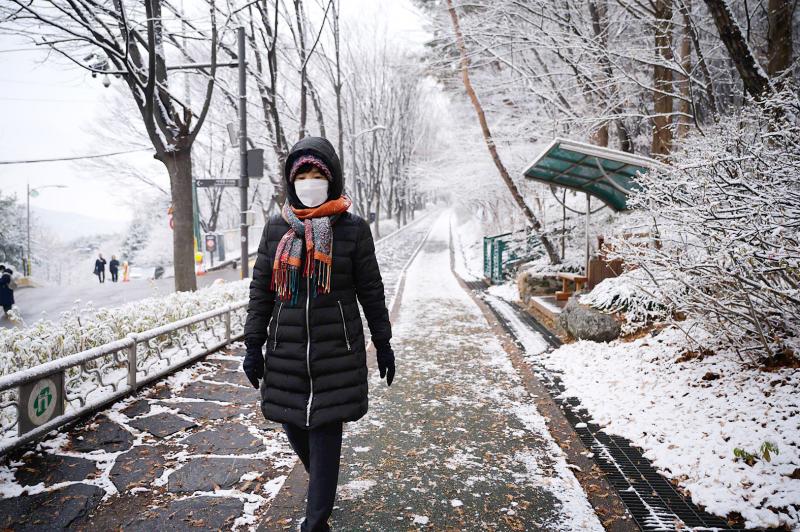
Photo: AFP
The Japanese government has suspended the travel subsidy program, dubbed “Go To Travel,” from Dec. 28 to Jan. 11 nationwide, local media reported yesterday, responding to concerns about its effects on the spread of COVID-19.
Media had widely reported earlier that the suspension would cover only the hardest-hit cities and regions such as Tokyo, and Nagoya, in central Japan.
South Korean President Moon Jae-in also faces sliding ratings as clusters of new infections fuel criticism over what many see as slack containment.
South Korea reported a new daily record of 1,030 infections on Sunday, a big worry for a country for months held up as a mitigation success story, but still a fraction of the tallies being seen in some European countries and the US, where vaccines are being rolled out. It reported 718 new cases yesterday.
Few Asian countries expect to receive significant amounts of COVID-19 vaccines in coming weeks as they manage distribution schedules, allow time to check for any inoculation side effects elsewhere or run their own late-stage trials.
Instead, they are counting on the methods that have largely kept infections in check for months — ahead of the curve testing, stringent travel curbs, strict social distancing and masks.
China, for instance, where the novel coronavirus emerged almost a year ago, has managed to limit new cases with tough, sweeping action.
It locked down an area of more than 250,000 people after half a dozen cases were confirmed near the Russian border in Heilongjiang Province, the Associated Press reported yesterday.
South Korea has warned that coronavirus restrictions might be raised to the highest phase 3 level, which would essentially mean a lockdown for the first time in Asia’s fourth-largest economy.
In Seoul, schools would close from today, a step toward the imposition of phase 3.
In Japan, which is hoping to stage the postponed summer Olympics next year, testing has remained relatively low, peaking at about 50,000 in one day recently.
Testing in Tokyo, which has the capacity for more than 60,000, is now about 9,000 a day.
Meanwhile, South Korea has aggressively ramped up testing to about 89,000 people a day as of Sunday, compared with just more than 22,000 in early October.
Additional reporting by AP

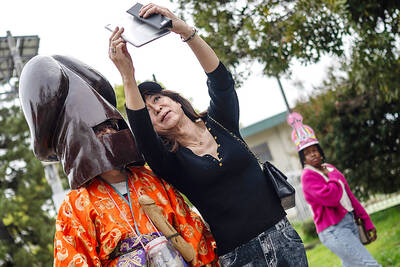
Showcasing phallus-shaped portable shrines and pink penis candies, Japan’s annual fertility festival yesterday teemed with tourists, couples and families elated by its open display of sex. The spring Kanamara Matsuri near Tokyo features colorfully dressed worshipers carrying a trio of giant phallic-shaped objects as they parade through the street with glee. The festival, as legend has it, honors a local blacksmith in the Edo Period (1603-1868) who forged an iron dildo to break the teeth of a sharp-toothed demon inhabiting a woman’s vagina that had been castrating young men on their wedding nights. A 1m black steel phallus sits in the courtyard of
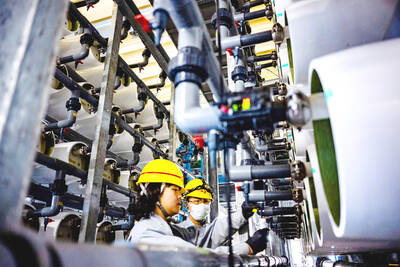
HIGH HOPES: The power source is expected to have a future, as it is not dependent on the weather or light, and could be useful for places with large desalination facilities A Japanese water plant is harnessing the natural process of osmosis to generate renewable energy that could one day become a common power source. The possibility of generating power from osmosis — when water molecules pass from a less salty solution to a more salty one — has long been known. However, actually generating energy from that has proved more complicated, in part due the difficulty of designing the membrane through which the molecules pass. Engineers in Fukuoka, Japan, and their private partners think they might have cracked it, and have opened what is only the world’s second osmotic power plant. It generates

JAN. 1 CLAUSE: As military service is voluntary, applications for permission to stay abroad for over three months for men up to age 45 must, in principle, be granted A little-noticed clause in sweeping changes to Germany’s military service policy has triggered an uproar after it emerged that the law requires men aged up to 45 to get permission from the armed forces before any significant stay abroad, even in peacetime. The legislation, which went into effect on Jan. 1 aims to bolster the military and demands all 18-year-old men fill out a questionnaire to gauge their suitability to serve in the armed forces, but stops short of conscription. If the “modernized” model fails to pull in enough recruits, parliament will be compelled to discuss the reintroduction of compulsory service, German

Hundreds of Filipinos and tourists flocked to a sun-bleached field north of Manila yesterday, on Good Friday, to witness one of the country’s most blood-soaked displays of religious fervor, undeterred by rising fuel prices. Scores of bare-chested flagellants with covered faces walked barefoot through the dusty streets of Pampanga Province’s San Fernando as they flogged their backs with bamboo whips in the scorching heat. Agence France-Presse (AFP) journalists said they saw devotees deliberately puncturing their skin with glass shards attached to a small wooden paddle to ensure their bleeding during the ritual, a way to atone for sins and seek miracles from


 RSS
RSS