


As Japan’s next prime minister, Japanese Chief Cabinet Secretary Yoshihide Suga is to face an early, and difficult, leadership decision: whether to call a general election before his honeymoon with voters fades or wait and risk seeing ratings slide.
The decision would affect Suga’s chances of holding office beyond the remainder of Japanese Prime Minister Shinzo Abe’s term, which expires next year.
A successful early election might also help him gain momentum to push his agenda, including deregulation and smashing bureaucratic silos.
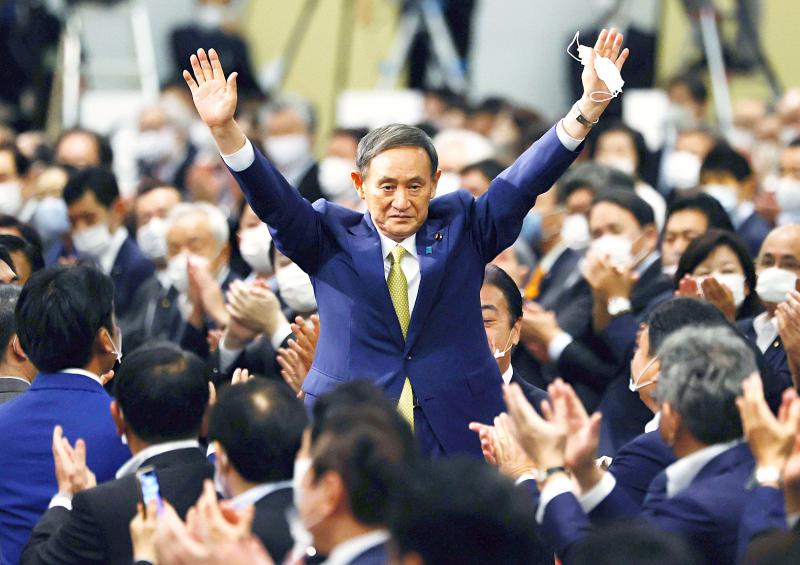
Photo: Kyodo via Reuters
Suga won the ruling Liberal Democratic Party’s (LDP) leadership poll on Monday, and the party’s parliamentary majority means he is virtually guaranteed to replace Abe, who is resigning after nearly eight years as prime minister because of illness.
Suga on Monday acknowledged that the question of timing for a lower house election was a tough call amid worries about COVID-19 and a slumping economy.
A poll for the powerful chamber must be held by late October next year.
Twelve years ago, then-Japanese prime minister Taro Aso was expected to call a snap election soon after taking office while his ratings were relatively high. He waited, his popularity declined and when he called an election in 2009, the LDP lost power for three years.
The memory of that trauma lingers, although the LDP’s opposition is far weaker now.
“There’s only a year left, so the timing of when to dissolve the lower house is a vexing problem,” Suga told a news conference on Monday after the LDP vote.
Speculation has swirled that Suga would call a lower house poll for as early as next month.
Aso, now minister of finance, yesterday said that an early election should be considered, because the Tokyo Olympics would be held next year.
Suga on Monday sounded cautious on the idea, saying that his priorities were to end the COVID-19 outbreak and revive the economy.
A robust LDP election performance would boost Suga’s chances of winning a full three-year term next year.
Long seen as more of a backroom operator than a top leader, Suga’s ratings have jumped since he began running for the LDP post.
Some party insiders fear that his rise could be short-lived.
“Mr Suga is good at making deals, but he’s not especially talented at answering questions in parliament,” said one LDP senior official, speaking on condition of anonymity because of the sensitivity of the matter.
Scenarios floated for an early election include Oct. 25, Nov. 1 and Dec. 6, which is Suga’s birthday.
An early poll would also diminish chances the LDP would lose seats because the newly unified opposition would have less time to prepare.
“Objectively, it is certain that sooner is better for the LDP,” independent political analyst Atsuo Ito said.
Abe’s success in leading the LDP to big wins in six national elections — aided by a weak opposition and low turnout — was key to his tenure as the nation’s longest-serving prime minister. Before Abe, Japan suffered a succession of short-lived leaders.
The LDP’s junior coalition partner, Komeito, is against an early election, and opinion polls show the public is more focused on steps to fight COVID-19 and reboot the economy than going to the polls.
Voter surveys measuring Suga’s popularity after he takes office following today’s parliamentary vote could guide the decision.
“It’s true calls in the LDP for an early election are growing, but Suga is cautious,” said Tomoaki Iwai, a professor at Nihon University, a private research university in Tokyo. “We have to see the opinion polls.”

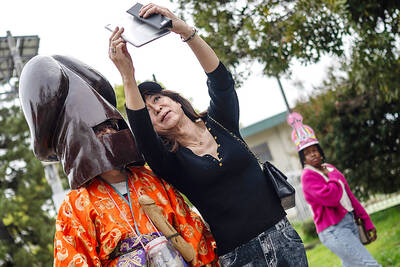
Showcasing phallus-shaped portable shrines and pink penis candies, Japan’s annual fertility festival yesterday teemed with tourists, couples and families elated by its open display of sex. The spring Kanamara Matsuri near Tokyo features colorfully dressed worshipers carrying a trio of giant phallic-shaped objects as they parade through the street with glee. The festival, as legend has it, honors a local blacksmith in the Edo Period (1603-1868) who forged an iron dildo to break the teeth of a sharp-toothed demon inhabiting a woman’s vagina that had been castrating young men on their wedding nights. A 1m black steel phallus sits in the courtyard of

HIGH HOPES: The power source is expected to have a future, as it is not dependent on the weather or light, and could be useful for places with large desalination facilities A Japanese water plant is harnessing the natural process of osmosis to generate renewable energy that could one day become a common power source. The possibility of generating power from osmosis — when water molecules pass from a less salty solution to a more salty one — has long been known. However, actually generating energy from that has proved more complicated, in part due the difficulty of designing the membrane through which the molecules pass. Engineers in Fukuoka, Japan, and their private partners think they might have cracked it, and have opened what is only the world’s second osmotic power plant. It generates

JAN. 1 CLAUSE: As military service is voluntary, applications for permission to stay abroad for over three months for men up to age 45 must, in principle, be granted A little-noticed clause in sweeping changes to Germany’s military service policy has triggered an uproar after it emerged that the law requires men aged up to 45 to get permission from the armed forces before any significant stay abroad, even in peacetime. The legislation, which went into effect on Jan. 1 aims to bolster the military and demands all 18-year-old men fill out a questionnaire to gauge their suitability to serve in the armed forces, but stops short of conscription. If the “modernized” model fails to pull in enough recruits, parliament will be compelled to discuss the reintroduction of compulsory service, German

Hundreds of Filipinos and tourists flocked to a sun-bleached field north of Manila yesterday, on Good Friday, to witness one of the country’s most blood-soaked displays of religious fervor, undeterred by rising fuel prices. Scores of bare-chested flagellants with covered faces walked barefoot through the dusty streets of Pampanga Province’s San Fernando as they flogged their backs with bamboo whips in the scorching heat. Agence France-Presse (AFP) journalists said they saw devotees deliberately puncturing their skin with glass shards attached to a small wooden paddle to ensure their bleeding during the ritual, a way to atone for sins and seek miracles from


 RSS
RSS