


Heavy rains hit parts of Pakistan for a fifth straight night, bringing more flooding to the nation’s financial capital Karachi and towns and villages and leaving at least 63 people dead, Pakistani officials said on Friday, while rescuers evacuated people from flooded neighborhoods.
About 75cm of rain have fallen in Karachi since Sunday last week, when monsoon rains began lashing the city in the southern Sindh province, forcing the municipal authorities to use boats to evacuate people trapped in flooded streets.
Forty-seven people were killed in the city of 15 million people in rain-related incidents, said provincial Chief Minister Murad Ali Shah.
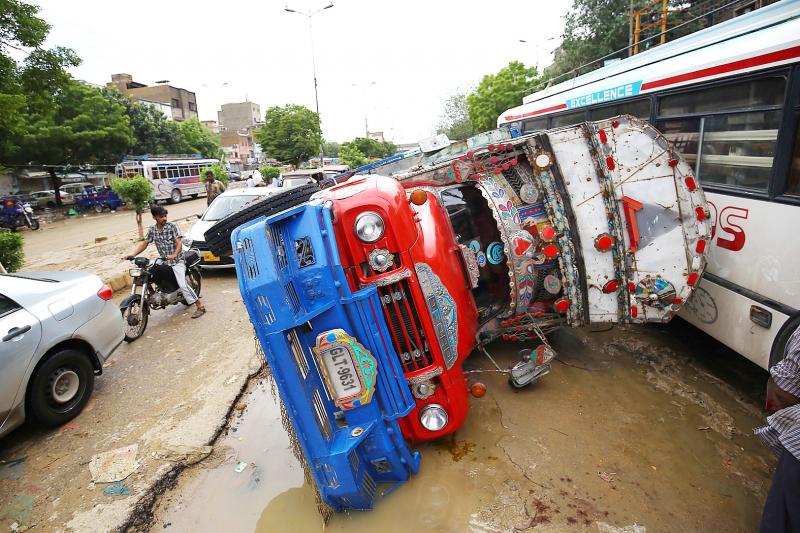
Photo: EPA-EFE
Authorities are working day and night to help rain-affected people in the city and elsewhere in the province, he added.
At least 16 people were killed in the northwestern province of Khyber Pakhtunkhwa due to overnight flash flooding, provincial Disaster Management Authority spokesman Taimur Ali said.
As downed power lines caused widespread electrical outages in Karachi, some workers stayed at their offices and others spent the night in open areas because there was no transportation to get home.
Hundreds of vehicles were dragged along city streets by powerful flood waters.
Pakistan’s military said it provided food to at least 10,000 people, and dozens of relief camps were set up for residents. Troops also repaired embankments of a swollen canal by which floodwaters entered the city.
Eight of those killed in Karachi died when a wall fell on them in a residential area.
More than 150 people have died in various parts of Pakistan since June in rain-related incidents and many residents were angry with authorities for not helping them.
The monsoon rains are hitting Pakistan at a time when authorities are trying to contain the spread of COVID-19, which has caused more than 6,283 deaths since February.
Pakistan on Friday reported nine more deaths from the virus.
Every year, many cities in Pakistan struggle to cope with the annual monsoon deluge, which usually lasts until September, drawing widespread criticism about poor urban planning.

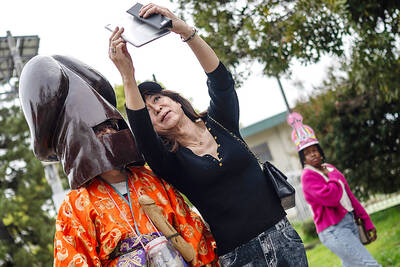
Showcasing phallus-shaped portable shrines and pink penis candies, Japan’s annual fertility festival yesterday teemed with tourists, couples and families elated by its open display of sex. The spring Kanamara Matsuri near Tokyo features colorfully dressed worshipers carrying a trio of giant phallic-shaped objects as they parade through the street with glee. The festival, as legend has it, honors a local blacksmith in the Edo Period (1603-1868) who forged an iron dildo to break the teeth of a sharp-toothed demon inhabiting a woman’s vagina that had been castrating young men on their wedding nights. A 1m black steel phallus sits in the courtyard of

HIGH HOPES: The power source is expected to have a future, as it is not dependent on the weather or light, and could be useful for places with large desalination facilities A Japanese water plant is harnessing the natural process of osmosis to generate renewable energy that could one day become a common power source. The possibility of generating power from osmosis — when water molecules pass from a less salty solution to a more salty one — has long been known. However, actually generating energy from that has proved more complicated, in part due the difficulty of designing the membrane through which the molecules pass. Engineers in Fukuoka, Japan, and their private partners think they might have cracked it, and have opened what is only the world’s second osmotic power plant. It generates

JAN. 1 CLAUSE: As military service is voluntary, applications for permission to stay abroad for over three months for men up to age 45 must, in principle, be granted A little-noticed clause in sweeping changes to Germany’s military service policy has triggered an uproar after it emerged that the law requires men aged up to 45 to get permission from the armed forces before any significant stay abroad, even in peacetime. The legislation, which went into effect on Jan. 1 aims to bolster the military and demands all 18-year-old men fill out a questionnaire to gauge their suitability to serve in the armed forces, but stops short of conscription. If the “modernized” model fails to pull in enough recruits, parliament will be compelled to discuss the reintroduction of compulsory service, German

Hundreds of Filipinos and tourists flocked to a sun-bleached field north of Manila yesterday, on Good Friday, to witness one of the country’s most blood-soaked displays of religious fervor, undeterred by rising fuel prices. Scores of bare-chested flagellants with covered faces walked barefoot through the dusty streets of Pampanga Province’s San Fernando as they flogged their backs with bamboo whips in the scorching heat. Agence France-Presse (AFP) journalists said they saw devotees deliberately puncturing their skin with glass shards attached to a small wooden paddle to ensure their bleeding during the ritual, a way to atone for sins and seek miracles from


 RSS
RSS