


Astride his white mare, a wide-brimmed hat shielding his eyes, Ridwan Sururi looks more cowboy than librarian as he winds toward the hilltop village, his horse Luna saddled with books.
Their arrival sends ripples of excitement through Serang, a quiet hamlet fringed by rice fields and a volcano on Indonesia’s main island of Java.
“The horse library!” children shout, sprinting toward the mosque where Luna is tethered. Slung over her saddle are two handmade wooden boxes filled with books.
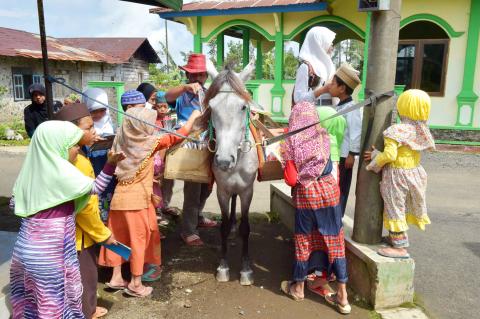
Photo: AFP
For many there, this unique mobile library is their only link to books. There is no traditional library nearby, and stores are kilometers away in big cities. It is a problem for villages across the sprawling Indonesian archipelago.
Sururi, a 43-year-old professional horse groomer, devised a unique way to encourage reading in his district.
Armed with Luna, one of several horses under his care, and about 100 books donated from a friend, Sururi began road-testing his novel mobile library early this year, unsure if it would succeed.
It was a huge hit.
In no time, the father of four was fielding requests from schools and villages further afield, eager crowds greeting him on arrival.
“The kids are always waiting for my horse and I,” Sururi told reporters. “Sometimes they even form a queue, waiting a very long time just to borrow a book.”
In Serang, enthusiastic youngsters flick through picture books, young adult titles and even some classics in English. Some shyly pet Luna while waiting their turn to browse.
Sururi believes the gentle nature of his six-year-old mare helps attract children, and pique an early interest in the books.
“The horse makes me happy,” said 10-year-old Arif, who like many Indonesians goes by one name, before settling in to read a book titled Wild Animals.
However, it is not just children discovering a love for reading via this charitable community library.
Adults are almost just as enthusiastic, many pausing work and emerging from their homes as Sururi and Luna pass through the narrow lanes of one village.
Warianti, 17, perusing titles alongside her elderly mothers, said villagers of all ages benefited from Sururi’s visits, as most did not have time to source books elsewhere.
“The horse library helps increase the knowledge of local women through reading,” she told reporters.
Adult literacy rates in Indonesia have climbed steadily in recent years, reaching nearly 96 percent in 2013, according to data from the Indonesian Ministry of Education and Culture.
However, some provinces remain far behind others. Central Java, where Sururi makes his rounds, is lagging in the bottom third nationwide.
Nearly 5 percent — or close to 1 million — of adults in the mainly rural province remain illiterate. Sururi is aware of this, growing up in Central Java without access to a great deal of books. However, the altruistic stable hand never underestimated the importance of reading, leading to his free-of-charge mobile book loaning service.
“That’s the aim of the horse library, so that everyone can broaden their horizons, gain knowledge, become more intelligent,” he said.
Outside his simple home, Sururi has cleared an area where he dreams of building a permanent library, one stocked with many books and — perhaps one day — a computer.
However, for now, everything is done by hand. The spines of all books are clearly labeled with a code for identification and he keeps meticulous records so books are returned on time.
Like a conventional library, books can be borrowed free of charge, but cannot be loaned forever.
In Serang, Sururi checks his notebook and tells one boy he needs to first return an outstanding title before loaning another. The young student sprints off home, returning a short while later clutching the forgotten item, relieved to see his pick of choice remains untouched on the shelf.
Once the flurry of borrowing is over, the children settle down in small circles, bearing their new books with pride as Sururi packs up for another week.
Soon the air is filled with the sound of dozens of children reading aloud, older pupils helping their younger friends with difficult words or phrases.
“When I see kids chasing my horse I feel so proud,” Sururi said. “I feel like I’m needed, and that’s hugely satisfying.”

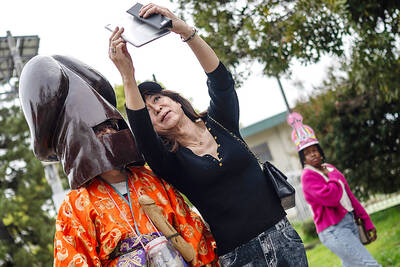
Showcasing phallus-shaped portable shrines and pink penis candies, Japan’s annual fertility festival yesterday teemed with tourists, couples and families elated by its open display of sex. The spring Kanamara Matsuri near Tokyo features colorfully dressed worshipers carrying a trio of giant phallic-shaped objects as they parade through the street with glee. The festival, as legend has it, honors a local blacksmith in the Edo Period (1603-1868) who forged an iron dildo to break the teeth of a sharp-toothed demon inhabiting a woman’s vagina that had been castrating young men on their wedding nights. A 1m black steel phallus sits in the courtyard of

HIGH HOPES: The power source is expected to have a future, as it is not dependent on the weather or light, and could be useful for places with large desalination facilities A Japanese water plant is harnessing the natural process of osmosis to generate renewable energy that could one day become a common power source. The possibility of generating power from osmosis — when water molecules pass from a less salty solution to a more salty one — has long been known. However, actually generating energy from that has proved more complicated, in part due the difficulty of designing the membrane through which the molecules pass. Engineers in Fukuoka, Japan, and their private partners think they might have cracked it, and have opened what is only the world’s second osmotic power plant. It generates

JAN. 1 CLAUSE: As military service is voluntary, applications for permission to stay abroad for over three months for men up to age 45 must, in principle, be granted A little-noticed clause in sweeping changes to Germany’s military service policy has triggered an uproar after it emerged that the law requires men aged up to 45 to get permission from the armed forces before any significant stay abroad, even in peacetime. The legislation, which went into effect on Jan. 1 aims to bolster the military and demands all 18-year-old men fill out a questionnaire to gauge their suitability to serve in the armed forces, but stops short of conscription. If the “modernized” model fails to pull in enough recruits, parliament will be compelled to discuss the reintroduction of compulsory service, German

Hundreds of Filipinos and tourists flocked to a sun-bleached field north of Manila yesterday, on Good Friday, to witness one of the country’s most blood-soaked displays of religious fervor, undeterred by rising fuel prices. Scores of bare-chested flagellants with covered faces walked barefoot through the dusty streets of Pampanga Province’s San Fernando as they flogged their backs with bamboo whips in the scorching heat. Agence France-Presse (AFP) journalists said they saw devotees deliberately puncturing their skin with glass shards attached to a small wooden paddle to ensure their bleeding during the ritual, a way to atone for sins and seek miracles from


 RSS
RSS