


As the spooked elephant starts to run, the vet pulls the trigger. Just a few minutes later the huge beast slumps to the floor unconscious, ready for Ivory Coast’s first elephant relocation.
These hunters are not interested in the elephant’s ivory. Instead, they want to protect people from the animal — and vice-versa — around Daloa, a town in the center of the country where humans and elephants have recently come into conflict.
This is because the animals’ local habitat, the Marahoue National Park, has been eaten away bit by bit by agriculture.
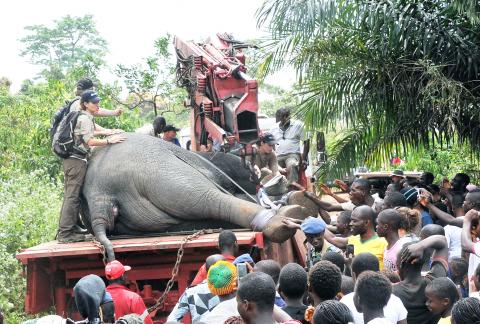
Photo: AFP
“The forest was devastated and the animals fled the park,” said Ibo Nahonain, head of Tapeguhe Village just outside Daloa. “Gradually they came here.”
Life with the 5 tonne beasts has its upsides and downsides.
“Sometimes they come within 100m of the village and everyone goes out to have a look at them,” Nahonain said.
“But the women and children who have to go out to the fields go with fear in their hearts,” Nahonain added.
Three people have died, trampled by elephants, and others have been injured, while the animals also destroy the villagers’ crops.
“They came three days in a row,” Aristide Sery Brito said. “They spoiled my cocoa plants and my banana plants, and devastated some of my yams.”
It became clear that one of the area’s two groups of occupants would have to leave, and the government decided to resettle the animals in the Azagny national park, 20,000 hectares of virgin forest 400km to the south of Daloa.
“In moving this herd of elephants we are acting as conservationists. At the same time, we are ensuring the wellbeing and safety of the population,” said Elvire-Joelle Mailly, director of wildlife at the Ivory Coast’s ministry for forests and water.
Ivory Coast used to be home to thousands of elephants, but their numbers have dwindled to barely a few hundred, according to the government.
After months of preparation, the process of tracking down the animals in thick jungle began on Sunday last week.
Vets were then sent in, either on foot or by helicopter, to inject the tranquilizer.
“After that the hardest thing is to get them onto the truck,” said Pete Morkel, a vet with International Fund for Animal Welfare (IFAW), which is helping to fund and carry out the relocation.
Despite the vets’ precautions, two elephants have died in the process.
One suffered a heart attack as a result of the tranquilizer, and one fell into a lake as the drug was taking effect and drowned.
“It’s very sad. We were aware of the risk. It became reality,” said Celine Sissler-Bienvenu, IFAW’s director of France and French-speaking Africa.
“It affected us a lot, but it shows that relocation of elephants can only be a solution of last resort,” she said.
Footage of a successful capture shows a groggy elephant sitting back onto its hind legs before being pushed onto its side by vets, aided by villagers.
Then a crane is used to lift the elephant onto the platform of a truck, before being secured in a huge white metal cage where an antidote is administered.
The animal is then transferred to another cage, which is placed on a trailer designed to transport tanks and begins its journey across the country.
Hundreds of people gathered to watch the animal leave Daloa, and a cry went up as the truck began to move.
When it arrived at its destination 15 hours later, the cage was opened.
A soft trumpeting sound emerged, followed by the animal, moving slowly and awkwardly, seemingly taking in its new surroundings.
“Censuses show that there are already elephants here. We have to hope they have had a good, long life in the park,” Sissler-Bienvenu said. “If this can increase the birth rate, we will be happy.”
Just one problem — the four animals that have so far been transported are all males.


Showcasing phallus-shaped portable shrines and pink penis candies, Japan’s annual fertility festival yesterday teemed with tourists, couples and families elated by its open display of sex. The spring Kanamara Matsuri near Tokyo features colorfully dressed worshipers carrying a trio of giant phallic-shaped objects as they parade through the street with glee. The festival, as legend has it, honors a local blacksmith in the Edo Period (1603-1868) who forged an iron dildo to break the teeth of a sharp-toothed demon inhabiting a woman’s vagina that had been castrating young men on their wedding nights. A 1m black steel phallus sits in the courtyard of

HIGH HOPES: The power source is expected to have a future, as it is not dependent on the weather or light, and could be useful for places with large desalination facilities A Japanese water plant is harnessing the natural process of osmosis to generate renewable energy that could one day become a common power source. The possibility of generating power from osmosis — when water molecules pass from a less salty solution to a more salty one — has long been known. However, actually generating energy from that has proved more complicated, in part due the difficulty of designing the membrane through which the molecules pass. Engineers in Fukuoka, Japan, and their private partners think they might have cracked it, and have opened what is only the world’s second osmotic power plant. It generates

JAN. 1 CLAUSE: As military service is voluntary, applications for permission to stay abroad for over three months for men up to age 45 must, in principle, be granted A little-noticed clause in sweeping changes to Germany’s military service policy has triggered an uproar after it emerged that the law requires men aged up to 45 to get permission from the armed forces before any significant stay abroad, even in peacetime. The legislation, which went into effect on Jan. 1 aims to bolster the military and demands all 18-year-old men fill out a questionnaire to gauge their suitability to serve in the armed forces, but stops short of conscription. If the “modernized” model fails to pull in enough recruits, parliament will be compelled to discuss the reintroduction of compulsory service, German

Hundreds of Filipinos and tourists flocked to a sun-bleached field north of Manila yesterday, on Good Friday, to witness one of the country’s most blood-soaked displays of religious fervor, undeterred by rising fuel prices. Scores of bare-chested flagellants with covered faces walked barefoot through the dusty streets of Pampanga Province’s San Fernando as they flogged their backs with bamboo whips in the scorching heat. Agence France-Presse (AFP) journalists said they saw devotees deliberately puncturing their skin with glass shards attached to a small wooden paddle to ensure their bleeding during the ritual, a way to atone for sins and seek miracles from


 RSS
RSS