


Japanese Prime Minister Yoshihiko Noda yesterday promised to restart nuclear plants following safety checks ordered in the wake of the country’s nuclear disaster, but also said the nation should reduce its reliance on atomic energy over the long term.
Addressing a special session of the Diet in Tokyo in his first policy speech since taking office two weeks ago, Noda said he would press ahead with the recovery along the tsunami-battered northeastern coast, calling on his fellow citizens not to forget “the spirit of dignity of all Japanese that was displayed despite the hopelessness of this giant disaster.”
Noda’s predecessor Naoto Kan was criticized as ineffective for his handling the March 11 earthquake and tsunami and the ensuing nuclear crisis. The crisis saw three reactors at the Fukushima Dai-ichi nuclear complex go into meltdown after their backup generators were destroyed by the tsunami.
In the wake of that emergency, the government ordered safety checks on all nuclear reactors. More than 30 of Japan’s 54 reactors were idled over the summer, causing electricity shortages amid the sweltering heat.
“We will move ahead with restarting those nuclear plants whose safety has been thoroughly checked and confirmed, and with the condition that a relationship of trust is built with the local communities,” Noda said.
He said he would fight to erase fears in the public about illnesses in children and pregnant women, work to ensure food safety and to compensate farmers and others who suffered damage from the massive radiation leak at Fukushima.
He also promised to carefully review the nation’s energy policy, exploring new technology and sources of sustainable energy.
“In the long and medium term, we must aim toward a direction of reducing our reliance on nuclear power as much as possible,” he said, without giving specifics.
Noda said that the burden of the recovery costs from the disaster should not be left to future generations. He said various options would be considered after carefully studying the economy and systems of one-time taxation. Japan’s sales tax stands at 5 percent.
Noda promised to continue with building homes, removing debris and aiding disaster victims in northeastern Japan, where entire coastlines have been wiped out and turned into mud and rubble.
He expressed his sympathy with people who lost their families and homes in the tsunami and quake, and those who had to evacuate because of the nuclear crisis. He also reminded the nation to remember those who were fighting to bring the nuclear plant under control and to help disaster victims.
“There is something else we must never forget. That is the love for the homeland the victims of the disaster, especially the people of Fukushima, hold in their hearts,” Noda said.
Meanwhile, he warned a strong yen could “hollow out” Japan’s industrial heart and undermine recovery, as he promised to deliver a strategy by year end to revive the economy.
Noda said the rocketing value of the yen could break domestic industries, wipe out jobs and hamper efforts to rebuild communities destroyed in March.
“The yen’s historic rise, coupled with catch-ups by emerging nations, has caused a crisis of unprecedented industrial hollowing-out,” Noda said.
The yen last month hit a post-World War II high as financial uncertainty in Europe and the US continues to send global traders scurrying into the safe-haven currency.

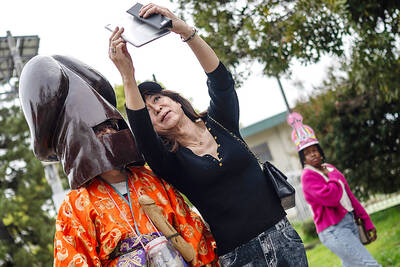
Showcasing phallus-shaped portable shrines and pink penis candies, Japan’s annual fertility festival yesterday teemed with tourists, couples and families elated by its open display of sex. The spring Kanamara Matsuri near Tokyo features colorfully dressed worshipers carrying a trio of giant phallic-shaped objects as they parade through the street with glee. The festival, as legend has it, honors a local blacksmith in the Edo Period (1603-1868) who forged an iron dildo to break the teeth of a sharp-toothed demon inhabiting a woman’s vagina that had been castrating young men on their wedding nights. A 1m black steel phallus sits in the courtyard of
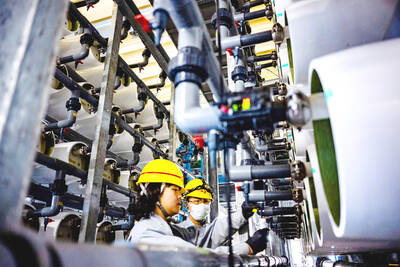
HIGH HOPES: The power source is expected to have a future, as it is not dependent on the weather or light, and could be useful for places with large desalination facilities A Japanese water plant is harnessing the natural process of osmosis to generate renewable energy that could one day become a common power source. The possibility of generating power from osmosis — when water molecules pass from a less salty solution to a more salty one — has long been known. However, actually generating energy from that has proved more complicated, in part due the difficulty of designing the membrane through which the molecules pass. Engineers in Fukuoka, Japan, and their private partners think they might have cracked it, and have opened what is only the world’s second osmotic power plant. It generates

JAN. 1 CLAUSE: As military service is voluntary, applications for permission to stay abroad for over three months for men up to age 45 must, in principle, be granted A little-noticed clause in sweeping changes to Germany’s military service policy has triggered an uproar after it emerged that the law requires men aged up to 45 to get permission from the armed forces before any significant stay abroad, even in peacetime. The legislation, which went into effect on Jan. 1 aims to bolster the military and demands all 18-year-old men fill out a questionnaire to gauge their suitability to serve in the armed forces, but stops short of conscription. If the “modernized” model fails to pull in enough recruits, parliament will be compelled to discuss the reintroduction of compulsory service, German

Hundreds of Filipinos and tourists flocked to a sun-bleached field north of Manila yesterday, on Good Friday, to witness one of the country’s most blood-soaked displays of religious fervor, undeterred by rising fuel prices. Scores of bare-chested flagellants with covered faces walked barefoot through the dusty streets of Pampanga Province’s San Fernando as they flogged their backs with bamboo whips in the scorching heat. Agence France-Presse (AFP) journalists said they saw devotees deliberately puncturing their skin with glass shards attached to a small wooden paddle to ensure their bleeding during the ritual, a way to atone for sins and seek miracles from


 RSS
RSS