


With many of his most vocal critics silenced by long prison terms and the island's tourism industry on the mend, 77-year-old President Fidel Castro had much to celebrate on the anniversary of the New Year's Day revolution that brought him to power 45 years ago.
The bearded guerrilla leader now shows his age, but he still has the stamina to give a speech lasting eight hours, as he did at a parliamentary session earlier this month.
A major address by Castro was considered likely over the next few days, although nothing was announced by Wednesday night. Numerous concerts and other cultural gatherings were scheduled around the island for yesterday and today, both official holidays.
But while Castro's government trumpeted its economic turnaround, political opponents complained that they are more oppressed than ever.
"If we wanted to classify 2003 we could say, without doubt, it has been a year of repression," activist Claudia Marquez wrote for the Miami-based Web site Cubanet.
"Not only against dissidence and the independent press, but against the populace in general," wrote Marquez, wife of imprisoned dissident Osvaldo Alfonso.
More than two generations have passed since Castro and his fellow rebels marched down from Cuba's Sierra Maestra mountains to celebrate the hurried departure of then-president Fulgencio Batista from the island on Jan. 1, 1959.
Today, Castro is the world's longest-ruling head of government and president of one of only four surviving socialist systems -- unique in the Western Hemisphere. His leadership over this Caribbean nation of 11.2 million remains unchallenged.
And despite the gleeful predictions a decade ago that Cuba's socialist system would collapse after the Soviet Union broke up and withdrew its aid and trade, the nation last year enjoyed 2.6 percent economic growth, powered by a rebound in tourism. Economic growth for all of Latin America and the Caribbean during the same period was just 1.5 percent.
"United, we struggle. United, we triumph," read the 45th anniversary posters around town, featuring a historic photograph of Castro and fellow bearded rebel leader Camilo Cienfuegos back in January, 1959.
But as Castro's communist government celebrates its survival and exhorts its people to unity, a potent dissident movement still bubbles beneath the surface -- even after the roundup that jailed 75 independent journalists, opposition party leaders and other activists in March last year.
Many Cubans, including Mauro Sampera, 73, publicly support Castro's government.
"For the new year, my hope is for health and that the revolutionary process continues," said Sampera, a retired teacher selling used books in Old Havana, on Wednesday.
"Without the revolution, my four children would not have gone to university," he said.
But there is an increasing sense that not everyone agrees.
"My wishes for the new year? We Cubans have a lot of wishes for the new year. But we cannot talk about them here in public," said a younger bookseller who declined to give his name.
Oswaldo Paya, probably Cuba's best known dissident, remains free and continues to boldly push for deep changes in Cuba's centralized political and economic systems.
Last month, Paya called for a national dialogue, providing a detailed document he says could be used as a guide for a democratic transition.
The government publicly ignored that document, just as it earlier shelved Paya's Varela Project, an effort that delivered to the Cuban parliament more than 25,000 signatures seeking an initiative on rights such as freedom of speech and assembly.
Many of the 75 dissidents sentenced to prison terms of six to 28 years were Varela Project volunteers, accused of being mercenaries working with US diplomats to undermine Castro's system -- charges they denied.
Human rights groups around the globe and democratic leaders condemned the spring crackdown, as well as the firing-squad executions of three men who tried to hijack a passenger ferry to the US.
US President George W. Bush used the crackdown as a reason for further tightening long-standing restrictions on US trade with and travel to the island.
Cuba continued to thumb its nose at the US government and opened its arms to US farmers, buying hundreds of millions of dollars of US agricultural goods under an exception to trade sanctions that were first imposed in 1960 by US President Dwight Eisenhower.

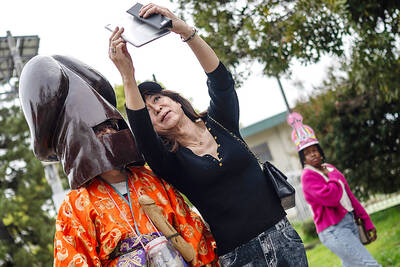
Showcasing phallus-shaped portable shrines and pink penis candies, Japan’s annual fertility festival yesterday teemed with tourists, couples and families elated by its open display of sex. The spring Kanamara Matsuri near Tokyo features colorfully dressed worshipers carrying a trio of giant phallic-shaped objects as they parade through the street with glee. The festival, as legend has it, honors a local blacksmith in the Edo Period (1603-1868) who forged an iron dildo to break the teeth of a sharp-toothed demon inhabiting a woman’s vagina that had been castrating young men on their wedding nights. A 1m black steel phallus sits in the courtyard of

HIGH HOPES: The power source is expected to have a future, as it is not dependent on the weather or light, and could be useful for places with large desalination facilities A Japanese water plant is harnessing the natural process of osmosis to generate renewable energy that could one day become a common power source. The possibility of generating power from osmosis — when water molecules pass from a less salty solution to a more salty one — has long been known. However, actually generating energy from that has proved more complicated, in part due the difficulty of designing the membrane through which the molecules pass. Engineers in Fukuoka, Japan, and their private partners think they might have cracked it, and have opened what is only the world’s second osmotic power plant. It generates

JAN. 1 CLAUSE: As military service is voluntary, applications for permission to stay abroad for over three months for men up to age 45 must, in principle, be granted A little-noticed clause in sweeping changes to Germany’s military service policy has triggered an uproar after it emerged that the law requires men aged up to 45 to get permission from the armed forces before any significant stay abroad, even in peacetime. The legislation, which went into effect on Jan. 1 aims to bolster the military and demands all 18-year-old men fill out a questionnaire to gauge their suitability to serve in the armed forces, but stops short of conscription. If the “modernized” model fails to pull in enough recruits, parliament will be compelled to discuss the reintroduction of compulsory service, German
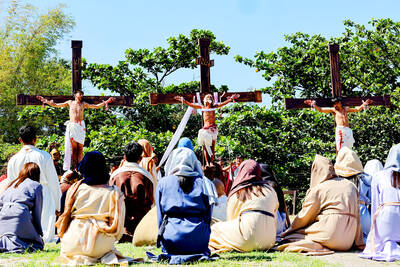
Hundreds of Filipinos and tourists flocked to a sun-bleached field north of Manila yesterday, on Good Friday, to witness one of the country’s most blood-soaked displays of religious fervor, undeterred by rising fuel prices. Scores of bare-chested flagellants with covered faces walked barefoot through the dusty streets of Pampanga Province’s San Fernando as they flogged their backs with bamboo whips in the scorching heat. Agence France-Presse (AFP) journalists said they saw devotees deliberately puncturing their skin with glass shards attached to a small wooden paddle to ensure their bleeding during the ritual, a way to atone for sins and seek miracles from


 RSS
RSS