


Michael slides a sequin glove over the pop star’s tarnished legacy, shrouding Michael Jackson’s complications with a conventional biopic that, if you cover your ears, sounds great.
Antoine Fuqua’s movie is sanctioned by Jackson’s estate and its producers include the estate’s executors. So it is, by its nature, a narrow, authorized perspective on Jackson. The film ends before the flood of allegations of sexual abuse of children, or Jackson’s own acknowledgment of sleeping alongside kids. Jackson and his estate have long maintained his innocence. In his only criminal trial, in 2005, Jackson was acquitted.
Michael doesn’t even subtly nod to these facts. It moonwalks right past them. The result is a kind of fantasy film, one that relives the extraordinary highs of Michael Jackson while turning a blind eye to the lows.

Photo: AP
There’s something understandably hard to resist about that. Who wouldn’t love to forget all the bad that comes with Michael Jackson? Billie Jean, alone, is good enough to give you amnesia. We’re talking about one of the greatest song-and-dance entertainers of the 20th century. The connection he forged with millions shouldn’t be taken for granted. And it can feel downright giddy to once again bask in Jackson’s former glory — or, at least, an uncanny approximation of it by Jaafar Jackson, his nephew. But that also makes Michael as much a fairy tale as Peter Pan’s Neverland.
Michael originally included scenes dealing with the sexual abuse allegations, but those were cut due to stipulations in an earlier settlement. The finished film, scripted by John Logan (Gladiator, Aviator), is largely structured as a father-son drama. In the film’s early Gary, Indiana-set scenes, Joe Jackson (a typically compelling Colman Domingo) forcefully drills his children into becoming the Jackson 5 and whips young Michael (an excellent Juliano Krue Valdi) with his belt.
While Michael spans the Jackson 5 and Off the Wall and Thriller, its through line is Michael’s struggle for emancipation from his overbearing father and manager. In that way, it’s quite similar to 2022’s Elvis, which likewise turned on the dynamic between Presley and the controlling Colonel Tom Parker.
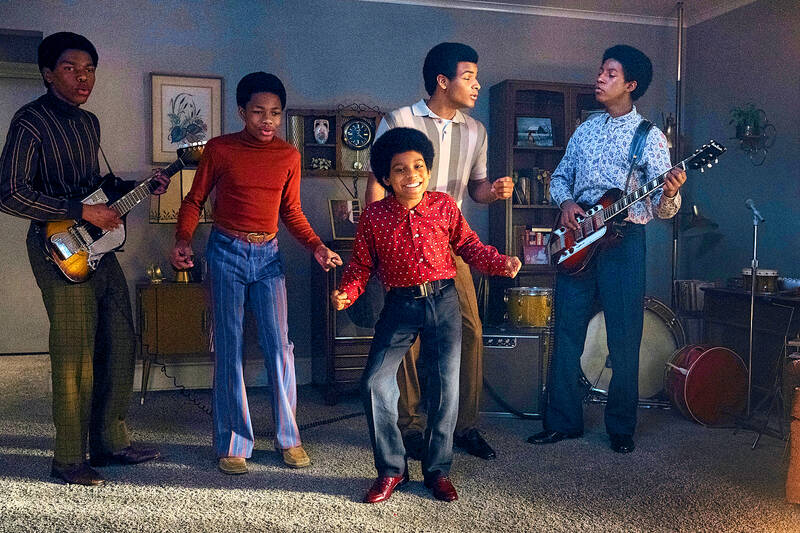
Photo: AP
Similarly, the broad-strokes, play-the-hits biopic approach is very much at work in Michael, produced by Graham King (Bohemian Rhapsody). Fuqua, best known for muscular thrillers like Training Day and The Equalizer, is maybe an unlikely pick for the task. But he cleverly stages some scenes, like when young Michael first lays down a track in a recording studio. While his father looms outside and producers tell Michael not to shuffle his feet so much, Fuqua moves inside the booth. We hear nothing but Michael’s voice. The noise stops and there’s just his pure, not-yet-corrupted vocal power, singing Who’s Lovin’ You.
What happened to Jackson as he became an adult, many would consider both an astonishing success story and an American tragedy. Michael doesn’t try for that balance. It mainly follows the emergence of an icon, albeit a peculiar one who takes shelter in a room full of children’s toys and whose need to be “perfect” drives him to cosmetic surgery in his early 20s. These and other developments (like the arrival of Bubbles the chimp) are mostly met with eye rolls by family members: the idiosyncrasies of a man-child genius.
At nearly every turn, you can feel the narrative being twisted, sometimes by those still alive. (Joe Jackson died in 2018, nine years after his son’s death at 50.) Katherine Jackson (Nia Long), Michael’s mother, is downright saintly. John Branca (Miles Teller), co-executor of Jackson’s estate and a producer of the film, is seen as a heroic ally to Michael.
Branca, perhaps, deserves the victory lap. Such a big-screen revival for Jackson was once unthinkable. But Michael is the latest in a string of successes for the former King of Pop, including Cirque du Soleil shows and MJ the Musical on Broadway — all despite the evidence presented by the 2019 documentary Leaving Neverland. Michael isn’t really a rebuttal to that film. It’s pure pop shock-and-awe. And turning up the volume on Beat It will win you some arguments.
What’s on screen is constantly running, in our minds, alongside what isn’t. Even the glossiest of biopics allow some negative characteristics to show, but Fuqua’s film sticks almost entirely to Michael, the myth. He visits kids in hospitals, makes Black history on MTV, writes the Thriller album in near solitude. (Kendrick Sampson plays a seldom-seen Quincy Jones.)
As played by Jaafar Jackson, Michael is a wide-eyed innocent who bore the scars of abuse and yet nevertheless maintained a childlike belief in music: king and casualty of pop, at once. If there’s one thing that needs no embellishment here, it’s the fervor of audiences for Jackson at his astonishing peak. Fuqua lingers on the fans losing their minds for Michael, but that ardor was real. Jaafar Jackson’s performance is a remarkable, charming facsimile not just for the dance moves and singing voice but, more crucially, for channeling Jackson’s sweetness.
Michael concludes on an oddly and — considering where things would ultimately go for Jackson — completely false note of triumph. But when the movie sticks to the music, as it often does in copious concert performances, it’s hard not to be moved. There is an undeniable thrill in being transported back to a more innocent America awakening to the power of pop spectacle, when arenas sang in unison to Man in the Mirror and Human Nature. The nostalgia of Michael is for more than Michael Jackson. But blindly believing only in that celebrity, in that fantasy, is repeating a sad history all over again.

Ajay Verma, a consultant gastroenterologist at Kettering general hospital in Northamptonshire, says our gut is a “complex machine.” “It is constantly providing us with the nutrition we need, initially to grow and develop, and then for us to survive, thrive and repair from injury and illness.” How can we keep it functioning well? Put simply: “Make sure what you put into it is balanced, and that you clear out its waste products adequately,” Verma says. “In a general gastroenterology clinic, the most common conditions we see are irritable bowel syndrome (IBS), gastroesophageal reflux disease, inflammatory bowel disease and constipation,” says Nisha

And so, in the wake of US President Donald Trump’s trip to the People’s Republic of China (PRC), all the experts on the Strait of Hormuz suddenly became experts on US-China-Taiwan relations. The Internet has certainly expanded human knowledge. Lots of these sudden experts made noise this week about Trump’s words after the meeting with PRC dictator Xi Jin-ping (習近平). Trump is going to sell out Taiwan! Longtime Taiwan commentator J. Michael Cole summed the situation up neatly in the Guardian: “We need to keep in mind that he has a tendency to say many things — sometimes contradicting himself within

Last week US President Donald Trump was asked by a reporter whether he would speak on the phone to the President of Taiwan. “l’ll speak to him. I speak to everybody. We have that situation very well in hand,” Trump said. This marked the second time in a couple of weeks he had said he would talk to the President of Taiwan. In 2016 he famously took a call from then-president Tsai Ing-wen (蔡英文), when he was president-elect. Despite warnings that the apocalypse was nigh because of a phone call, the world quickly forgot about the conversation between two democratically-elected presidents.
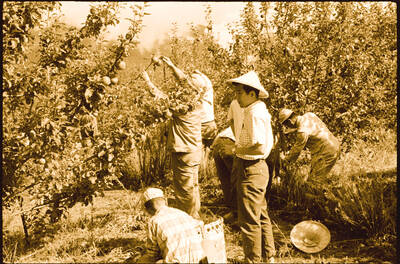
May 25 to May 31 Few believed that apples could be cultivated on a commercial scale in Taiwan’s high mountains. When horticulturalist Cheng Chao-hsiung (程兆熊) first proposed the idea in 1955, both American and Taiwanese colleagues dismissed it as implausible, arguing that temperate fruit could not be reliably grown on a subtropical island, especially on rugged terrain. However, it was this terrain in the Central Mountain Range where many Chinese Civil War veterans were resettled in the late 1950s. With limited job prospects and no family in Taiwan, they were placed on cooperative farms aimed toward self-sufficiency. Some say the conditions


 RSS
RSS