


What is the importance within the Chinese Nationalist Party (KMT) of the meeting between Xi Jinping (習近平), the leader Chinese Communist Party (CCP), and Cheng Wen-tsan (鄭文燦), the leader of the KMT?
Local media is an excellent guide to determine how important — or unimportant — a news event is to the public. Taiwan has a vast online media ecosystem, and if a news item is gaining traction among readers, editors shift resources in near real time to boost coverage to meet the demand and drive up traffic.
Cheng’s China trip is among the top headlines, but by no means dominates. The Xi-Cheng meeting is taking place as this column is being written, and one television news channel chose “absconding foreign worker turns himself into Spiderman,” featuring dramatic footage of a man escaping authorities by climbing down the face of a building as their lead story.
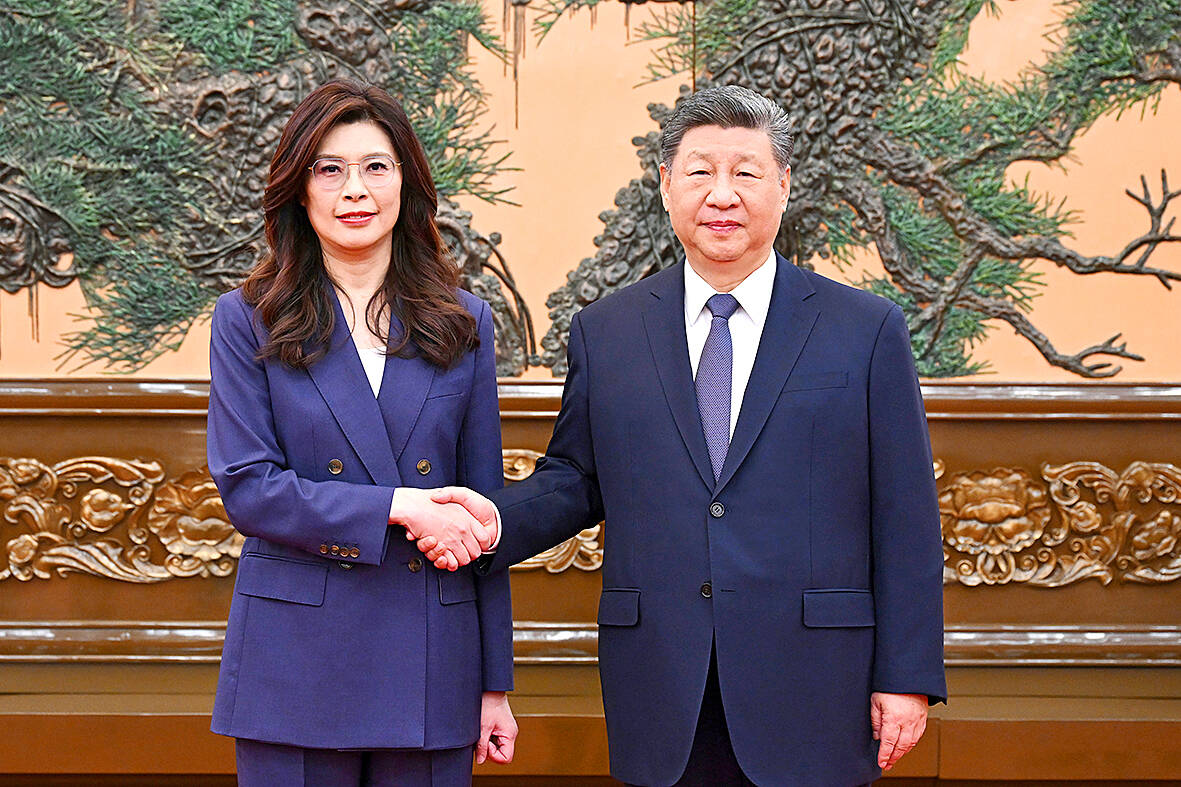
Photo: AP
The international press is covering Cheng’s trip as “historic,” but left off vital context. For more on this, read Michael Turton’s context-rich “Notes from Central Taiwan: The farce of Cheng’s ‘peace’ trip” (April 9, page 12).
RISE OF THE IDEOLOGUES
There are several reasons this remains a story worthy of coverage and that distinguishes it from previous visits. As the Taiwanese public appears to view it, it is worthy of attention, but is far from the historic event the international press portrays it as.
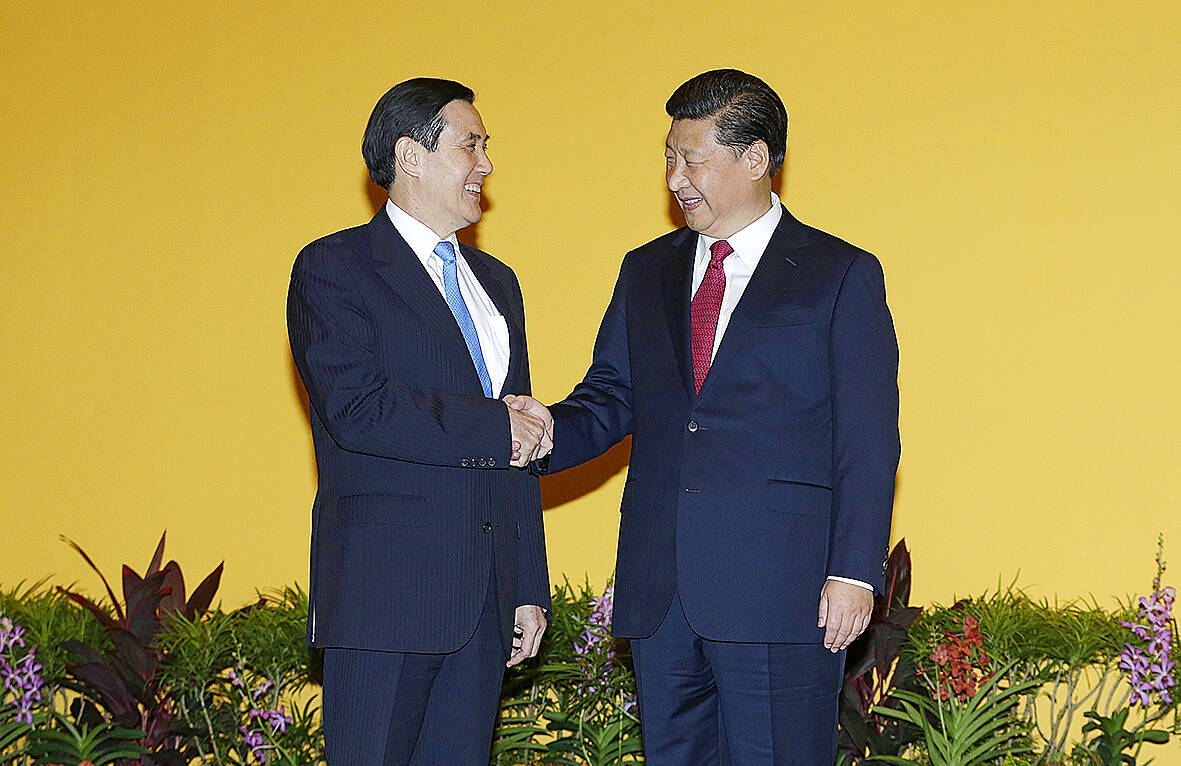
Photo: AP
It is symbolic that, after a string of similar visits between 2005 and 2016, this is the first such trip in a decade. After losing two national elections in 2016 and 2020 in devastating landslides, and polling that showed that the KMT’s positions relating to China were far outside mainstream public opinion, subsequent KMT leaders thought better of sinking their own party’s electoral prospects.
They replaced high-profile party chair-level visits with a stream of visits to the CCP by vice chairs, party lawmakers and officials, and former party leaders. Communication channels remained open and connections strong, but significantly lower profile.
The return of a high-profile contacts with the CCP reflects a shift in the KMT.
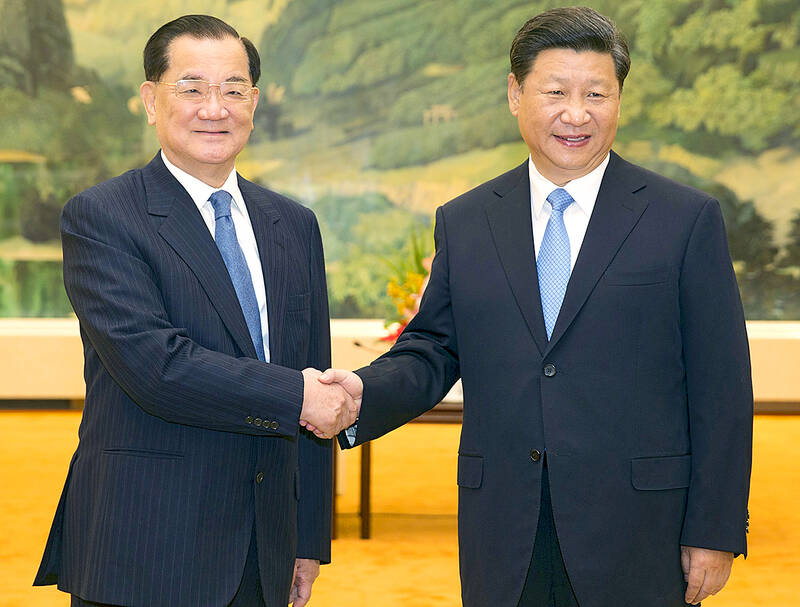
Photo: Reuters
The 2024 election restored much of the party’s confidence, which was sent into the stratosphere by their resounding defeat of recall attempts against their lawmakers in the summer last year.
Though they lost the presidential election in 2024, it was not the blowout it was in the previous two elections. It was a three-way race, and many in the party note that their candidate and the other opposition candidate Ko Wen-je (柯文哲) from the Taiwan People’s Party (TPP) combined garnered nearly 60 percent of vote.
In the legislative election, the KMT restored their status as the largest party, and with their smaller TPP allies are able to command the legislature and its agenda.

Photo: Facebook
As the recall campaigns got into full swing, there was a stunning shift in public opinion, and voters unexpectedly came out in force to defend the KMT’s lawmakers. The ruling Democratic Progressive Party (DPP) took a pounding in the polls, and the KMT’s and TPP’s spiked.
Ideologues in the party interpreted this as meaning the pendulum of voter sentiment was swinging back in their direction, and KMT members surged out to vote for the upstart candidate Cheng, electing her party chair — though with only 50.15 percent support. In total, she was elected by only 65 thousand people out of a population of 23 million.
While preparing this column, at Cheng’s post Xi meeting press conference, she outlined a restoration of the vision that animated her personal mentor Lien Chan (連戰) — who led the first KMT chair’s 2005 “mission of peace” to China — that continued through to the eight-year presidency of Ma Ying-jeou (馬英九).
As the KMT’s press release quotes her as saying: “We bear a greater responsibility to the people on both sides and to all descendants of the Chinese nation. The ‘great rejuvenation of the Chinese nation’ must be a shared revival, representing the renewed vitality of Chinese civilization and a compassionate vision contributing to global peace and human progress.”
For the ideologues in the KMT, the “great rejuvenation of the Chinese nation” is a sacred mission to rectify what they view as a great historical tragedy: The splitting off of the Province of Taiwan from the motherland.
THE CONCERNS OF THE ELECTIBILITY CAMP
Not everyone in the KMT is happy about this. This has split the party into roughly two camps, which the local and foreign press have identified in ways I find misleading.
The local press has used terms identifying Cheng’s camp as “anti-American” and the opposition as “pro-American.” In reality, while many in Cheng’s camp are skeptical of America and see both their history and future as tied to China, few are deeply anti-American per se. There is likely more virulent anti-American sentiment in Denmark these days than in the KMT.
The foreign press struggles with whether the KMT is “pro-China” or “China-friendly.” The KMT is the Chinese Nationalist Party, so all are pro-China on some level; the debate inside the party is over how close to draw to the CCP.
In such a diverse party as the KMT, the real split is between ideologues like Cheng and what I call the “electibility” camp.
The electability camp is dominated by people who regularly interact with their constituents and are keenly aware that the underlying electoral math remains challenging as long as the ideologues are in charge.
In previous analysis in this column, I demonstrated that even in a two-way presidential race in 2024, while it would have been a tighter race, it was no slam dunk for the KMT.
In further analysis, I noted that the KMT lost the vote for legislative contingencies by hundreds of thousands of votes. The reason for the far better result for the KMT in 2024 was a far smarter electoral strategy by then KMT chairman Eric Chu (朱立倫) that maximized turnout in less populous districts, swinging them into the KMT camp. Similarly, the vote for party list legislators actually saw a very slight decline in 2024 over 2020.
Additionally, the spike in support following the recall votes was temporary. The relative support for the various parties has returned to roughly where it was before, with the DPP still far ahead — though still not in the majority.
The electability camp is fearful that the restoration of the earlier ideological stance will recreate the very electoral conditions that led to their landslide defeats in 2016 and 2020, which only recovered somewhat in 2024 under the more pragmatic and electable leadership of Chu.
Polling continues to show widespread dislike and distrust of the very stances that Cheng is restoring, especially over the “1992 consensus” and other related “one China” stances. The public is also against the continued blocking of defense spending by the KMT in the legislature.
They are concerned that Cheng’s trip to Beijing will reignite public distrust during an election year.
In the KMT’s favor are two factors. The first is that this year’s elections are local, so the focus will be less on China.
The second is that after so many years in power, there is some frustration and exhaustion with the DPP nationally, which could serve as a drag in downstream local races.
Cheng is convinced that voters are desperate for peace, and emphasizes the potential upsides of bringing that about.
The tricky part is that very few trust the CCP’s intentions. After all, the CCP’s designs on annexing Taiwan are explicit. Cheng repeatedly says the CCP is showing “goodwill and sincerity,” but so far few believe that is a reality.
Despite Cheng’s hopes for peace, the CCP’s military “gray zone” intimidation has not lessened.
Donovan’s Deep Dives is a regular column by Courtney Donovan Smith (石東文) who writes in-depth analysis on everything about Taiwan’s political scene and geopolitics. Donovan is also the central Taiwan correspondent at ICRT FM100 Radio News, co-publisher of Compass Magazine, co-founder Taiwan Report (report.tw) and former chair of the Taichung American Chamber of Commerce. Follow him on X: @donovan_smith.


The US war on Iran has illuminated the deep interdependence of Asia on flows of oil and related items as raw materials that become the basis of modern human civilization. Australians and New Zealanders had a wake up call. The crisis also emphasizes how the Philippines is a swatch of islands linked by jet fuel. These revelations have deep implications for an invasion of Taiwan. Much of the commentary on the Taiwan scenario has looked at the disruptions to world trade, which will be in the trillions. However, the Iran war offers additional specific lessons for a Taiwan scenario. An insightful
The problem with Marx’s famous remark that history repeats itself, first as tragedy, the second time as farce, is that the first time is usually farce as well. This week Chinese Nationalist Party (KMT) Chair Cheng Li-wun (鄭麗文) made a pilgrimage to the People’s Republic of China (PRC) “to confer, converse and otherwise hob-nob” with Chinese Communist Party (CCP) officials. The visit was an instant international media hit, with major media reporting almost entirely shorn of context. “Taiwan’s main opposition leader landed in China Tuesday for a rare visit aimed at cross-strait ‘peace’”, crowed Agence-France Presse (AFP) from Shanghai. Rare!

April 6 to April 13 Few expected a Japanese manga adaptation featuring four tall, long-haired heartthrobs and a plucky heroine to transform Taiwan’s television industry. But Meteor Garden (流星花園) took the nation by storm after premiering on April 12, 2001, single-handedly creating the “idol drama” (偶像劇) craze that captivated young viewers across Asia. The show was so successful that Japan produced its own remake in 2005, followed by South Korea, China and Thailand. Other channels quickly followed suit, with more than 50 such shows appearing over the following two years. Departing from the melodramatic

Sunflower movement superstar Lin Fei-fan (林飛帆) once quipped that the Democratic Progressive Party (DPP) could nominate a watermelon to run for Tainan mayor and win. Conversely, the DPP could run a living saint for mayor in Taipei and still lose. In 2022, the DPP ran with the closest thing to a living saint they could find: former Minister of Health and Welfare Chen Shih-chung (陳時中). During the pandemic, his polling was astronomically high, with the approval of his performance reaching as high as 91 percent in one TVBS poll. He was such a phenomenon that people printed out pop-up cartoon


 RSS
RSS