


Taiwan has arranged for about 8 million barrels of crude oil, or about one-third of its monthly needs, to be shipped from the Red Sea this month to bypass the Strait of Hormuz and ease domestic supply pressures, CPC Corp, Taiwan (CPC, 台灣中油) said yesterday.
The state-run oil company has worked with Middle Eastern suppliers to secure routes other than the Strait of Hormuz, through which about 20 percent of the world’s oil and liquefied natural gas typically passes, CPC chairman Fang Jeng-zen (方振仁) said at a meeting of the legislature’s Economics Committee in Taipei.
Suppliers in Saudi Arabia have indicated they can transport crude oil to the Red Sea through pipelines, while those in the United Arab Emirates are evaluating routing oil through pipelines to Oman for sea shipments, Fang said.
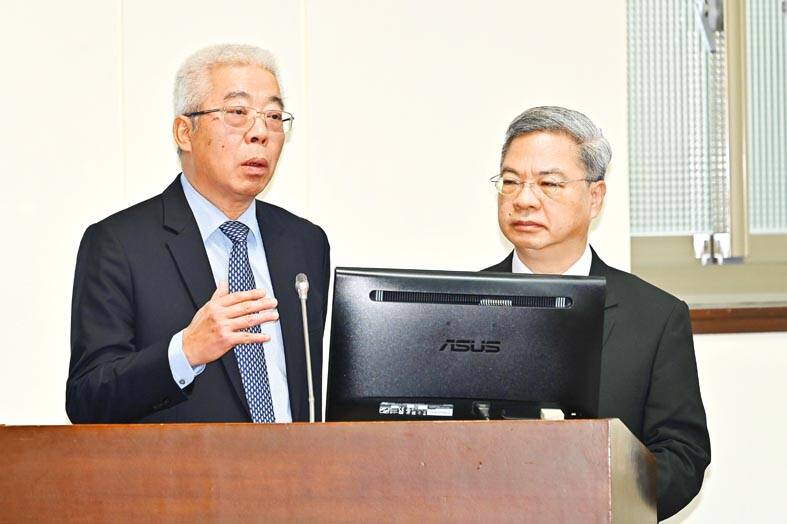
Photo: Tu Chien-jung, Taipei Times
One tanker carrying about 2 million barrels has already been loaded and is docked in the Persian Gulf, but has yet to depart due to the conflict in the Middle East.
To mitigate risks, CPC has also been diversifying its crude oil sources, including exploring supplies from West Africa and assessing imports from Southeast Asia, Australia and the US, Fang said.
At the same meeting, Minister of Economic Affairs Kung Ming-hsin (龔明鑫) said the government is planning to provide financial support to help CPC address its mounting losses.
The company has been forced to absorb increases in crude oil prices on multiple occasions in recent years, including since the US and Israel launched an attack on Iran at the end of February, to keep domestic fuel prices stable.
To buffer the impact of the spike in crude oil prices triggered by the war, CPC has already run up losses of NT$9 billion (US$283.15 million), bringing its accumulated losses to NT$79.2 billion as of Tuesday last week, the Ministry of Economic Affairs estimates.
The losses have left the company with a net worth of only NT$86.1 billion, and lawmakers questioned Kung on plans to bolster CPC’s finances.
Kung said three approaches would be used, including increasing the company’s capital by NT$350 billion over four years.
Of that, NT$168.7 billion has already been included as part of the government’s fiscal budget request for next year, he said.
The ministry would also help CPC find NT$300 billion in new financing to improve cash flow and refinance some of the company’s debt, he said.
The other approach would be to provide subsidies to the company, but the amount and the source of the funds are still being discussed, Kung added.

National Taiwan University (NTU) yesterday said it disqualified a person from an entrance examination for using AI smart glasses to cheat, along with two others for making untruthful statements in their curriculum vitae. The three applicants were given null scores, Taiwan’s highest-ranked university said, calling on prospective students to be honest in the admissions process. NTU registrar Lee Hung-sen (李宏森) said that the cheating applicant wore a hat and thick-rimmed glasses to the second written exam for medical school, claiming that they felt cold. Suspicions were aroused when the applicant stared oddly at the test for long stretches while steadily bringing the paper
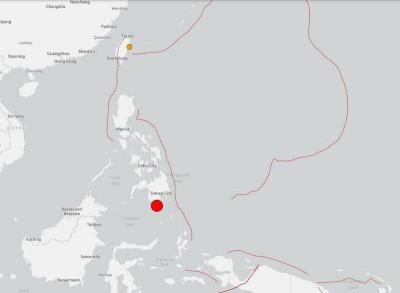
A magnitude 7.8 earthquake struck off the southern coast of Mindanao in the Philippines at 7:38am today, prompting the US Tsunami Warning System to issue an alert for neighboring countries, including Taiwan. The system issued a purple alert indicating a "tsunami threat." The potential threat zone includes Taiwan, the Philippines, Papua New Guinea, Yap and Palau. Philippine authorities were assessing the damage from the quake, with the office of civil defense seeking to verifying initial reports that 15 people had been killed and 129 injured in the region, mostly from falling debris. Arlene Hollero, disaster chief of Maasim town in the Philippines' Sarangani Province,
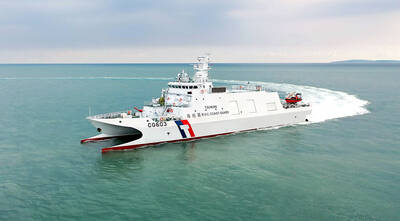
‘GRAY ZONE’ PRESSURE: Beijing’s activities are intended to create the deceitful impression that China has jurisdiction over the area around Taiwan, the CGA said Taiwan’s rights over its territorial waters and exclusive economic zone must not be violated by any country, the Mainland Affairs Council said yesterday, adding that it will not accept any unprovoked actions. The council issued the remarks in response to the China Coast Guard conducting maritime enforcement drills near eastern Taiwan and claiming to fully exercise China’s maritime administrative law enforcement authority. The Coast Guard Administration (CGA) has been closely monitoring the situation and is taking concrete steps to defend the nation’s sovereignty and secure its waters, the council said. China has no sovereign rights over the waters off eastern
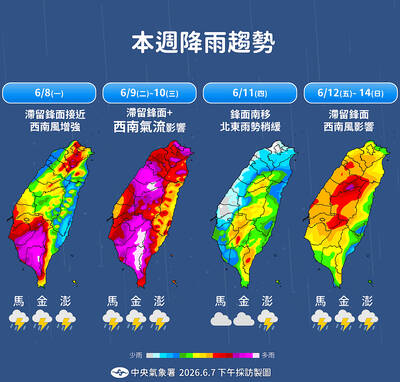
Heavy rain is expected to affect parts of Taiwan this week, the Central Weather Administration (CWA) said yesterday as a meteorologist said the active part of the annual plum rain season has started. A stationary plum rain front and southwesterly winds would bring unstable weather and abundant moisture to Taiwan from today for about a week, with the heaviest rainfall forecast for tomorrow and Wednesday, the CWA said. The agency said western and northeastern Taiwan, and mountainous areas in the east and southeast, could expect showers or thunderstorms on those two days, with localized heavy rain possible. Other parts of


 RSS
RSS