


April 6 to April 13
Few expected a Japanese manga adaptation featuring four tall, long-haired heartthrobs and a plucky heroine to transform Taiwan’s television industry.
But Meteor Garden (流星花園) took the nation by storm after premiering on April 12, 2001, single-handedly creating the “idol drama” (偶像劇) craze that captivated young viewers across Asia. The show was so successful that Japan produced its own remake in 2005, followed by South Korea, China and Thailand.
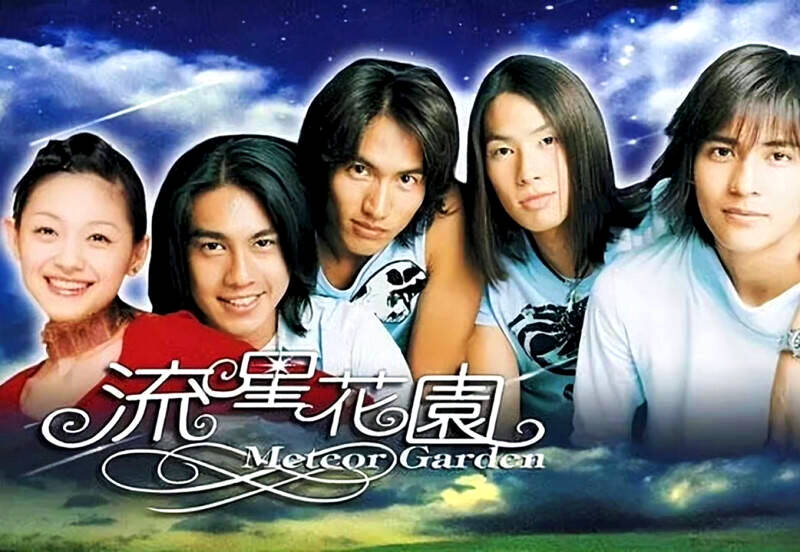
Photo: Taipei Times file
Other channels quickly followed suit, with more than 50 such shows appearing over the following two years. Departing from the melodramatic family epics full of sorrow, betrayal and bitterness, these idol shows, often set in schools, were generally wholesome and optimistic about love. They followed a winning formula: “attractive actors, dreamy storylines and realistic settings.”
While traditional dramas relied on established, skilled actors, Meteor Garden’s cast was largely unknown and inexperienced, with producers prioritizing charm and star potential over thespian skills. The five protagonists went on to become household names, enjoying successful careers in the entertainment scene.
BIRTH OF A GENRE
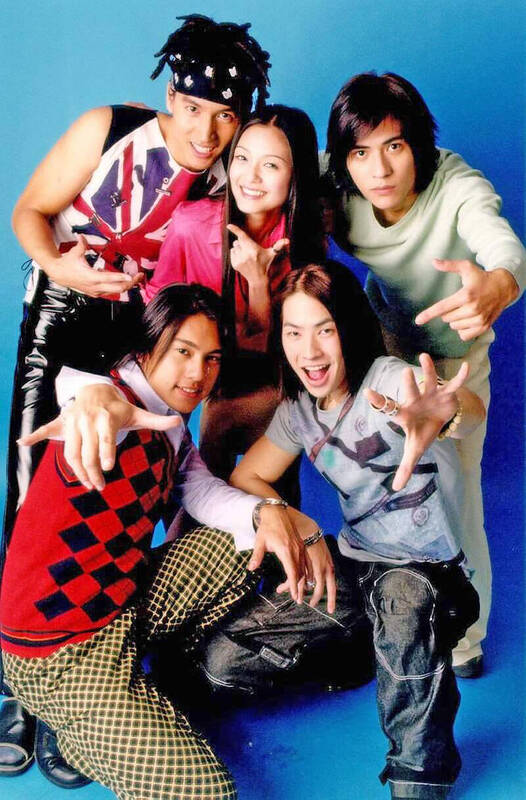
Photo: Taipei Times file
The term “idol drama” first appeared around 1993, after satellite STAR Chinese Channel began airing Japanese drama series. Cable TV was legalized in 1994, intensifying competition in the industry.
According to “A diachronic analysis of the industry transition of Taiwanese trendy drama” (台製偶像劇產業發展變遷之歷時性研究), cable television ratings had surpassed those of terrestrial channels by 2001. Alarmed by the loss of younger viewers and this decline, broadcasters began recruiting new production teams and experimenting with fresh formats.
At that time, variety show producer Angie Chai (柴智屏) was enjoying success with the Taiwan Television (台視) program Super Sunday (超級星期天). But her company’s 9:30pm slots on Wednesday and Thursday were underperforming, and the channel was considering giving them to another production firm, according to a Taiwan Panorama article.
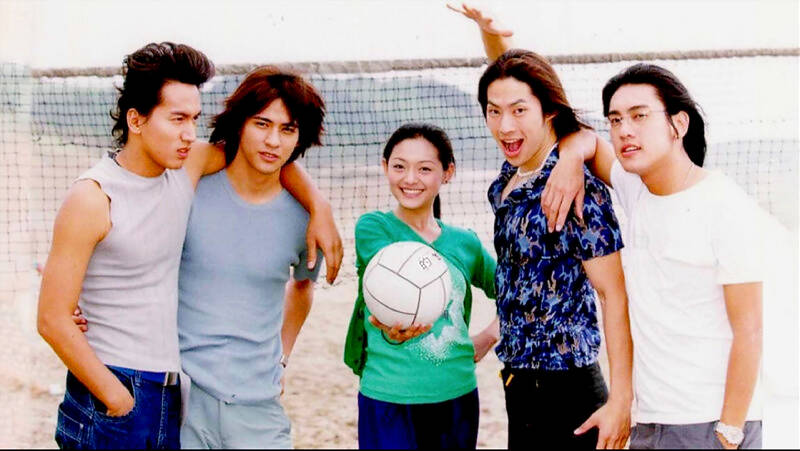
Photo: Taipei Times file
During negotiations, Chai offered to personally produce the shows, and the channel agreed. However, the Wednesday variety slot was soon taken, leaving her with the Thursday drama slot — a format she had no experience in. The media was skeptical, calling her “creatively spent and on her way out.”
Chai noticed that while teenagers made up a large share of the television audience, few programs were made specifically for them. The 2000 sitcom Spicy Teacher (麻辣鮮師) is said to be one of the first shows set in a school and featuring fresh faces, helping establish the template for the deliberately idol-centric Meteor Garden.
Taiwan had also not seen an influential boy band in years, leading many young people to instead follow groups from Japan, South Korea and Hong Kong. Chai hoped to use the drama as a vehicle to change that.

Photo courtesy of Gala Television
CASTING NEW FACES
The popular manga Boys Over Flowers by Yoko Kamio — a schoolyard romance featuring four rich, handsome yet arrogant boys who terrorize their classmates until a girl of modest means stands up to them — fit the bill. Chai’s adaptation kept the characters’ Japanese names, but set it in Taiwan and added local youth culture elements. It only ran for 19 episodes, another break from the typical long-running television dramas.
The male leads were chosen through auditioning. The four who made the final cut: Jerry Yan (言承旭), Vanness Wu (吳建豪), Ken Chu (朱孝天) and Vic Chou (周渝民), all sported long or shaggy hair, which stood out by the standards of that time, and were over 180cm tall.
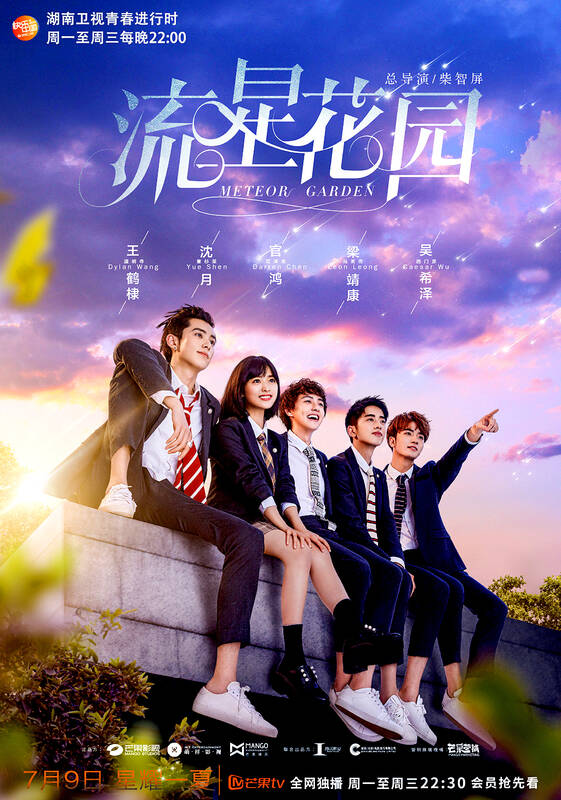
Photo courtesy of Weibo
Music was also key to building idol appeal, and the quartet soon formed the boy band F4 (Flower Four), named after their fictional group in the manga. They also performed the drama’s ending theme song, Meteor Rain (流星雨).
The late Barbie Hsu (徐熙媛), co-host of the variety shows Guess (我猜我猜我猜猜猜) and 100% Entertainment (娛樂百分百) was cast as the female lead.
Director Tsai Yueh-hsun (蔡岳勳) later recalled that part of the motivation for seeking new actors came from the lack of talent development among television stations, which tended to play it safe by casting established household names. Their gamble paid off, as the actors’ “natural” performances made them more relatable amid the story’s fantastical plot and somewhat surreal backdrop.
INTERNATIONAL HIT
With ratings of 6.94 percent, the show absolutely blew up, sparking a massive craze.
Other Taiwanese channels quickly jumped on the trend with their own productions. While the majority of these early dramas also drew from Japanese manga, the idol drama that directly followed on Taiwan Television, Kiss with Toast Man (吐司男之吻), was an original story that tackled local issues such as retaking university entrance exams and gangsters.
Huang Nuan-yun (黃暖雲) writes in “Analysis of the competitive resources and production strategies of Taiwan idol dramas” (台灣偶像劇之優勢資源與產製策略分析) that these youth-focused shows generally emphasized positive, wholesome portrayals of love and the courage to pursue one’s dreams.
Gone were the marital disputes and bitter feuds between wealthy families that had long captivated older audiences. “Although love is a common element in all dramas, idol dramas make people believe in love, while more mature shows often take a cynical view of it,” producer Fang Ke-jen (方可人) told Huang.
This idol drama rush lasted until about 2010, and Chai has been dubbed Taiwan’s “godmother of idol drama.”
Meteor Garden’s impact also resonated overseas. It wasn’t just audiences in Chinese-speaking regions already familiar with Taiwanese entertainment who turned in; the series also caused a stir in South Korea, Thailand, Indonesia and especially the Philippines, where the show and F4 became a cultural phenomenon and inspired fans to learn Mandarin.
When Jerry Yan visited Manila in 2003, he was received by president Gloria Macapagal Arroyo, while hysterical fans gathered outside the presidential palace. Even Japan, the source country of the story, aired the series in 2003 and produced its own remake in 2005.
Despite the proliferation of the genre and the rise of Korean dramas, Meteor Garden remained relevant. South Korea did its remake in 2009, and China, which banned it over reports that the characters’ behaviors were negatively influencing schoolchildren, produced its own version in 2018, also with Chai as producer.
Just five years ago, Thailand released its adaptation, showing that the legacy of this groundbreaking drama is very much alive.
Taiwan in Time, a column about Taiwan’s history that is published every Sunday, spotlights important or interesting events around the nation that either have anniversaries this week or are tied to current events.

Taiwan’s English education system is being pulled apart by three opposing forces. Bilingual Nation 2030 pulls students toward English and global communication. Artificial Intelligence (AI) readiness pulls them toward digital judgment, verification and AI-mediated work. But Taiwan’s old exam culture pulls them back toward memorization, grammar drills, timed reading and correct answers. If the education system keeps using old exams to define success, it risks producing graduates who are neither genuinely bilingual nor genuinely AI-ready, but trained for tasks machines can already perform. The first force is Bilingual Nation 2030. Launched in 2018, the policy aimed to “help Taiwan’s workforce connect
It seems every few days one bumps into one of those “real man” comments in which Taiwan is urged to “face reality” or similar, and “make a deal,” with the speaker implying that soon it will be too late. “Deal” advocates always present themselves as having a superior grip on reality, and the manly ability to make the “hard choice.” Their testosterone-laden language often echoes that of Taiwan sellout advocates. Note that such commentary always specifies a process (“make a deal, work with, make progress”), never the end state of what occupation by a violent authoritarian colonialist state will entail. In
June 1 to June 7 "If all Taiwanese were as afraid of dying as you, then what would happen?” Physician Shih Chiang-nan (施江南) reportedly said this to his wife Chen Chiao-tung (陳焦桐) after she urged him to stop intervening on behalf of Taiwanese soldiers stranded overseas after serving in the Japanese Army during World War II. Shih had clashed with high-ranking officials over the issue, engaged in several heated arguments with Taiwan governor-general Chen Yi (陳儀) and allegedly shouted at general Ko Yuan-fen (柯遠芬), chief of staff of the Taiwan Garrison Command, over

“Taiwan’s Opposition Leader Comes to US With a Message Straight Out of Beijing” read a May 31 headline in the Wall Street Journal. Top US administration officials and members of Congress almost certainly read the WSJ, and if there was a bullet point takeaway that people in Washington should absorb ahead of Chinese Nationalist Party (KMT) Chair Cheng Li-wun’s (鄭麗文) arrival in DC on June 9, that headline is it. The last few columns have discussed this very topic, and the timing is not coincidental. While those top officials likely do not read the Taipei Times, judging by the number


 RSS
RSS