


The problem with Marx’s famous remark that history repeats itself, first as tragedy, the second time as farce, is that the first time is usually farce as well. This week Chinese Nationalist Party (KMT) Chair Cheng Li-wun (鄭麗文) made a pilgrimage to the People’s Republic of China (PRC) “to confer, converse and otherwise hob-nob” with Chinese Communist Party (CCP) officials.
The visit was an instant international media hit, with major media reporting almost entirely shorn of context.
“Taiwan’s main opposition leader landed in China Tuesday for a rare visit aimed at cross-strait ‘peace’”, crowed Agence-France Presse (AFP) from Shanghai. Rare! Yes, a visit so rare that only nine KMT chairs and honorary chairs have met with Xi, beginning with honorary KMT chairman Lien Chan (連戰), whose name literally means “united front,” in 2012.
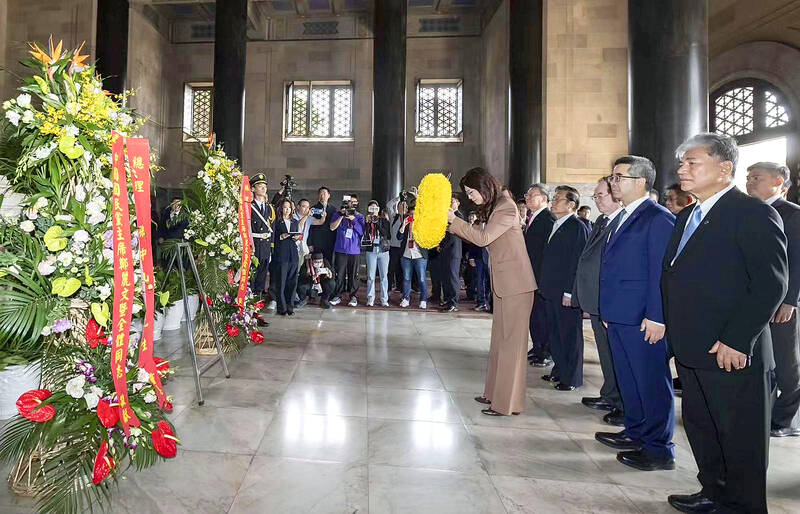
Photo: EPA
At least AFP had a throwaway line noting visits by KMT officials to the PRC. Some media reports couldn’t even manage that.
Oh yeah. Five times KMT chairs have kow-towed to Xi — is Taiwan safer now?
Not to be outdone in removing key context, National Public Radio (NPR) in the US confidently asserted that “Beijing paused many of its exchanges with the KMT, as well as most state-level ties with Taipei, after the KMT lost power to Taiwan’s current ruling party, the Democratic Progressive Party (DPP) in 2016.”
I am sure this will come as a surprise to KMT stalwarts such as former KMT chair and presidential candidate Hung Hsiu-chu (洪秀柱), who visited in 2023 to meet with the new director of the CCP’s Taiwan Affairs Office (TAO) in Xiamen, and again last year to attend a military parade.
Fu Kun-chi (傅崐萁), the “King of Hualien” and one of the most powerful members of the KMT, visits the PRC often, as does KMT deputy chairman Andrew Hsia (夏立言), who regularly leads delegations to the PRC, including twice last year. Of course, there is former president and KMT chairman Ma Ying-jeou, an annual visitor. Scores of lower-ranking KMT officials and local government officials routinely visit the PRC. There are even secret visits in the other direction, allegedly.
Meanwhile, as if Taiwan were a place far from civilized discourse, whose tribal ways were only dimly understood, NBC News invented a whole new political party for Cheng: “When Cheng Li-wun, chairperson of Taiwan’s Nationalist Party…”. The New York Times also averred that Cheng headed the Taiwan Nationalist Party. Imagine if the international media used the name of the KMT in Chinese?
The international media should have been asking: if these exchanges build peace, why does Cheng need to visit for “peace?” Shouldn’t we already have it? Shouldn’t tensions be falling, with this constant flow of KMT visitors? Shouldn’t we have fewer “gray zone” tactics around Taiwan? What are the practical outcomes of all these visits for Taiwan’s security?
As I have ceaselessly observed, tensions are an important lever for the PRC in shaping the way the international media reports on Taiwan. Cheng’s visit is a prime example of this.
The tension mechanism works thusly: the PRC tension-mongers, the KMT then piously claims it can reduce tensions via exchanges. This position, as transparently false as it is, nevertheless often seems reasonable to outsiders. Thus, one purpose of tensions in the PRC-Taiwan relationship is to construct a political understanding that renders KMT visits plausible and shifts the blame for tensions to the Democratic Progressive Party (DPP) and its defense of Taiwan’s democracy. The international media then laps this up, "as a dog returns to its vomit," because hyping Cheng’s perfectly ordinary trip as a breakthrough moment generates clicks. At least most reports put “peace” in quotes.
The truth is that short of complete surrender, Taiwan has no way to alter the level of tensions.
The KMT is not interested in “peace” but in using the PRC to blame the DPP, to appeal to its base and to attack US support of Taiwan. PRC-induced tensions serve the KMT well. Because KMT visits are normalized, it is important to portray Cheng’s trip as what it is: a display of fealty.
Cheng frequently positions Taiwan as “between” US and China. That too serves the PRC’s narrative that the US is the cause of cross-strait problems. Taiwan is where it is because the PRC demand to annex it has put it there. If there were no PRC program to annex Taiwan, Taiwanese would have close and congenial relations with their giant neighbor.
For the PRC, the visit is simply part of its program of circumventing the central government, whose legitimacy Beijing denies, and working with local officials to subvert Taiwan. This is its global policy, applied to every nation.
The Economist managed to contextualize the visit well, but still insisted that “China particularly resents the DPP’s rejection of the “1992 consensus” whereby China and Taiwan’s KMT government agreed that both sides of the Taiwan Strait are part of “one China” while allowing for different interpretations of what that means.”
Differing interpretations? The PRC has never accepted that. The international media quietly gave up that falsehood years ago. It also appeared in the NPR report on Cheng’s visit, though without the “1992 consensus” verbiage. That claim was farcical when it was first made two decades ago, and remains farcical now. It should never appear in print, but of course we will see it again.
The reason for that is clear: the KMT is continuing to push it. In her statement at her reception, Cheng said that the “1992 consensus” will be the foundation of relations, along with opposition to Taiwan independence. “Peace,” ever the reason the KMT meets so regularly with the CCP, will come with KMT submission to the CCP’s Taiwan program, Cheng appears to be saying.
The last KMT chair to meet with Xi was Hung Hsiu-chu in 2016. She became the presidential candidate, had to be removed because she was losing so badly and the KMT was crushed in the 2016 election. Many reports took note of the unpopularity of Cheng’s position on the “1992 consensus”. While there were numerous local and international reports of division in the KMT over this, it is actually an old issue in the party. Every KMT presidential candidate has been hurt by the party’s allegiance to the faux “1992 consensus”, and every election KMT candidates search for a language that enables them to say Taiwan is part of China without directly saying so. May they continue to fail.
Longtime Taiwan-based journalist Tim Culpan observed on Twitter that Cheng had said on April 1 that her trip would be based on the “1992 consensus” and opposing Taiwan independence, but in her interview with NBC she stressed that Taiwan’s future must be determined by its own people. These two positions are completely incompatible. That too is a standard program of KMT speakers, who know enough to appear Taiwan-centric to western reporters, while speaking truth on their way to the PRC.
Chris Horton, author of Ghost Nation and longtime journalist, described Cheng’s trip perfectly in a wonderful piece in Nikkei Asia: “Today, these former foes with shared roots — the Chinese Nationalist Party and the Chinese Communist Party — are working together once more. The enemy this time? Taiwanese sovereignty.”
Notes from Central Taiwan is a column written by long-term resident Michael Turton, who provides incisive commentary informed by three decades of living in and writing about his adoptive country. The views expressed here are his own.

Michael slides a sequin glove over the pop star’s tarnished legacy, shrouding Michael Jackson’s complications with a conventional biopic that, if you cover your ears, sounds great. Antoine Fuqua’s movie is sanctioned by Jackson’s estate and its producers include the estate’s executors. So it is, by its nature, a narrow, authorized perspective on Jackson. The film ends before the flood of allegations of sexual abuse of children, or Jackson’s own acknowledgment of sleeping alongside kids. Jackson and his estate have long maintained his innocence. In his only criminal trial, in 2005, Jackson was acquitted. Michael doesn’t even subtly nod to these facts.
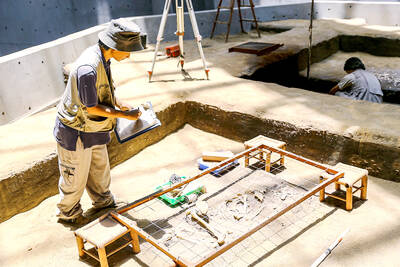
Writing of the finds at the ancient iron-working site of Shihsanhang (十 三行) in New Taipei City’s Bali District (八里), archaeologist Tsang Cheng-hwa (臧振華) of the Academia Sinica’s Institute of History and Philology observes: “One bronze bowl gilded with gold, together with copper coins and fragments of Tang and Song ceramics, were also found. These provide evidence for early contact between Taiwan aborigines and Chinese.” The Shihsanhang Web site from the Ministry of Culture says of the finds: “They were evidence that the residents of the area had a close trading relation with Chinese civilians, as the coins can be
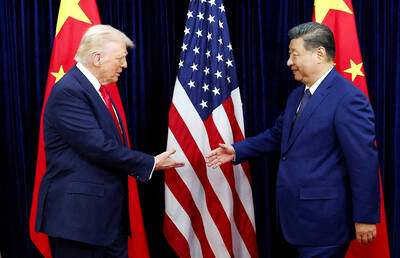
The March/April volume of Foreign Affairs, long a purveyor of pro-China pablum, offered up another irksome Beijing-speak on the issues and solutions for the problems vexing the People’s Republic of China (PRC) and the US: “America and China at the Edge of Ruin: A Last Chance to Step Back From the Brink” rang the provocative title, by David M. Lampton and Wang Jisi (王緝思). If one ever wants to describe what went wrong with US-PRC relations, the career of Wang Jisi is a good place to start. Wang has extensive experience in the US and the West. He was a visiting
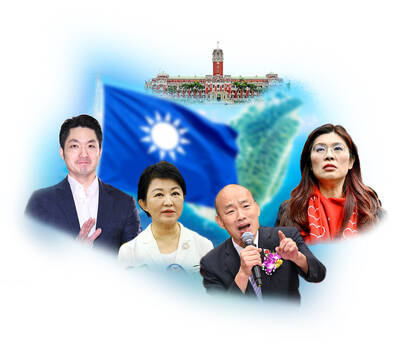
The January 2028 presidential election is already stirring to life. In seven or eight months, the primary season will kick into high gear following this November’s local elections. By this point next year, we will likely know the Democratic Progressive Party (DPP) candidate and whether the Taiwan People’s Party (TPP) will be fielding a candidate. Also around this time, the Chinese Nationalist Party (KMT) will either have already completed their primary, or it will be heading into the final stretch. By next summer, the presidential race will be in high gear. The big question is who will be the KMT’s


 RSS
RSS