


Writing of the finds at the ancient iron-working site of Shihsanhang (十 三行) in New Taipei City’s Bali District (八里), archaeologist Tsang Cheng-hwa (臧振華) of the Academia Sinica’s Institute of History and Philology observes: “One bronze bowl gilded with gold, together with copper coins and fragments of Tang and Song ceramics, were also found. These provide evidence for early contact between Taiwan aborigines and Chinese.”
The Shihsanhang Web site from the Ministry of Culture says of the finds: “They were evidence that the residents of the area had a close trading relation with Chinese civilians, as the coins can be traced back to the Han Dynasty to Tang Dynasty, and with people from Southeast Asia where the glass beads were widely used.”
From Han to Tang! That’s centuries of time. Chinese merchants of that era did not conduct trade on Chinese ocean-going vessels, because there were none. In that period, they were more likely to be passengers on Arab, Southeast Asian, Persian or Indian vessels. It is rather unlikely that they conducted trade trips to Taiwan, which was defended by fierce peoples who had little the Chinese wanted. It is far more likely that those objects, if traded, had worked their way up to Shihsanhang along the trade networks of Taiwan’s own indigenous peoples, which extended across the South China Sea.
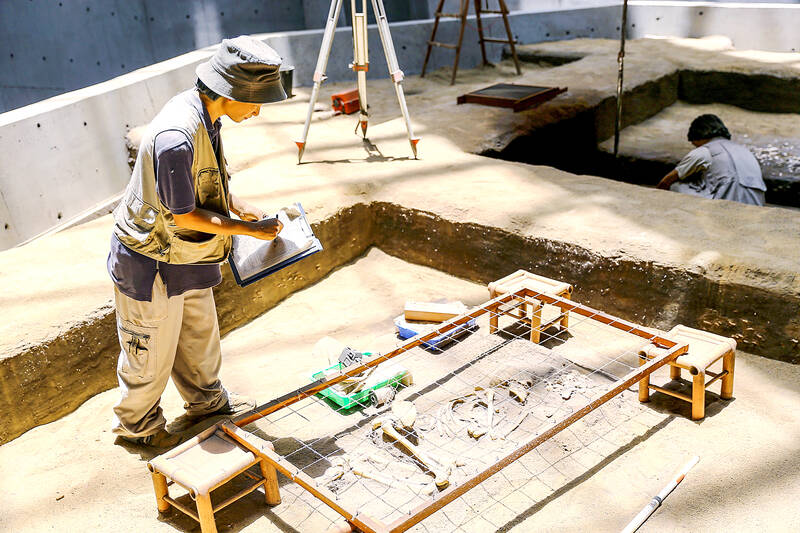
Photo courtesy of the New Taipei City Tourism and Travel Department
The Ministry of Culture’s reference to the glass bead trade, which was conducted with southeast Asia and not with the mainland of Asia across the strait, supports that interpretation. As a 2016 article in Antiquity on Taiwan’s position in prehistoric trade networks observes, both its iron-working and bronze-working technologies appear to be imported from south Asia and southeast Asia, respectively, not from any of the polities on the nearby mainland of Asia.
“The particular styles and forms of casting molds found at Jiuxianglan (舊香蘭) do not occur at contemporary sites in China, but they resemble molds found in Thailand and southern Vietnam,” the authors write.
CHINESE IMPORTS?
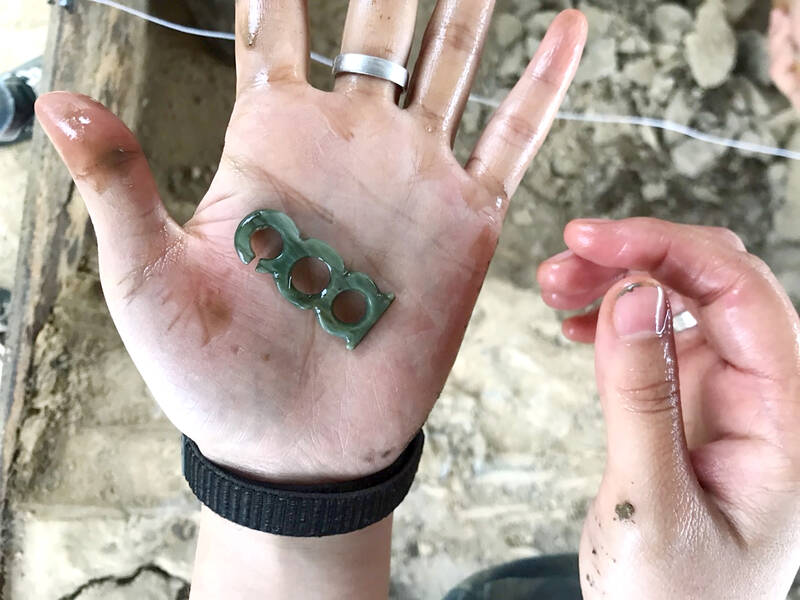
Photo: Lin Hsin-han, Taipei Times
If there was trade in goods from the Han to the Tang, where are the imports of Chinese manufacturing technologies? Note too that in Taiwan the bronze and iron ages occurred at the same time, unlike in China.
Glass beads found in Taiwan are also linked to networks coming up from the south, rather than across the Strait.
“The emergence and development of a Metal Age in Taiwan presented a range of surprising links with Southeast Asia, and especially with southern Thailand, Vietnam and the Philippines, although notably not China,” the authors of the Antiquity piece conclude.
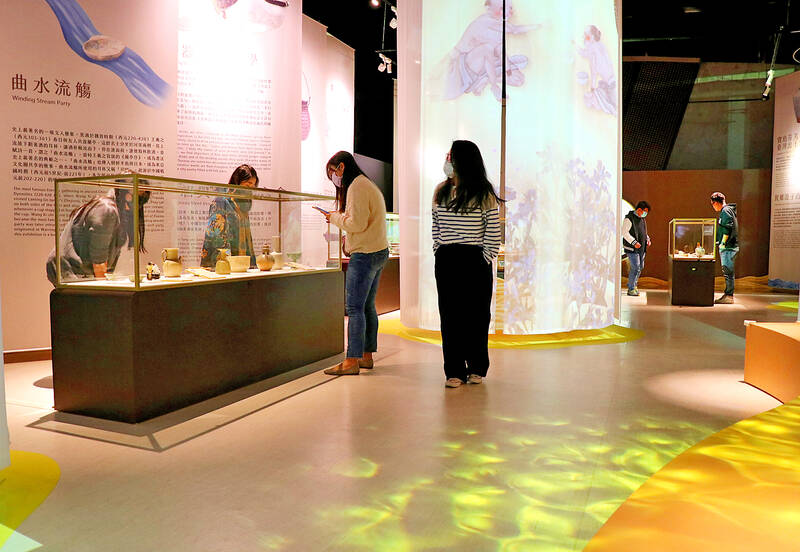
Photo courtesy of the Shihsanhang Museum
In fact, excavations associated with the development of the Tainan Science Park turned up neolithic ax heads made with basalt from Penghu, with stone from the islands used in later eras as well. That trade implies the existence of local seagoing vessels that could have reached the Chinese coast. Where is the flood of Chinese artifacts?
If Chinese merchants or fisherman were trading things to the local indigenous people, one would expect a rather larger selection of objects, including utilitarian items such as iron knives and cloth and perhaps ceremonial objects. The fact that coins and ceramics are found suggests shiny things that indigenous people traded among themselves because they found them attractive and because, as small objects, they were easily carried.
Indeed, a close analysis of glass artifacts from the Litzuwei (籬仔尾) site (1-8th century AD) in Tainan published in 2024 observes that the different regions of Taiwan had distinct preferences in their selection of trade goods.
There may have been contacts between fishermen and the early peoples of Taiwan, but they have been lost to history. Chen Di (陳第), the Ming strategist who visited Taiwan in 1603 while serving in a campaign against Japanese pirates, said that the indigenous people had been driven into the mountains by the pirate attacks during the 1560s. It was only after that, he said, that they came into contact with Chinese traders.
Yet another possibility is that the coins and ceramics were recovered from shipwrecks, which were frequent in the treacherous waters around Taiwan. A 1995 Panorama piece chronicled a resident of Penghu who had said he had located and recovered artifacts from two shipwrecks and knew of four or five other possible shipwreck sites in the area.
In 2016 Academia Sinica Department of History and Philology researcher Liu I-chang (劉益昌) announced that eight wrecks from the Dutch colonial era had been located in Tainan’s Taijiang National Park (台江國家公園). Because trade vessels leaving Fuzhou used the tip of Taiwan and its tiny islets as the reference for the turn to the Ryukyu islands and Japan to the north, there must have been many wrecks in the area. In other areas of the world shipwrecks were sources of iron and tools for local indigenous people. They could also have been despoiled from hapless mariners who made it to shore.
Navigation in the Strait was a problem even for mariners experienced in the area.
“In the passage to Taiwan it is the Black-water Ditch that is most dangerous,” wrote Yu Yonghe (陏永河) in his 1697 diary of his trip to Taiwan.
“The helmsman will cast paper ingots [into the ditch], holding his breath in fear lest [the vessel be swept] southward by the current to one knows not where,” he observes.
The Portuguese, who traveled through the Strait on their way to Japan, left accounts filled with shipwrecks and storms that blew them off course for days or weeks. Learning the rhythms of the local seas and winds took westerners decades. Indeed, the first provable Portuguese landing on Formosa, 1582, was the result of a shipwreck.
Spokespersons of the People’s Republic of China (PRC) constantly claim that the annexation of Taiwan to the PRC is “inevitable.” That framing of “inevitability” has two dimensions. One invokes the powerful military advantages of the PRC to contend that no one can stop the PRC from annexing Taiwan, a popular claim among pro-China types on the Internet. The second dimension, however, presents annexation as the inevitable outcome of a long historical relationship, as Taiwan’s destiny.
The entire archaeological history of Taiwan, especially after the beginning of the metal age, shows that there is nothing inevitable about contacts between Taiwan and the area that is now the PRC. Despite hosting complex interregional trading networks, both sides ignored each other until the end of the 16th century when Chinese pirates began to haunt the island’s coasts. Even the geographic overlaps in their networks — for example, both Taiwanese indigenous peoples and Chinese traded with northern Luzon — did not lead to the development of dense trade networks between the two sides.
Such networks would await the arrival of the Dutch, who brought in people from China, and trade items that rapidly spread across southern Taiwan. The instant demand for Dutch goods among indigenous people shows that if the Chinese had been regularly trading with the local indigenous people, there should be a much richer selection of Chinese artifacts in local archaeological sites. The Dutch experience also demonstrates that the PRC claims of early administration of Taiwan are lies: where is the demand for the goods Chinese administrators would have introduced to the locals?
Notes from Central Taiwan is a column written by long-term resident Michael Turton, who provides incisive commentary informed by three decades of living in and writing about his adoptive country. The views expressed here are his own.
The breakwater stretches out to sea from the sprawling Kaohsiung port in southern Taiwan. Normally, it’s crowded with massive tankers ferrying liquefied natural gas from Qatar to be stored in the bulbous white tanks that dot the shoreline. These are not normal times, though, and not a single shipment from Qatar has docked at the Yongan terminal since early March after the Strait of Hormuz was shuttered. The suspension has provided a realistic preview of a potential Chinese blockade, a move that would throttle an economy anchored by the world’s most advanced and power-hungry semiconductor industry. It is a stark reminder of
May 11 to May 17 Traversing the southern slopes of the Yushan Range in 1931, Japanese naturalist Tadao Kano knew he was approaching the last swath of Taiwan still beyond colonial control. The “vast, unknown territory,” protected by the “fierce” Bunun headman Dahu Ali, was “filled with an utterly endless jungle that choked the mountains and valleys,” Kano wrote. He noted how the group had “refused to submit to the measures of our authorities and entrenched themselves deep in these mountains … living a free existence spent chasing deer in the morning and seeking serow in the evening,” even describing them as

As a different column was being written, the big news dropped that Chinese Nationalist Party (KMT) caucus whip Fu Kun-chi (傅?萁) announced that negotiations within his caucus, with legislative speaker Han Kuo-yu (韓國瑜) of the KMT, party Chair Cheng Li-wun (鄭麗文), Taichung Mayor Lu Shiow-yen (盧秀燕) and Taiwan People’s Party (TPP) Chair Huang Kuo-chang (黃國昌) had produced a compromise special military budget proposal. On Thursday morning, prior to meeting with Cheng over a lunch of beef noodles, Lu reiterated her support for a budget of NT$800 or NT$900 billion — but refused to comment after the meeting. Right after Fu’s
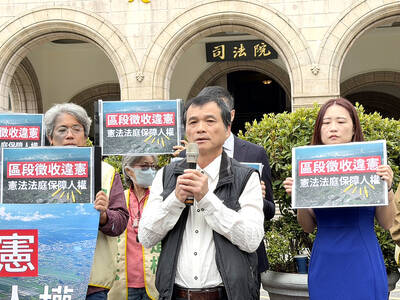
What government project has expropriated the most land in Taiwan? According to local media reports, it is the Taoyuan Aerotropolis, eating 2,500 hectares of land in its first phase, with more to come. Forty thousand people are expected to be displaced by the project. Naturally that enormous land grab is generating powerful pushback. Last week Chen Chien-ho (陳健和), a local resident of Jhuwei Borough (竹圍) in Taoyuan City’s Dayuan District (大園) filed a petition for constitutional review of the project after losing his case at the Taipei Administrative Court. The Administrative Court found in favor of nine other local landowners, but


 RSS
RSS