


As a different column was being written, the big news dropped that Chinese Nationalist Party (KMT) caucus whip Fu Kun-chi (傅?萁) announced that negotiations within his caucus, with legislative speaker Han Kuo-yu (韓國瑜) of the KMT, party Chair Cheng Li-wun (鄭麗文), Taichung Mayor Lu Shiow-yen (盧秀燕) and Taiwan People’s Party (TPP) Chair Huang Kuo-chang (黃國昌) had produced a compromise special military budget proposal.
On Thursday morning, prior to meeting with Cheng over a lunch of beef noodles, Lu reiterated her support for a budget of NT$800 or NT$900 billion — but refused to comment after the meeting. Right after Fu’s announcement, Lu confirmed to the press her support for the compromise proposal.
Standing next to Fu as he made his announcement was lawmaker Hsu Chiao-hsin (徐巧芯), who had previously been viewed as the leader of a group of lawmakers pushing for an NT$800 billion budget instead of the party’s official NT$380 billion “+N” proposal.
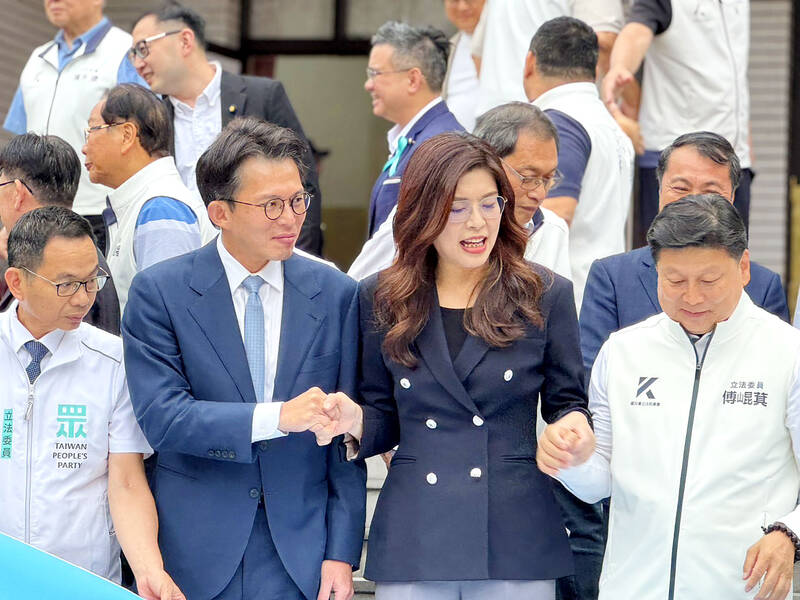
Photo: Lo Kuo-chia, Taipei Times
The topic of the special military budget is a potentially existential one, and was the topic of two previous columns that provide more context: “Donovan’s Deep Dives: The battle over Taiwan’s defense spending” (May 2, page 12) and “Donovan’s Deep Dives: The special defense budget is a crucial test of KMT leadership and party unity” (May 7, page 12). For a broader perspective with historical context, I also highly recommend Michael Turton’s “Notes from Central Taiwan: The KMT’s old defense game” (May 7, page 12).
From the scant details available as this is being written, the new proposal is NT$300 billion up front, with a second tranche of NT$480 billion to be disbursed for arms purchases from the US once formal approval is given for further sales by Washington. The total of NT$780 billion is less than the NT$800 billion that Jason Hsu (許毓仁) — a former KMT lawmaker and senior fellow at Washington, DC-based Hudson Institute — claims is the US’ “bottom line.”
That rumored “bottom line” figure has been bandied about for weeks, but this is the first time I have seen it directly attributed to any one person. Officially, the Americans strongly support the ruling Democratic Progressive Party’s (DPP) NT$1.25 trillion special military budget to be spread out over eight years.
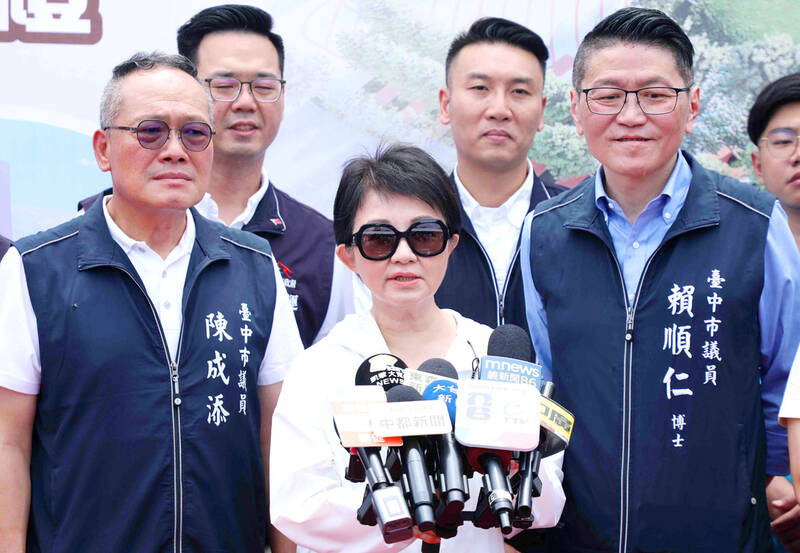
Photo: Tsai Shu-yuan, Taipei Times
WHAT IS UP WITH HUANG GUOCHANG?
Officially, the DPP is standing firm by their proposal. But yet again, the NT$800 billion appears in a NextApple news piece, attributing these quotes to TPP Chair Huang via his Threads social media account: “Yesterday, during negotiations over the arms procurement budget, the DPP presented a united front, insisting that not a single dollar could be cut from the NT$1.25 trillion proposal. Defense Minister [Wellington] Koo Li-hsiung [顧立雄] even flew into a rage…”
He then continued: “But then DPP caucus chief Tsai Chi-chang [蔡其昌] and senior officials from the Executive Yuan privately came to the TPP asking for help, saying that in reality they only needed NT$800 billion for arms purchases plus an additional NT$60 billion.”
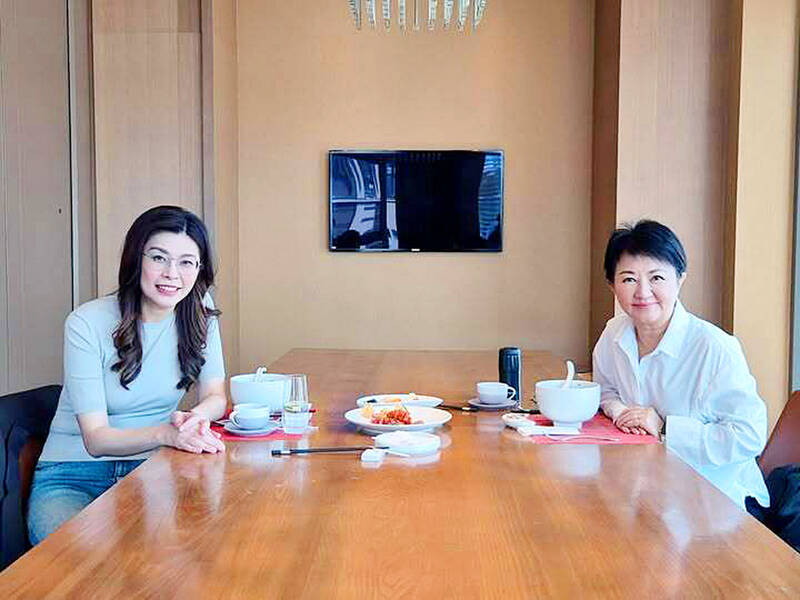
Photo taken from Cheng Li-wun’s Facebook page
Checking the source, I discovered that the quotes came from the only Threads account with any significant following was “huang.guochang,” along with a presumably linked Instagram account of the same name — but neither is verified. It seems highly unlikely that he would not have accounts on both platforms — and no other accounts fit the follower count and content profile — but it begs a key question: If this is his account, why is he using China’s Hanyu Pinyin spelling Huang Guochang as his username instead of the modified Wade-Giles Huang Kuo-chang used in Taiwan?
No similar post appears on his Facebook profile “kcfor2016,” which is verified and presumably the “kc” refers to “Kuo-chang.” However, in 2016 he had very different political views, and Facebook is now typically used for more “serious” and “official” posts and Threads for more informal content. This is all something of a mystery.
So, either Huang made a disastrously stupid mistake in revealing the DPP’s private negotiating position — ensuring they will never try to compromise or reach consensus with him again — or he really should look into whoever is behind the very official-looking “huang.guochang” accounts on Instagram (113k followers) and Threads (60.7k followers) pretending to speak for him.
CHENG’S WINS AND LOSSES
Like any compromise, this is a mix of wins and losses for Cheng, though until the full details are released, it is hard to do a full accounting.
Clearly, she had to back down and increase the headline number to something closer to the NT$800 billion that reportedly more members of the KMT caucus supported. On the other hand, by breaking it into two tranches and lowering the first tranche to NT$80 billion below her earlier position of NT$380 billion, she can claim the second tranche of NT$480 billion was more or less what she meant by “+N” all along.
Crucially for Cheng, she has held on to her authority as party leader. She can justifiably point out that she listened to all viewpoints in her party and successfully hammered out a compromise, which is what the leader of a democratic party is supposed to do.
However, it does weaken her hand on two fronts in her quest to negotiate a “peace framework” with the Chinese Communist Party (CCP) Secretary-General Xi Jinping (習近平). Initially, she had opposed any special military budget at all, and then picked a relatively small NT$380 billion with many strings attached under pressure — or one-third of the DPP’s requested budget — presumably to show goodwill and sincerity to Xi and the CCP.
It is likely that she, and perhaps Fu, dug in their heels at going for a full NT$800 billion to ensure that the US did not get their rumored “bottom line.” There may also be many more strings attached in the final proposal that have not been made public yet.
For the CCP, this is no doubt a big disappointment. They are expected to bring up Taiwan in the upcoming meeting between Xi and US President Donald Trump.
Though no deal has been finalized between the KMT and the DPP, at two-thirds the size of the DPP’s proposal, it will be harder for the CCP to portray the Taiwanese as completely disunited and claim that a “majority of Taiwanese compatriots” really support unification. Beijing would not like this deal to go through at all, or at very least not have such substantive movement towards a potential deal prior to Trump’s arrival.
If Cheng had not backed down, she risked KMT lawmakers openly disobeying her authority. That would have tanked her dreams of having a “peace framework” to present to voters in 2028.
By unifying the KMT and TPP alliance, she keeps her dreams alive, though the size and timing of the proposal does weaken her hand in building trust in Beijing.
Another reason she likely compromised is that many in her party made it clear that failing to do so would risk tanking the party’s chances in key races in local elections in November. Typically, following a disastrous election result, party chairs are expected to resign to take responsibility.
That would have left Cheng with two ugly options: Either follow tradition and resign or fight on without the full backing of the party and likely many calling for her to step down.
She may be calculating that a weakened hand in the short term is better than having no hand to play at all after the elections. Now, if the elections go reasonably well — and the electoral math looks good for the KMT — she can resume her quest to work a deal with Beijing after November with her position and authority secure.
Donovan’s Deep Dives is a regular column by Courtney Donovan Smith (石東文) who writes in-depth analysis on everything about Taiwan’s political scene and geopolitics. Donovan is also the central Taiwan correspondent at ICRT FM100 Radio News, co-publisher of Compass Magazine, co-founder Taiwan Report (report.tw) and former chair of the Taichung American Chamber of Commerce. Follow him on X: @donovan_smith.

Ajay Verma, a consultant gastroenterologist at Kettering general hospital in Northamptonshire, says our gut is a “complex machine.” “It is constantly providing us with the nutrition we need, initially to grow and develop, and then for us to survive, thrive and repair from injury and illness.” How can we keep it functioning well? Put simply: “Make sure what you put into it is balanced, and that you clear out its waste products adequately,” Verma says. “In a general gastroenterology clinic, the most common conditions we see are irritable bowel syndrome (IBS), gastroesophageal reflux disease, inflammatory bowel disease and constipation,” says Nisha
The arithmetic is straightforward and uncomfortable. By the end of 2025, Taiwan had committed itself to a 50-30-20 electricity mix — half natural gas, 30 per cent coal, 20 per cent renewables. The Ministry of Economic Affairs’s (MOEA) own monthly energy reports tell a different story. Natural gas reached 47.8 per cent of generation last year. Coal stood at 35.4 per cent, comfortably above its target ceiling. Renewables came in at 13.1 per cent, well short of the 20 per cent Taipei had pledged a decade earlier. Installed renewable capacity reached roughly half of the 12 gigawatts (GW) the government
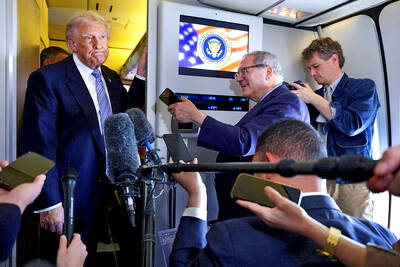
Last week US President Donald Trump was asked by a reporter whether he would speak on the phone to the President of Taiwan. “l’ll speak to him. I speak to everybody. We have that situation very well in hand,” Trump said. This marked the second time in a couple of weeks he had said he would talk to the President of Taiwan. In 2016 he famously took a call from then-president Tsai Ing-wen (蔡英文), when he was president-elect. Despite warnings that the apocalypse was nigh because of a phone call, the world quickly forgot about the conversation between two democratically-elected presidents.
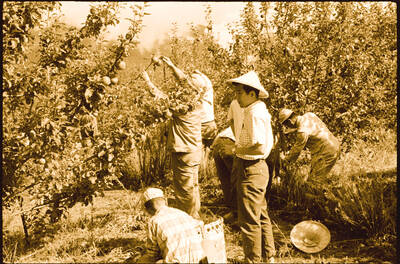
May 25 to May 31 Few believed that apples could be cultivated on a commercial scale in Taiwan’s high mountains. When horticulturalist Cheng Chao-hsiung (程兆熊) first proposed the idea in 1955, both American and Taiwanese colleagues dismissed it as implausible, arguing that temperate fruit could not be reliably grown on a subtropical island, especially on rugged terrain. However, it was this terrain in the Central Mountain Range where many Chinese Civil War veterans were resettled in the late 1950s. With limited job prospects and no family in Taiwan, they were placed on cooperative farms aimed toward self-sufficiency. Some say the conditions


 RSS
RSS