


Hallways, generally speaking, are not places you want to be in the movies. You can be just strolling down one when, all of a sudden, elevator doors open up and a river of blood comes flowing out.
They are often corridors of violence — the site of the hammer rampage of Oldboy or the rotating fisticuffs of Inception — where narrow walls buffer and condense the action. Or they can focus a character’s direction. To set Lee Marvin’s appropriately named Walker on his obsessive path in the revenge thriller Point Blank, John Boorman just needed to send him and his ominously echoing heels down a hallway.
But Exit 8, a new film by the Japanese director Genki Kawamura, is the first movie I can recall to land in a hallway, and stay there. The movie opens in first person, from the perspective of a guy on a crowded Tokyo subway. Like everyone else, he’s looking at his phone.
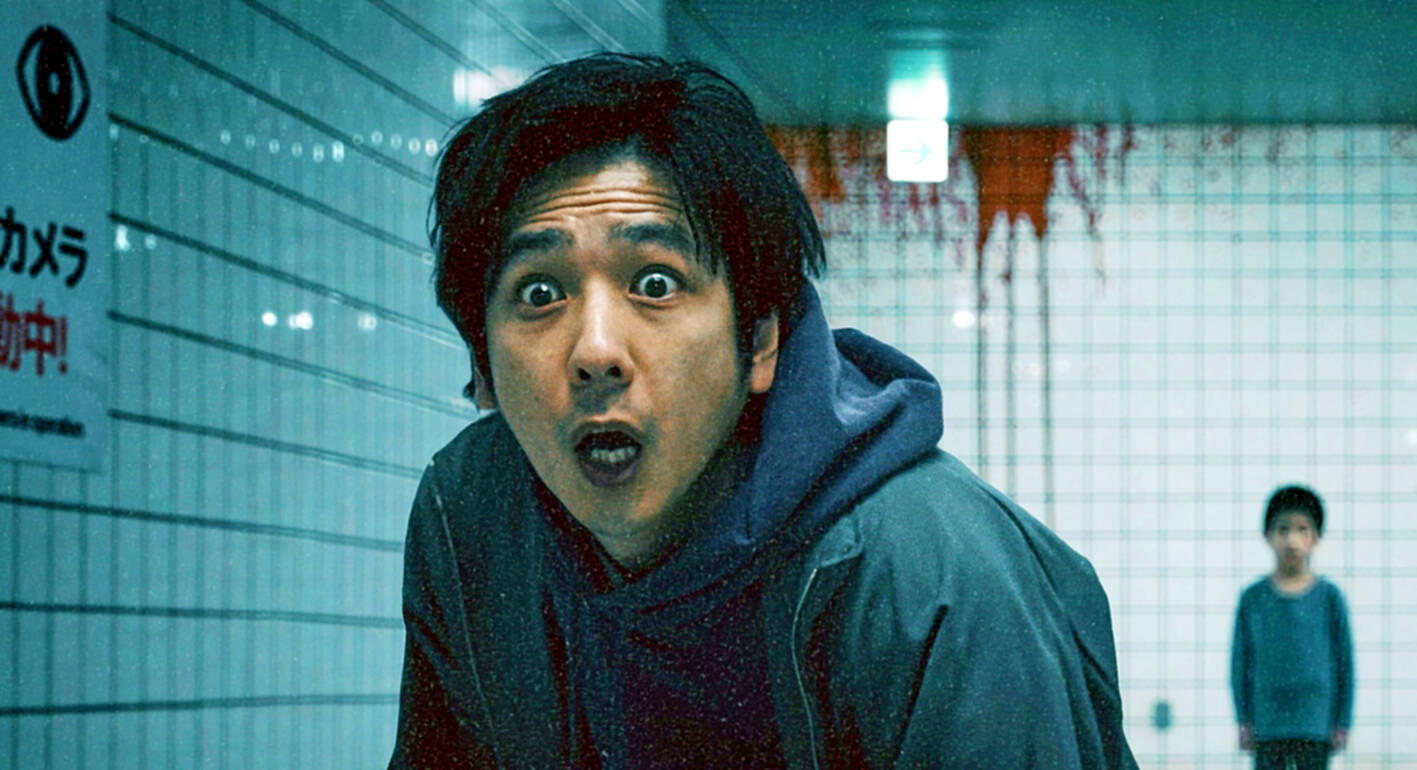
Photo: AP
While he huffs and puffs his way off the train and up the stairs (he has asthma), he fumbles with his earbuds. He pauses from his music — a curiously march-like tune by Ravel — to speak to a woman on the phone. She’s in the hospital and they need to make a choice. He mumbles that he’s on his way before the line cuts out.
As he shuffles through the throngs of commuters in the byzantine underground, he turns toward signs for Exit 8. But after he passes down a hallway, he’s mystified to end up back where he started. At first he assumes he made a wrong turn, and hustles down the Exit 8 corridor again, only to, again, arrive at the same spot.
Of all the nightmarish puzzles the movies have conjured, Exit 8 is among the most devilishly simple, and, as it turns out, metaphorically rich. Kawamura’s film is based on an indie video-game sensation, The Exit 8, where first-person players are ushered down a tiled metro tunnel (almost exactly like the one in the movie) and don’t escape its repeating loop until they grasp the game and make it from one level to the next.
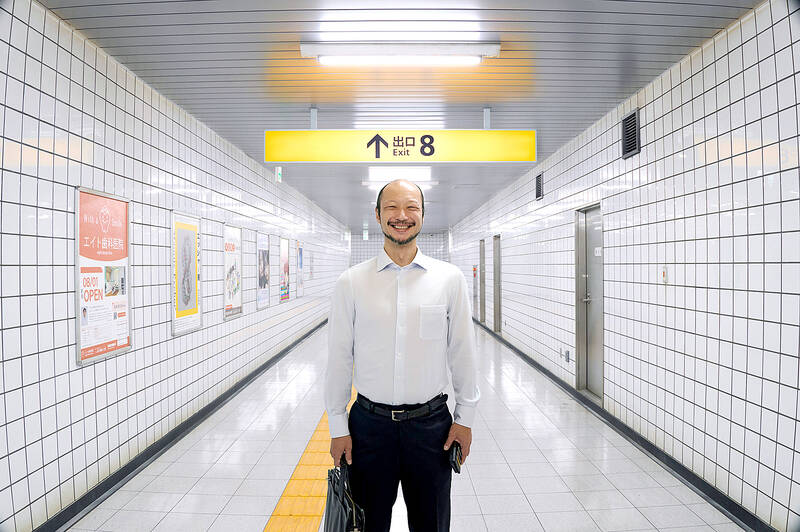
Photo: AP
So, yes, The Super Mario Galaxy Movie has company. You could, realistically, enter a movie theater right now, walk down the hall, follow signs for the video-game adaptation, and stroll unaware not into the Nintendo escapade but into the Kafkaesque labyrinth of Exit 8.
Such a detour, I’d say, would be advisable. By its nature, Exit 8 is sparse and repetitive. But in the not-especially-decorated annals of video game adaptations, it’s one of the most compelling and clever meldings of the two mediums — cinema and gaming — we’ve seen yet. It was an enormous hit in Japan.
The game, itself, is spartan. But while the movie keeps the game’s premise and even much of its central gameplay intact, it suffuses it with just enough backstory to expand and deepen it. Kawamura’s previous film, A Hundred Flowers, seen through the eyes of a woman with dementia, was also predicated by a seemingly restrictive point of view. In Exit 8, he levels up a bare-bones game with humanity.
Our guy’s name is never spoken. He’s credited only as The Lost Man, and played by Kazunari Ninomiya, a pop star who was a standout in Clint Eastwood’s Letters From Iwo Jima. We only get a look at him once the hallway starts repeating and our perspective shifts. After going around in circles, he notices instructions on the wall: Turn back if you see any anomaly, proceed forward if you don’t.
The Lost Man begins counting every vent, door and poster (including a very fitting Escher one) along his way. Part of the trick is deciphering what constitutes an anomaly and what doesn’t. There’s a very robotic commuter who walks past every time — The Walking Man (Yamato Kochi) — and, at one level, a boy (Naru Asanuma) in the middle of the corridor. Making it to Exit 8 may be a game, but passage ultimately hinges on seeing — really seeing — those around you.
That’s why the image that’s likely to stick with you after the film isn’t the sterile subway hallway that’s overwhelmingly where the movie resides. In this Mobius strip of a movie, it’s those first moments on the subway, when faces lit by smartphones choose not to notice an anomaly: a man shouting at a mother with a crying baby. Exit 8 may be based on the thinnest of conceits, but bringing it into the realm of cinema means opening it to the possibility of empathy. The marching music in The Lost Man’s earbuds may be a call to arms, after all.


The US war on Iran has illuminated the deep interdependence of Asia on flows of oil and related items as raw materials that become the basis of modern human civilization. Australians and New Zealanders had a wake up call. The crisis also emphasizes how the Philippines is a swatch of islands linked by jet fuel. These revelations have deep implications for an invasion of Taiwan. Much of the commentary on the Taiwan scenario has looked at the disruptions to world trade, which will be in the trillions. However, the Iran war offers additional specific lessons for a Taiwan scenario. An insightful

Polling data often confirms what we expect, but sometimes it throws up surprises. When examined over time, some patterns appear that speak to something bigger going on. In this column, whenever possible, Formosa’s polls are used. Despite the sometimes cringeworthy antics of Formosa’s Chairman, Wu Tzu-Chia (吳子嘉), the data produced includes detailed breakdowns crucial for analysis. It has also been conducted monthly 11-12 times a year for many years with many of the same questions, allowing for analysis over time. When big shifts do occur between one month and the next it is usually in response to some event in

The problem with Marx’s famous remark that history repeats itself, first as tragedy, the second time as farce, is that the first time is usually farce as well. This week Chinese Nationalist Party (KMT) Chair Cheng Li-wun (鄭麗文) made a pilgrimage to the People’s Republic of China (PRC) “to confer, converse and otherwise hob-nob” with Chinese Communist Party (CCP) officials. The visit was an instant international media hit, with major media reporting almost entirely shorn of context. “Taiwan’s main opposition leader landed in China Tuesday for a rare visit aimed at cross-strait ‘peace’”, crowed Agence-France Presse (AFP) from Shanghai. Rare!

April 6 to April 13 Few expected a Japanese manga adaptation featuring four tall, long-haired heartthrobs and a plucky heroine to transform Taiwan’s television industry. But Meteor Garden (流星花園) took the nation by storm after premiering on April 12, 2001, single-handedly creating the “idol drama” (偶像劇) craze that captivated young viewers across Asia. The show was so successful that Japan produced its own remake in 2005, followed by South Korea, China and Thailand. Other channels quickly followed suit, with more than 50 such shows appearing over the following two years. Departing from the melodramatic


 RSS
RSS