


Polling data often confirms what we expect, but sometimes it throws up surprises. When examined over time, some patterns appear that speak to something bigger going on.
In this column, whenever possible, Formosa’s polls are used. Despite the sometimes cringeworthy antics of Formosa’s Chairman, Wu Tzu-Chia (吳子嘉), the data produced includes detailed breakdowns crucial for analysis. It has also been conducted monthly 11-12 times a year for many years with many of the same questions, allowing for analysis over time.
When big shifts do occur between one month and the next it is usually in response to some event in the news. This is unlike some pollsters, whose data gyrates wildly from month to month without any apparent reason or cause.

Photo: Lo Pei-der, Taipei Times
Formosa’s polling is also widely respected and cited by political analysts and commentators across the political spectrum, unlike some polling outfits that are favored by one side or the other. By sticking to one polling outfit consistently, this ensures apples-to-apples comparisons and enforces discipline to avoid the temptation to cherry-pick.
That does not mean other polls should never be used — sometimes they ask questions and provide data that Formosa does not. For example, another reputable poll that is worth citing is the biannual National Chengchi University’s (NCCU) Election Study Center’s “Trends of Core Political Attitudes” polling.
After (unusually) skipping February, Formosa just released their latest monthly poll, conducted from March 26 to 28. It had some juicy insights on the current political situation, but also shed some light on longer-term trends.
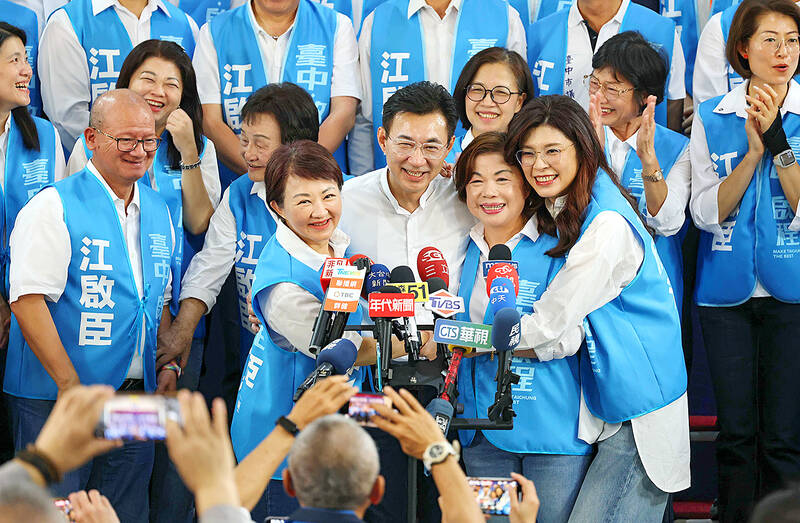
polling suggests that Cheng’s upcoming visit to China will cost the KMT dearly. Photo: Tsai Shu-yuan, Taipei Times
THE DPP GENDER SWAP
In the late 2010s, there was some discussion about why women were more favorable to the Chinese Nationalist Party (KMT), typically by five to 10 points. Conversely, men preferred the Democratic Progressive Party (DPP) by similar margins. This gap carried over to politicians — especially former president Tsai Ing-wen (蔡英文) — who was similarly more popular with men than women, by similar or even larger margins.
Why this was the case was the subject of some debate. Yet, none of the theories seemed to explain the gap fully and lacked data. Likely, the causes were complicated and nuanced, varying from person to person.

Photo: Fang Pin-chao, Taipei Times
In recent years, this has been flipped on its head and today women are more positive on the DPP and President William Lai (賴清德) than men, but curiously barely differ on the KMT.
Men’s favorability towards the DPP stands at 41.1 percent, with 47 percent viewing them unfavorably. For women, it is 46.1 and 40.8 percent, respectively. There is a similar, but slightly smaller gap on confidence in Lai and satisfaction in his administration.
Yet, on favorability and unfavorability on the KMT, the gap is only 0.9 percent and 2 percent, respectively. The men came in slightly higher in both, but still close enough to be roughly tied.
THE TPP’S MOODY MEN PROBLEM
Of course, that is because men — especially young, angry men — have moved to supporting the Taiwan People’s Party (TPP), right? After all, this is the stereotype, and ties in with broader international trends of a wider gender gap among younger voters.
Curiously, the answer is both yes and no. The view that younger people are more likely to support the TPP is broadly correct, but the 20-29 demographic shows mood swings. Typically, they are the most likely group to view the TPP favorably, but periodically it declines sharply, and is overtaken by the 30-39 demographic.
On gender, TPP support goes through mysterious, periodic cycles. For periods, favorability among men rises significantly above that for women, yet they reconverge during other periods. I have not been able to identify any significant factor for this cyclical pattern.
Currently, for women, favorability towards the TPP is 24 percent versus 27.8 for men. While the men are 3.8 more likely to view the TPP favorably, they are also slightly more likely to view them unfavorably at 57.4 versus 55.6 for the women.
Ah, but this poll started on March 26, the day party founder Ko Wen-je (柯文哲) received a 17-year jail sentence, so that influenced the poll, right? The answer is not as clear-cut as one might expect.
Since the January poll, TPP favorability among men plunged by 8.5 percent, but only 1.4 percent with women. Muddying the picture, favorability among both men and women one year ago was almost the same as now, but the unfavorability among both was higher than this latest poll.
Even more confusing, while unfavorability rose since January by three to four points, it is still lower than a year ago by a similar margin.
What is interesting is that women who view the TPP favorably have been consistent. For example, it is 24 percent now, 25.4 percent in January and 23.1 percent one year ago. It is the men who account for the big swings.
Since the TPP’s support skews young, it appears they have a moody, young man problem. That makes it harder to predict what their support really is.
SOME BRIGHT SPOTS FOR THE DPP
There were some bright spots in this latest poll for the DPP. Favorability among 20-29 year olds is 48.6 percent, a full five points higher than the average across all demographics. Similarly, unfavorability is at 39.8, or a full four points lower than the average.
Recently, the DPP has polled far below the average among that demographic compared to other age groups, so this is a noticeable shift. For many years, DPP support among young voters was much higher than other groups, with few supporting the KMT.
That shifted in the last few years, with many drifting to the TPP. However, the KMT remained unpopular among younger voters despite the last three KMT chairs putting in considerable efforts to woo them.
With only the latest poll showing the DPP making solid gains among the young, it is far too early to determine if this is a trend, or a temporary blip related to recent news and events.
The DPP also got some good news on a question Formosa asks periodically: whether the benefits outweigh the costs of restarting nuclear power plants. In total, 63.2 percent thought it beneficial and only 18.7 percent thought the downsides were higher. That is a dramatic shift from 2017, when the two were basically even.
This suggests President Lai’s dramatic shift on the subject was a politically sound move, despite 55.4 percent calling it an “overthrow” of the DPP’s longstanding position on nuclear power.
Another interesting question was whether the costs outweighed the benefits for the KMT in this November’s election by a theoretical KMT Chairwoman Cheng Li-wun (鄭麗文) meeting with Chinese Communist Party General-Secretary Xi Jinping (習近平). The result was not good news for the KMT, 56.1 percent thought it would cost them, versus only 21.6 percent who thought it would benefit them.
Confidence in Cheng has also been dropping, at only 23.9 percent versus 28.7 in January. Those lacking confidence in her also ticked up slightly to 54.5 percent.
The poll was conducted just prior to the announcement that Cheng was visiting China this month, but there is still no Xi meeting confirmed, so the results were not likely effected much.
The poll was also conducted prior to Chu Cheng-chi (朱政騏), a former legislative assistant who won a DPP primary for a Taipei city council seat, being indicted Thursday on charges of spying for China.
Donovan’s Deep Dives is a regular column by Courtney Donovan Smith (石東文) who writes in-depth analysis on everything about Taiwan’s political scene and geopolitics. Donovan is also the central Taiwan correspondent at ICRT FM100 Radio News, co-publisher of Compass Magazine, co-founder Taiwan Report (report.tw) and former chair of the Taichung American Chamber of Commerce. Follow him on X: @donovan_smith.

The Portuguese never established a presence on Taiwan, but they must have traded with the indigenous people because later traders reported that the locals referred to parts of deer using Portuguese words. What goods might the Portuguese have offered their indigenous trade partners? Among them must have been slaves, for the Portuguese dealt slaves across Asia. Though we often speak of “Portuguese” ships, imagining them as picturesque vessels manned by pointy-bearded Iberians, in Asia Portuguese shipping between local destinations was crewed by Asian seamen, with a handful of white or Eurasian officers. “Even the great carracks of 1,000-2,000 tons which plied

It’s only half the size of its more famous counterpart in Taipei, but the Botanical Garden of the National Museum of Nature Science (NMNS, 國立自然科學博物館植物園) is surely one of urban Taiwan’s most inviting green spaces. Covering 4.5 hectares immediately northeast of the government-run museum in Taichung’s North District (北區), the garden features more than 700 plant species, many of which are labeled in Chinese but not in English. Since its establishment in 1999, the site’s managers have done their best to replicate a number of native ecosystems, dividing the site into eight areas. The name of the Coral Atoll Zone might

On Monday morning, in quick succession, the Chinese Communist Party (CCP) and the Chinese Nationalist Party (KMT) released statements announcing “that the Central Committee of the Communist Party of China and General Secretary Xi Jinping (習近平) have invited KMT Chairwoman Cheng Li-wun (鄭麗文) to lead a delegation on a visit to the mainland” as the KMT’s press release worded it. The KMT’s press release added “Chairwoman Cheng expressed her gratitude for the invitation and has gladly accepted it.” Beijing’s official Xinhua news release described Song Tao (宋濤), head of the Taiwan Work Office of the CCP Central Committee, as
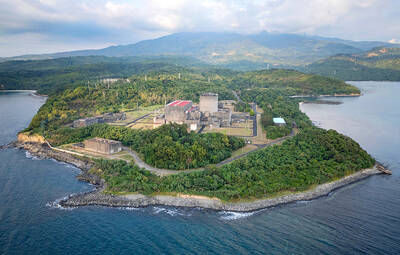
Nuclear power is getting a second look in Southeast Asia as countries prepare to meet surging energy demand as they vie for artificial intelligence-focused data centers. Several Southeast Asian nations are reviving mothballed nuclear plans and setting ambitious targets and nearly half of the region could, if they pursue those goals, have nuclear energy in the 2030s. Even countries without current plans have signaled their interest. Southeast Asia has never produced a single watt of nuclear energy, despite long-held atomic ambitions. But that may soon change as pressure mounts to reduce emissions that contribute to climate change, while meeting growing power needs. The


 RSS
RSS