


People Concerto (眾人協奏曲) began with a simple idea: take a step and hear a sound. Composer Chang Shiuan (張玹) then wondered what kind of music would emerge if a group of people moved together.
But turning that notion into reality was much more complicated than Chang had expected, requiring collaborators from fields ranging from dance and theater to technology and installation design.
The result is an immersive concert in which audiences wander across a 7-by-9 grid while infrared sensors, AI systems, lights, text prompts and a roaming dancer shape and translate their movements into an ever-changing soundscape. Here, the audience becomes the musicians, and no two performances unfold the same way.
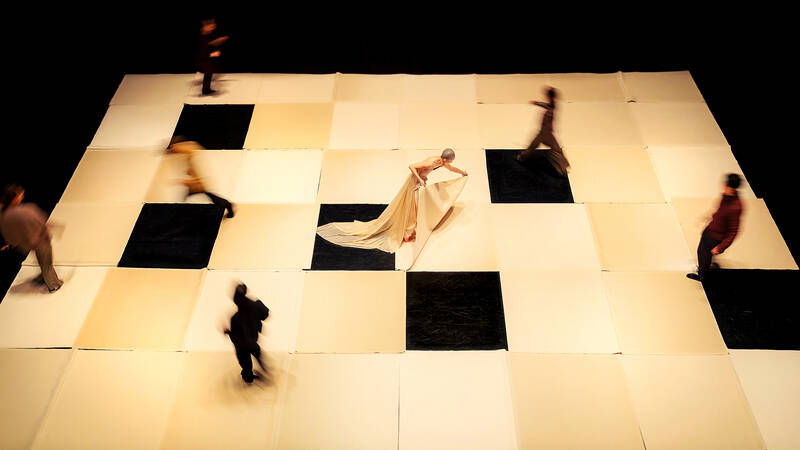
Photo courtesy of Lee Chia-yeh
The hour-long experience will run tomorrow to Sunday at National Kaohsiung Center for the Arts (Weiwuying). While the piece is still rooted in Chang’s compositional practice, incorporating prerecorded vocal and orchestral material alongside live music, it also pushed him into unfamiliar territory.
“It’s my first time creating a large-scale interactive sound installation, my first time doing a stage production and my first time making a participatory work. I never imagined doing any of this at first,” he tells the Taipei Times.
EVOLVING PRACTICE
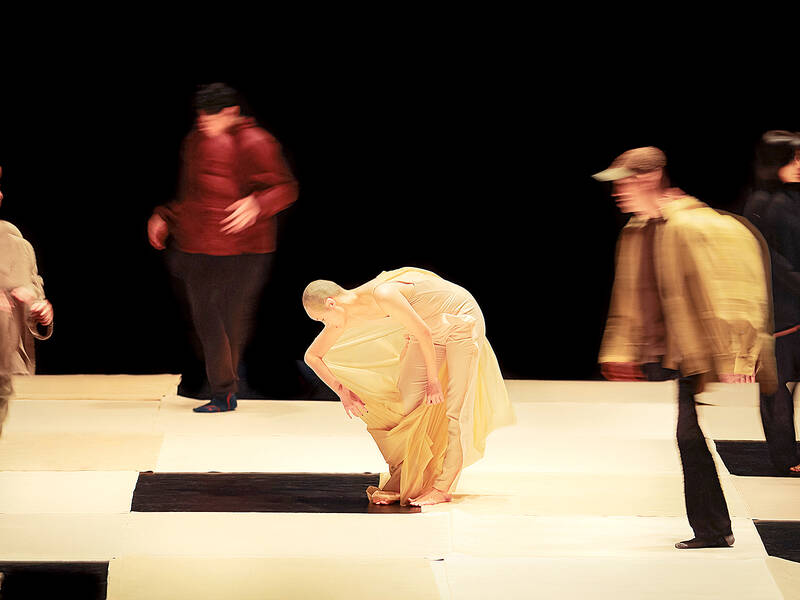
Photo courtesy of Lee Chia-yeh
People Concerto is the latest manifestation of Chang’s creative journey, which began 12 years ago when he hit an artistic block and found himself recalling a childhood memory. At barely two years old, he was pushing a baby walker that produced a knocking sound with every step.
“In that moment, movement and sound became inseparably linked,” he says.
He has explored this notion literally through works like Sounding Light (定光), a collaboration with Cloud Gate Theater in 2020, and also conceptually in last year’s violin concerto 23.5N / 121E, tracing the migration of Taiwan red cypress through processes such as natural growth, logging or transport.
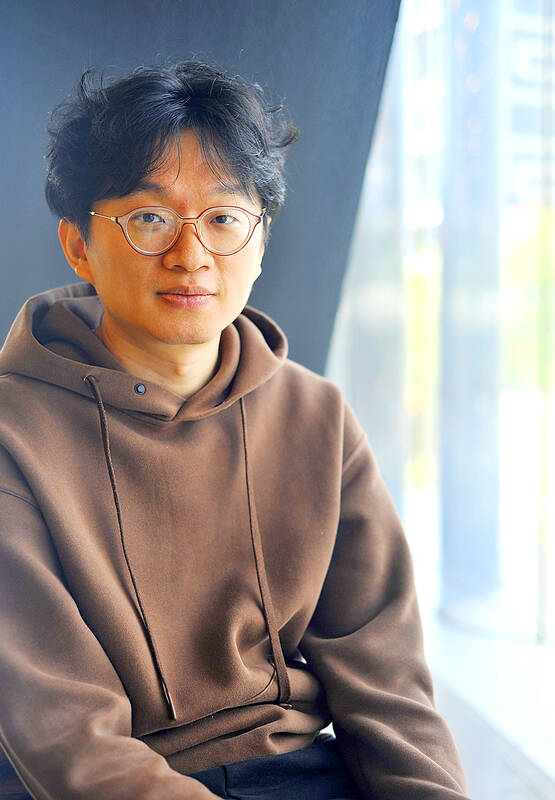
Photo: Han Cheung, Taipei Times
Earthing (安土) was a commission for Dunren Psychiatric Hospital (敦仁醫院) that further shifted Chang’s focus from composing for himself to listening to and connecting with the experiences of others. In People Concerto, his earlier question of “Who am I?” expands to “Who are we?” while also exploring “Where am I?” through the audience’s movements.
COLLECTIVE MUSIC
The black and white grid of the stage is each embedded with sounds and organized into five movements. Germany’s Neue Vocalsolisten Stuttgart provides the vocal parts, which resemble voice speaking from the sky, while the instrumental bits by Belgian ensemble Ictus carry a playful, childlike and sometimes funky quality.
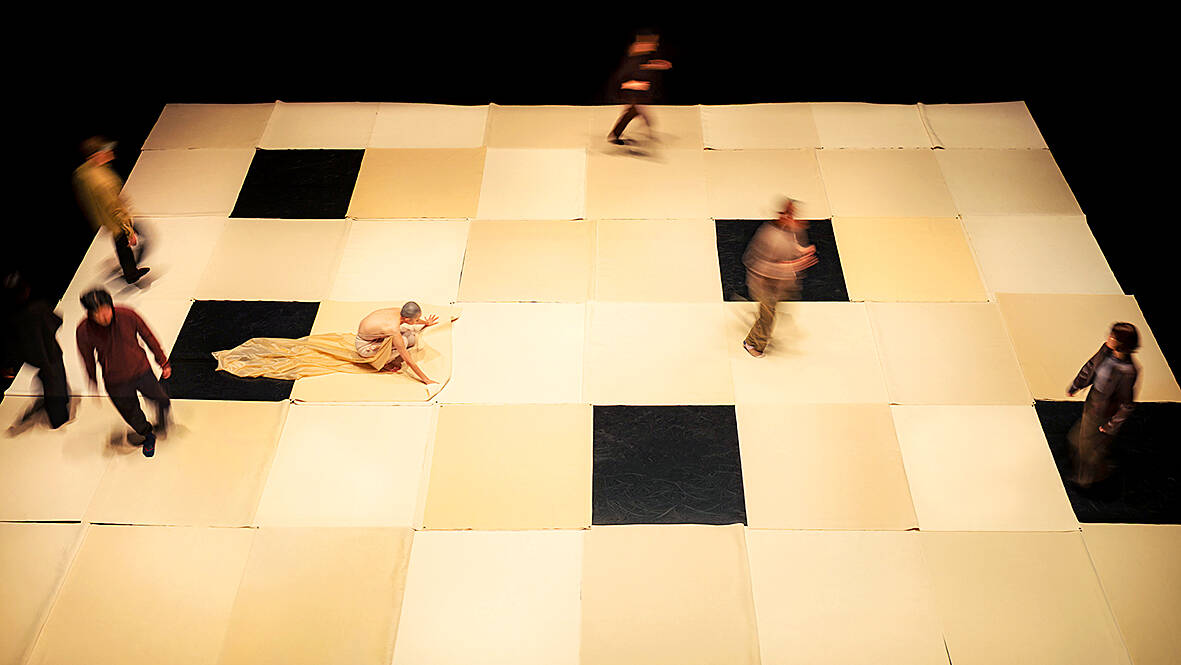
Photo courtesy of Lee Chia-yeh
Rather than forming traditional melodies, Chang compares the piece to listening in a forest: water flowing over stones at varying speeds, the wind moving through branches and leaves, birds calling from near and far.
“Each sound is distinct and independent, but together they form the sound of the forest,” he said.
To Chang, the entire installation is the instrument, and the audience id the musician. Their movements are not entirely random; changes in lighting, the dancer’s movements and subtle prompts hint at possible paths and interactions.
“In addition to figuring out how to write for this new instrument — the entire installation — I also have to understand the musicians,” he says. “In this case, they are the audience, so it’s very tricky. Not everybody notices the cues, nor are they required to follow them. But however they move, the resulting sound should still be pleasant.”
DIVERSE COLLABORATORS
Chang enlisted the Quanta Research Institute and installation and spatial designer Ma Yuan-yuan (馬圓媛) to create a stage with an infrared motion-capture system that tracks the position and movements of each participant. AI processes the data and selects sounds from the composer’s library, learning and adapting along the way.
He stresses that the AI is just a method of processing the complexities of this venture, not composing the piece.
“AI should not replace our creativity or the things we can do ourselves,” he said. “Whether AI is involved doesn’t really matter. If it happens to help realize an idea, then we will use it.”
Chang describes dancer and choreographer Liu I-ling (劉奕伶) as something like a bodhisattva — a guiding presence whose task is to help nudge the world forward. Moving among the audience, she subtly reshapes the environment and influences the collective flow of movement, without participants consciously realizing it.
The biggest challenge, Chang said, was stepping beyond his usual role as a composer, working closely with collaborators from different fields, considering the audience and ensuring that all the components fit together.
“None of these elements are simply added on,” he said. “Everything is connected.”


The US war on Iran has illuminated the deep interdependence of Asia on flows of oil and related items as raw materials that become the basis of modern human civilization. Australians and New Zealanders had a wake up call. The crisis also emphasizes how the Philippines is a swatch of islands linked by jet fuel. These revelations have deep implications for an invasion of Taiwan. Much of the commentary on the Taiwan scenario has looked at the disruptions to world trade, which will be in the trillions. However, the Iran war offers additional specific lessons for a Taiwan scenario. An insightful
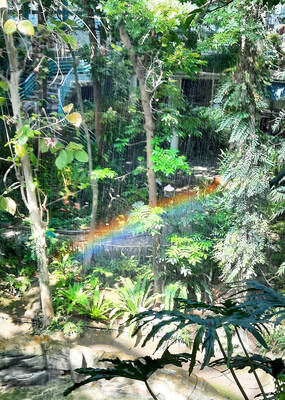
It’s only half the size of its more famous counterpart in Taipei, but the Botanical Garden of the National Museum of Nature Science (NMNS, 國立自然科學博物館植物園) is surely one of urban Taiwan’s most inviting green spaces. Covering 4.5 hectares immediately northeast of the government-run museum in Taichung’s North District (北區), the garden features more than 700 plant species, many of which are labeled in Chinese but not in English. Since its establishment in 1999, the site’s managers have done their best to replicate a number of native ecosystems, dividing the site into eight areas. The name of the Coral Atoll Zone might

Polling data often confirms what we expect, but sometimes it throws up surprises. When examined over time, some patterns appear that speak to something bigger going on. In this column, whenever possible, Formosa’s polls are used. Despite the sometimes cringeworthy antics of Formosa’s Chairman, Wu Tzu-Chia (吳子嘉), the data produced includes detailed breakdowns crucial for analysis. It has also been conducted monthly 11-12 times a year for many years with many of the same questions, allowing for analysis over time. When big shifts do occur between one month and the next it is usually in response to some event in
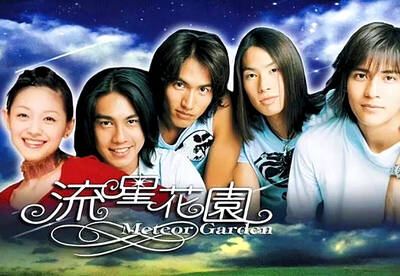
April 6 to April 13 Few expected a Japanese manga adaptation featuring four tall, long-haired heartthrobs and a plucky heroine to transform Taiwan’s television industry. But Meteor Garden (流星花園) took the nation by storm after premiering on April 12, 2001, single-handedly creating the “idol drama” (偶像劇) craze that captivated young viewers across Asia. The show was so successful that Japan produced its own remake in 2005, followed by South Korea, China and Thailand. Other channels quickly followed suit, with more than 50 such shows appearing over the following two years. Departing from the melodramatic


 RSS
RSS