


Russia’s main security agency is expanding its sweeping surveillance powers, deepening the state’s reach into economic and social life to suppress any risk of dissent to President Vladimir Putin.
The Federal Security Service, or FSB, the main successor to the Soviet-era KGB, is getting wide-ranging access to corporate databases, telecommunications networks, financial communications and even information on international contacts by scientists under a spate of legal changes.
“Every political model has its own beneficiary class. And in Russia the beneficiary class is the security apparatus,” said Ekaterina Schulmann, a Berlin-based political scientist at the Carnegie Russia Eurasia Center. “The system is built, essentially, for the convenience of the security enforcers.”
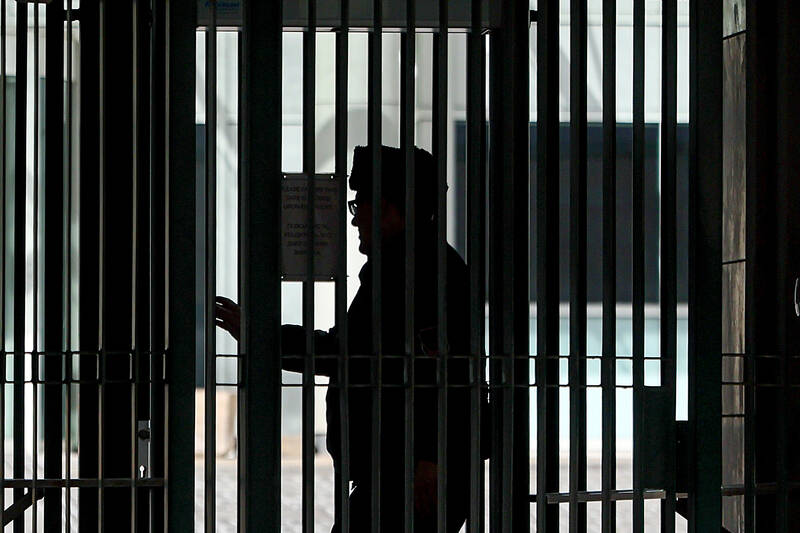
Photo: EPA
POLITICAL REPRESSION
The FSB’s expanding authority underscores how the Kremlin is increasingly tightening the screws over every aspect of Russia’s economic and social life, especially since Putin ordered the February 2022 full-scale invasion of Ukraine. Russian officials justify the crackdown on national security grounds as a response to emerging foreign threats, as the war that was meant to be won within days has dragged into a fifth year.
In reality, Putin, a former KGB agent in East Germany who later headed the FSB, has resorted to growing political repression the longer his more than quarter-century rule in Russia has gone on. The confrontation with the West over Ukraine has accelerated that trend.
Kremlin spokesman Dmitry Peskov didn’t respond to a request for comment.
A law set to take effect April 1 grants the FSB the authority to obtain copies of any organization’s databases without a court order.
Under the measure, even international businesses and banks like Raiffeisen Bank International AG and UniCredit SpA that still work in Russia must ensure IT systems allow them to hand over data on demand. For foreign lenders, this makes compliance with global privacy standards challenging.
It comes on top of an FSB order last year to major banks to install surveillance systems by next year, allowing for the monitoring of messages and other content in banking applications, the RBC newswire reported, citing people familiar with the matter.
Raiffeisen declined to comment, and UniCredit didn’t immediately respond to a question from Bloomberg News.
NO RESTRAINT
Even before the recent changes, the FSB already combined counterintelligence, some elements of law enforcement and investigative powers in a single system with little or no external restraint, while also targeting political critics of the Kremlin using repressive legislation passed in recent years. In counties like the US and the UK, the roles of investigative bodies are split between several agencies and subject to stronger oversight, limiting their influence over businesses, the economy and broader society.
“The new law creates a parallel, extra-judicial mechanism, which, of course, increases the risk of both leaks and the misuse of these new capabilities,” said Alexander Khurudzhi, a member of the pro-business “Novye Lyudi” party. “This is a particularly sensitive issue for banks and the financial sector.”
While the law says security service officials bear responsibility for unlawful use of copies or parts of databases, which must also be destroyed once the purpose of obtaining them has been achieved, there’s no oversight mechanism to ensure material is deleted, according to Khurudzhi.
Putin signed separate legislation in February allowing the FSB to suspend mobile, landline and Internet communications under certain conditions. Telecom providers were exempted from any liability in the case of a shutdown.
The security agency is playing a central role in shaping Russia’s so-called sovereign internet, including a move to restrict the Telegram messenger and tighter control over digital platforms. In February, the FSB warned Telegram could expose sensitive military information, and this month it has become largely inaccessible in Russia without a VPN.
Telegram has denied the FSB’s claim, calling it a “fabrication to justify outlawing” the app, while the company’s billionaire founder Pavel Durov has vowed to resist those attempts, saying “restricting citizens’ freedom is never the right answer.”
Russia also open a criminal case against Durov for allegedly aiding terrorist activity, local Russian media reported in February, citing materials provided by the FSB. Durov, who confirmed the case was opened, called it “a sad spectacle of a state afraid of its own people.”
Officials are pushing users toward a state-backed alternative called Max, which critics say lacks secure encryption, potentially allowing the FSB easier access to data and surveillance. Most other Western messaging services and social networks, including WhatsApp, are also inaccessible without VPNs.
OUTAGES
Moscow and St. Petersburg have also faced near-total mobile internet outages for more than a week this month, in what Russian media has said may be tests of a so-called white list of services allowed to function during shutdowns. The FSB has the final say over which apps are included on that list, according to Russian news outlet The Bell.
Russian businesses in Moscow and some other regions have sustained billions of rubles in losses from the lengthy Internet and communications disruptions over the past year and with no current indication they’ll be compensated.
Fourteen people were detained Sunday in Moscow and several others dispersed by security agents at a square where a protest over the internet outages had been planned, the OVD-Info monitoring group said in a series of Telegram posts.
Lawmakers have handed the FSB the right to operate its own jails, undoing earlier reforms that had transferred oversight of pre-trial detention centers to the penitentiary system.
Businesses are being told to detail foreign contacts to the FSB.
One owner of a large construction company that also operates in Central Asia who asked not to be identified given the sensitive nature of the topic, said the agency instructed him to write reports on every interaction with anyone abroad — even on social media or by phone.
Scientists and researchers also face increased scrutiny for foreign contacts.
New rules have subjected scientists to FSB vetting and approval for certain projects involving overseas collaboration. Since 2022, at least a dozen scientists and researchers have been arrested, and in a handful of cases, convicted and handed jail terms on treason charges linked to previously state-sanctioned foreign contacts.
The wave of new measures goes beyond just strengthening the security apparatus’s hand. Other laws are aimed at clamping down on the spread of information and ideas — especially foreign ones.
One new law that took effect March 1 bans films that discredit “traditional Russian spiritual and moral values.”
Instagram and YouTube have also been blocked.
“Today, the screws are being tightened to the limit,” said Viktor Zvagelsky, the head of the organization Business Against Corruption. “We hope that after the Special Military Operation ends there will be a rollback, a thaw,” he said referring to the Kremlin’s description of the war on Ukraine.

Taiwan’s English education system is being pulled apart by three opposing forces. Bilingual Nation 2030 pulls students toward English and global communication. Artificial Intelligence (AI) readiness pulls them toward digital judgment, verification and AI-mediated work. But Taiwan’s old exam culture pulls them back toward memorization, grammar drills, timed reading and correct answers. If the education system keeps using old exams to define success, it risks producing graduates who are neither genuinely bilingual nor genuinely AI-ready, but trained for tasks machines can already perform. The first force is Bilingual Nation 2030. Launched in 2018, the policy aimed to “help Taiwan’s workforce connect
It seems every few days one bumps into one of those “real man” comments in which Taiwan is urged to “face reality” or similar, and “make a deal,” with the speaker implying that soon it will be too late. “Deal” advocates always present themselves as having a superior grip on reality, and the manly ability to make the “hard choice.” Their testosterone-laden language often echoes that of Taiwan sellout advocates. Note that such commentary always specifies a process (“make a deal, work with, make progress”), never the end state of what occupation by a violent authoritarian colonialist state will entail. In

“Taiwan’s Opposition Leader Comes to US With a Message Straight Out of Beijing” read a May 31 headline in the Wall Street Journal. Top US administration officials and members of Congress almost certainly read the WSJ, and if there was a bullet point takeaway that people in Washington should absorb ahead of Chinese Nationalist Party (KMT) Chair Cheng Li-wun’s (鄭麗文) arrival in DC on June 9, that headline is it. The last few columns have discussed this very topic, and the timing is not coincidental. While those top officials likely do not read the Taipei Times, judging by the number

As someone who normally steers clear of books with “transcendence” or “metaphysics” in their subtitles, this reviewer — a casual observer of local belief systems since the 1990s — found Fabian Graham’s Money God Temples in Taiwan a challenging read. Those who’ve only dipped their toes into temple culture will likely need to parse several sections with special care if they’re to keep up with the author, a British ethnographic researcher whose previous books have investigated religious practices among ethnic Chinese in Southeast Asia. This scholarly volume examines a facet of Taiwan’s religious landscape that didn’t exist a century ago, and


 RSS
RSS