


In our discussions of tourism in Taiwan we often criticize the government’s addiction to promoting food and shopping, while ignoring Taiwan’s underdeveloped trekking and adventure travel opportunities. This discussion, however, is decidedly land-focused. When was the last time a port entered into it?
Last week I encountered journalist and travel writer Cameron Dueck, who had sailed to Taiwan in 2023-24, and was full of tales. Like everyone who visits, he and his partner Fiona Ching loved our island nation and had nothing but wonderful experiences on land. But he had little positive to say about the way Taiwan has organized its port systems for sailors who want to stop over and tour. Indeed, Ching said this was often the attitude toward Taiwan among sailing enthusiasts.
When people sail up from the south, from the Philippines and Australia, she said, the natural thing to do would be to stop at Taiwan. But Taiwan is often skipped because its port bureaucracy is too paranoid and unwieldy for most boaters to deal with.

GRAPHIC: TT
Dueck wrote up their experiences in a piece for Yachting World last year. He originally planned to dock at Kaohsiung.
“We were still five miles (8km) from port when we realized that clearing into Taiwan might not be as simple as we’d hoped. Our VHF radio crackled into life and a stern voice from the port authority asked who we were, where we were coming from and where we were going,” he said.
After hours of waiting, they made it into the port, but were told to wait outside the harbor while their documents were checked. Eventually, they were allowed in.

Photo courtesy of the Changhua County Government
A couple of meters from the pier, about to toss out their mooring ropes, they were told to turn around and go back outside the harbor and wait. They complied, and again waited for hours. Finally, after a “flurry of activity behind the scenes by sympathetic agents and officials that overheard our radio traffic,” they were permitted to dock. The official who met them apologized for the way they had been treated, saying “it shouldn’t be this way.”
Dueck told me it is relatively difficult to sail from port to port in Taiwan. The entry process of customs immigration and quarantine (CIQ), is normally only done once upon entry into a country, but in Taiwan he said they were asked to repeat more or less the entire process for each port.
In other countries this is usually routine, and it is a powerful enabler of maritime tourism. But in Taiwan, until 1999, boats leaving from a certain port could only return to that port, and no one could sail unless they were going fishing. That mentality remains. Dueck said they simply gave up on sailing internally, and left their boat to criss-cross Taiwan by land. He compared the nation’s maritime policies negatively to Japan, where loosening of controls has led to an expansion of tourism.
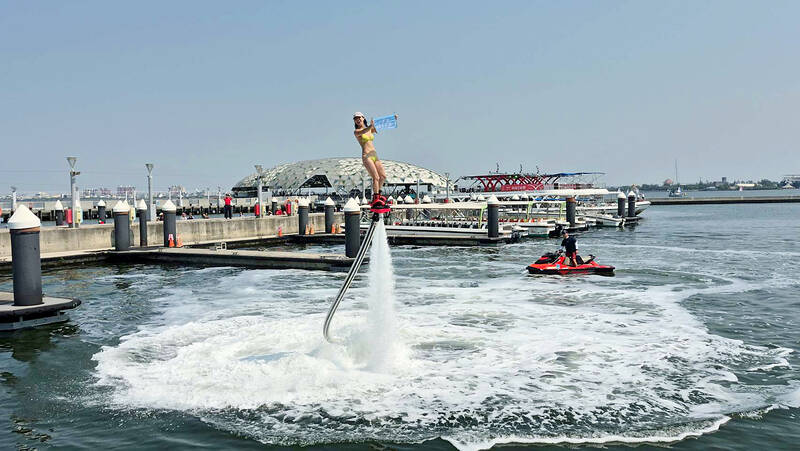
Photo: Chen Yen-ting, Taipei Times
Here in Taiwan, where officials fantasize about attracting high spending tourists, it would seem that the world of yachting enthusiasts would be a natural target.
Dueck’s piece observed that local fishermen remain fiercely opposed to opening the ports. He quoted a local sailing enthusiast who pointed out that Taiwan has 400 commercial and fishing ports, but less than half are open to pleasure cruisers.
Another issue highlighted in my conversations with Dueck is the lack of repair facilities. Their vessel’s engine broke down and they had to stay in Tainan for months. Whereas once Taiwan was a boat manufacturing powerhouse, today there are few spare facilities and experienced engineers for the repair of pleasure craft. Dueck found it difficult to get his craft repaired. Taiwan should look to the Philippines, where there are many English-speaking engineers with marine experience, to address this gap via migrant worker programs.
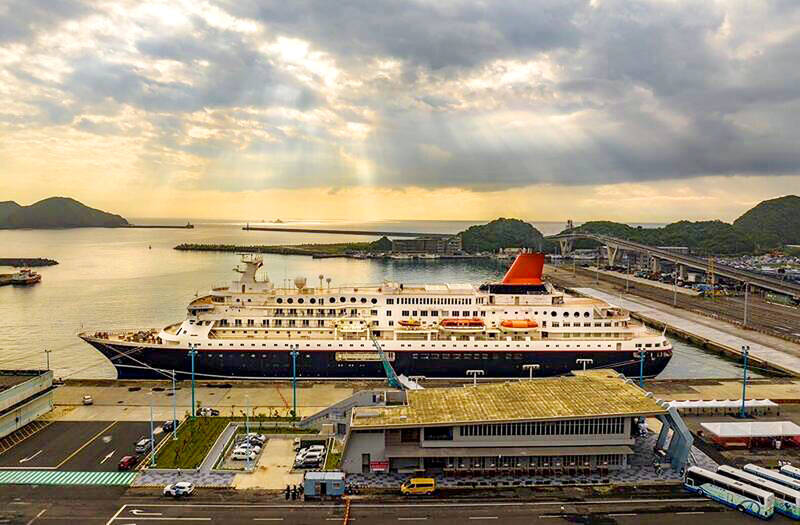
Photo: TT file photo
A chapter in Regional Revitalization Through Development of Taiwan’s Yachting Industry: Challenges and Opportunities, a recent book on using ports for regional revitalization, identifies other problems faced by would-be mariners and marine tourism promoters. The authors point out that successive governments have produced policy papers dating back to the early 1990s on promoting marine tourism and the yachting industry. But a variety of problems have hindered development of yachting tourism.
Laws and regulations relating to yachts remain underdeveloped.
“Because yachts are registered differently from other vessels, it is difficult to manage and supervise them,” they write.
Originally there was a set of “Yacht Management Measures” but those were abolished in 2007. Yachts were then classified under the Law of Ships (船舶法), which had no classification for yachts, but simply sorted ships by tonnage. This was revised in 2010, and yachts were more clearly defined, with inspection provisions and registration and licensing systems established.
The authors of that chapter conducted interviews with yacht owners, makers and harbor authorities, and found numerous problems. Berths, they say, are expensive, and yacht harbors are often reconstructed fishing harbors, making them inappropriate for yachts. There is a shortage of berths as well.
They also identify the supervisory environment as an issue. As Dueck learned, there is often no central point of contact for all the things a yacht owner has to do when entering a harbor, requiring owners to contact multiple authorities (Dueck was advised to hire an agent to carry out these tasks, but didn’t, something he regretted). He said they made many small errors in their documentation, in part because of the lack of clear instructions online. Local officials often seemed unclear on what processes they needed to follow, he said.
Taiwan, which so often follows Japan, should do that with its ports and marinas.
“Japan is known for its extensive network of small, community-based marinas and its Sea Stations, which are often operated by local municipalities,” the authors of the survey chapter above describe.
Decentralization may be difficult given Taiwan’s security environment, but it is something the central government might think about. Local governments have done well developing local natural and historical resources as tourist sites. Ports and marinas should be integrated into that effort.
In Japan, the authors of the survey chapter note, marina and port development is part of wider regional revitalization efforts, something many coastal areas in Taiwan could benefit from. Dueck told me via e-mail there has been an increase in the number of boats headed to Japan because of this, a market Taiwan could easily tap into with tourism and repair services. If security is a concern, boats can easily be tracked by AIS, and Dueck assured me that boaters are very willing to abide by local rules and to pay reasonable fees.
Readers should recall that ports and harbors are government-owned and operated. When we think about “state-owned land” we generally imagine the forested reaches of the mountains or the vast holdings of government enterprises on the plains. But the ports are just as much under state control. The slow implementation of long-discussed government policies is the fault of the central government’s foot-dragging on making it simple and easy for pleasure boaters to take advantage of Taiwan’s ports.
Many in Taiwan argue, myself among them, that it should orient itself outward toward the Pacific and south toward the archipelagic states of southeast Asia, instead of inward towards China and the past. Developing strong links to the sailing community and routine inclusion of Taiwan in its sailing routes would not only facilitate this, but also be an interesting and creative application of the nation’s longstanding New Southbound policy.
Notes from Central Taiwan is a column written by long-term resident Michael Turton, who provides incisive commentary informed by three decades of living in and writing about his adoptive country. The views expressed here are his own.

Yesterday, the Democratic Progressive Party (DPP) nominated legislator Puma Shen (沈伯洋) as their Taipei mayoral candidate, the Chinese Nationalist Party (KMT) put their stamp of approval on Wei Ping-cheng (魏平政) as their candidate for Changhua County commissioner and former legislator Tsai Pi-ru (蔡壁如) of the Taiwan People’s Party (TPP) has begun the process to also run in Changhua, though she has not yet been formally nominated. All three news items are bizarre. The DPP has struggled with settling on a Taipei nominee. The only candidate who declared interest was Enoch Wu (吳怡農), but the party seemed determined to nominate anyone

In a sudden move last week, opposition lawmakers of the Chinese Nationalist Party (KMT) and Taiwan People’s Party (TPP) passed a NT$780 billion special defense budget as a preemptive measure to stop either Chinese leader Xi Jinping (習近平) or US President Donald Trump from blocking US arms sales to Taiwan at their summit in Beijing, said KMT heavyweight Jaw Shaw-kong (趙少康), speaking to the Taipei Foreign Correspondents Club on Wednesday night in Taipei. The 76-year-old Jaw, a political talk show host who ran as the KMT’s vice presidential candidate in 2024, says that he personally brokered the deal to resolve
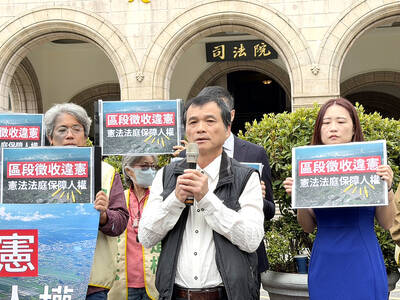
What government project has expropriated the most land in Taiwan? According to local media reports, it is the Taoyuan Aerotropolis, eating 2,500 hectares of land in its first phase, with more to come. Forty thousand people are expected to be displaced by the project. Naturally that enormous land grab is generating powerful pushback. Last week Chen Chien-ho (陳健和), a local resident of Jhuwei Borough (竹圍) in Taoyuan City’s Dayuan District (大園) filed a petition for constitutional review of the project after losing his case at the Taipei Administrative Court. The Administrative Court found in favor of nine other local landowners, but

The Chinese Nationalist Party (KMT) and its sock puppet, the Taiwan People’s Party (TPP), passed their version of the government’s proposed supplementary defense spending bill last week, engendering much commentary. While all eyes were on the defense budget, the PRC’s assault on Taiwan was advancing on other fronts. The removal of domestic drone production and other technologies critical to the nation’s asymmetrical defenses from the list of items purchased in the “compromise” bill shows how the KMT-TPP alliance appears to be serving the People’s Republic of China (PRC). Ironically, the cuts will impact industries heavily represented by tech firms in areas run


 RSS
RSS