


The entire Li Zhenxiu (李貞秀) saga has been an ugly, complicated mess.
Born in China’s Hunan Province, she moved to work in Shenzhen, where she met her future Taiwanese husband. Most accounts have her arriving in Taiwan and marrying somewhere between 1993 and 1999.
She built a successful career in Taiwan in the tech industry before founding her own company. She also served in high-ranking positions on various environmentally-focused tech associations.
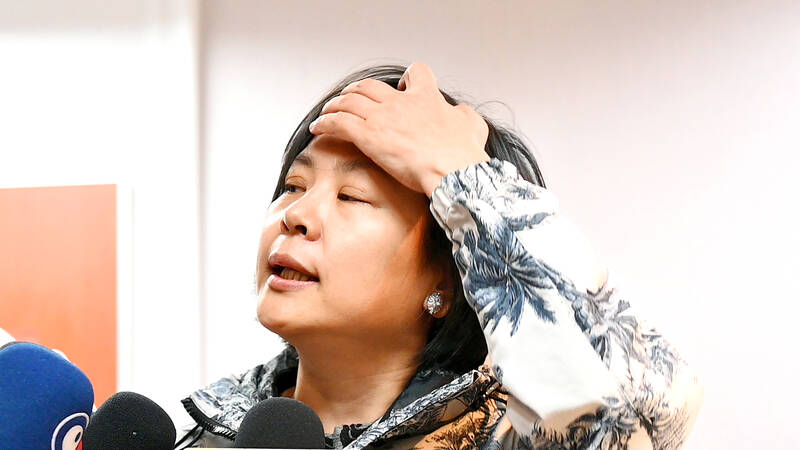
Photo: Tu Chien-jung, Taipei Times
She says she was inspired by the founding of the Taiwan People’s Party (TPP) in 2019 by Ko Wen-je (柯文哲), and began volunteering for the party soon after.
Ko had been positioning himself and his party to make strategic inroads beyond his early base of independents fed up with both parties, expanding into the pan-blue side of the political spectrum. They spotted an underserved and underrepresented segment of the population: China-born “mainland spouses” of local citizens, many of whom had become citizens themselves and can vote.
Naturalized citizens being appointed as party list lawmakers is not new. The Chinese Nationalist Party (KMT) had a Cambodian-born lawmaker, and the TPP included a Vietnamese-born citizen to their party list in the 2024 election.
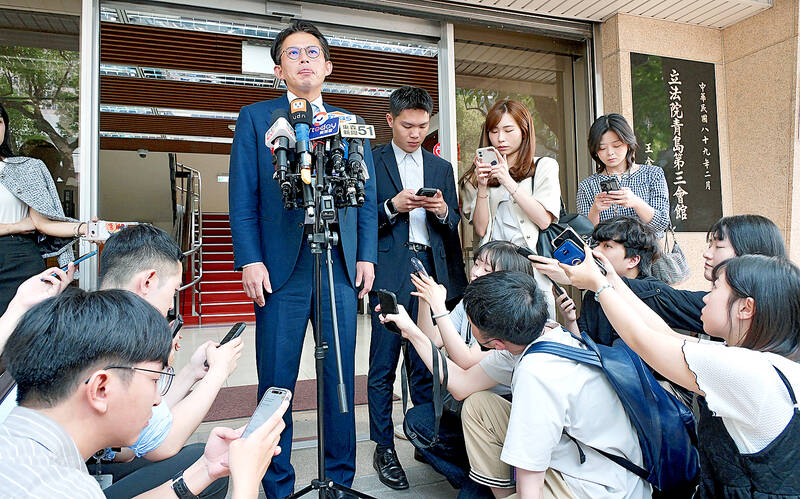
Photo: Liu Hsin-de, Liberty Times
Lacking the talent cultivation infrastructure of the two big parties, to maximize exposure and cultivate more talent in the party, Ko instituted a “two-year” term rule for the TPP’s party list lawmakers. They won eight seats in 2024, and they were expected to step down after only serving two years of the four-year term to allow the next eight people on the party’s list to step up and into the limelight as lawmakers, allowing the party to give 16 people the chance to advance rather than just eight.
Li was ranked 15th on the party list and took office in February. She has been erroneously called the first Chinese spouse in the legislature. For the entire authoritarian period, the vast majority of lawmakers were elected in China in 1947 and kept in place to represent the entirety of “free China,” and it is fair to assume many were married.
However, Li appears to be the first born in the People’s Republic of China.
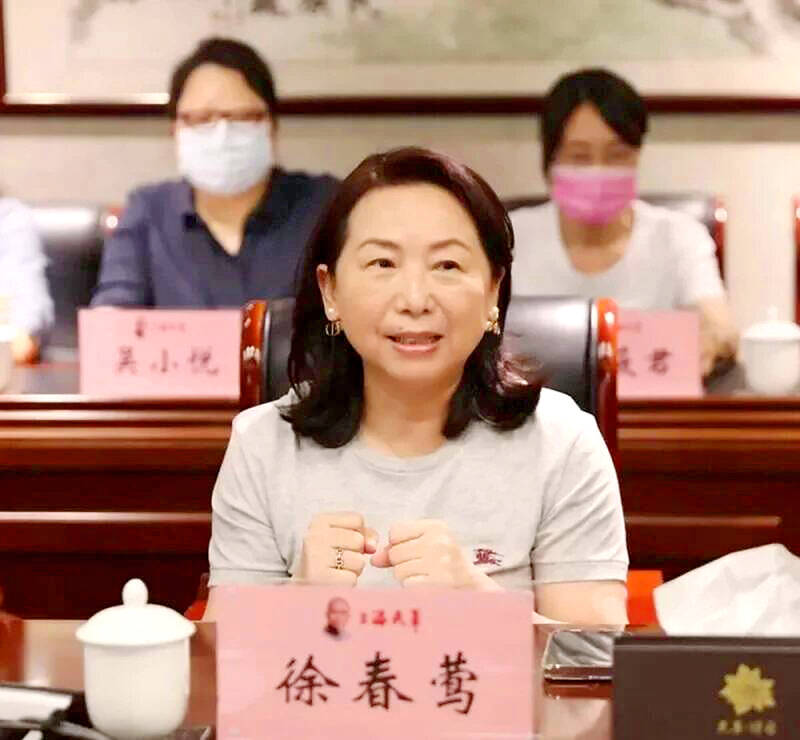
Photo: Liu Yung-yun, Taipei Times
Though Li has a respectable career resume, it appears that she was not Ko’s first choice.
On March 24, the New Taipei District Prosecutors’ Office charged Chinese immigrant Xu Chunying (徐春鶯), who has links to the TPP, on suspicion of taking part in Beijing-directed election interference. The prosecutors allege that Xu had been a KMT member, but became disillusioned with the party over its perceived failure to ease Chinese immigrants’ path to residency and unwillingness to nominate Chinese-born candidates for the party list and turned her attention to the TPP.
In 2023, she was allegedly approached by the TPP to be on their party list, but she turned them down. For a deeper look at what a horrible candidate she would have been, check out Michael Turton’s “ Notes from Central Taiwan: Ko, Xu and the politics of ‘green terror’ (April 2, page 12).
Apparently, it was Xu who suggested the TPP run with Li instead.
An obvious question is, why didn’t the KMT put a “mainland spouse” on their party list, but the TPP did? At an estimated population of 350,000 to 400,000, this is a sizeable voting bloc.
Then-KMT party chairman Eric Chu (朱立倫) was pragmatic and likely understood the risks. He feared appearing too close to China would cost them votes elsewhere.
He also likely understood the potential national security risks, which would paint the party in a bad light. Beijing views anyone ethnically Chinese anywhere in the world to be “theirs” and will stoop to any level to use any leverage they can find to manipulate them, including threatening family members in China. Li’s parents still live there.
Additionally, he would have been aware of the legal conundrum. Lawmakers are not allowed to hold any other nationality, and Beijing will not allow citizens to renounce their citizenship to take up Republic of China citizenship because it would in effect be recognizing Taiwan as a foreign country — leaving Chinese-born citizens with an impossible catch-22.
KO’S BET
It is possible Ko was ignorant of this, but more likely he simply thought he could get away with it and any fights over it would be good publicity for the TPP. He has a pattern of this type of behavior.
Ko turned out to be right. The Central Election Commission mysteriously approved her, and Legislative Speaker Han Kuo-yu (韓國瑜) of the KMT rejected the government’s request to disqualify her.
The ensuing fight was ugly. The executive branch refused to acknowledge her and pursued legal channels to try to oust her. The TPP defended her, accusing the government of “discrimination against Chinese spouses.”
Polling showed overwhelmingly that she was considered unsuitable. A Z.Media poll released March 31 found only 16.4 percent thought she was suitable. Only 37.3 percent of TPP supporters found her suitable.
Ko began talking about her perhaps resigning, likely frustrated with the whole situation.
However, it was not the legal controversies or the alleged connection to Xu or the low polling that finally led to her downfall, though no doubt they contributed to it.
Li claimed that Ko had given Hsinchu Mayor Ann Kao (高虹安) NT$7 million. She later backtracked and apologized, but Li was later accused of having reported Kao over alleged misuse of assistant funds, prompting several party officials to call on her to step down.
On April 13, the TPP’s Central Evaluation Committee voted unanimously to expel her from the party, which automatically ousts her from the legislature. The committee found Li’s statements and actions had seriously damaged the party’s reputation and internal cohesion, and that she had engaged in repeated misconduct.
From there it was all downhill.
TPP Chairman Huang Kuo-chang (黃國昌) alleged that she had demanded payment to voluntarily resign, saying she relied on her NT$200,000 monthly lawmaker salary to pay for her children. Huang is probably not lying: Li said her public remark — “whoever wants me gone should foot the bill” — was not a demand for payment, but it is hard to interpret that any other way.
Though she continues to defend Ko, despite him being one of the first to suggest she might resign, she has been on the attack against other party figures, especially Huang and Vicky Chen (陳智菡), who she called “demons” among other slurs and accusations.
The day after her expulsion, Taipei prosecutors launched an investigation over allegations of document forgery and corruption
Li remains defiant and has been doing the talk show rounds, which will no doubt help her raise money for her kids.
IMPACT
Will this impact the party’s chances in the November elections?
Probably not directly, because by then voters may have forgotten the whole mess. However, if Li remains a fixture on the talk shows and continues her accusations, it may still be in the news and have some impact.
More likely it will be added to the pile of woes the TPP is facing, furthering the impression that the party is a mess.
In the Formosa poll released at the end of last month, the TPP had an already high disapproval rating of 56.5 percent. This situation increases the chance that this number will continue to remain high.
A more difficult question is whether or not it will hit the party’s approval rating, which stood at 25.8 percent. Despite all the scandals and disasters that have hit the party, their approval has never dipped below 20 percent.
Is there a point at which their hardcore base will finally say “enough” and give up on the party? That is hard to predict, but for now there is no good alternative party to fill the political niche they have carved out for themselves.
Donovan’s Deep Dives is a regular column by Courtney Donovan Smith (石東文) who writes in-depth analysis on everything about Taiwan’s political scene and geopolitics. Donovan is also the central Taiwan correspondent at ICRT FM100 Radio News, co-publisher of Compass Magazine, co-founder Taiwan Report (report.tw) and former chair of the Taichung American Chamber of Commerce. Follow him on X: @donovan_smith.


Taiwan’s English education system is being pulled apart by three opposing forces. Bilingual Nation 2030 pulls students toward English and global communication. Artificial Intelligence (AI) readiness pulls them toward digital judgment, verification and AI-mediated work. But Taiwan’s old exam culture pulls them back toward memorization, grammar drills, timed reading and correct answers. If the education system keeps using old exams to define success, it risks producing graduates who are neither genuinely bilingual nor genuinely AI-ready, but trained for tasks machines can already perform. The first force is Bilingual Nation 2030. Launched in 2018, the policy aimed to “help Taiwan’s workforce connect

“Taiwan’s Opposition Leader Comes to US With a Message Straight Out of Beijing” read a May 31 headline in the Wall Street Journal. Top US administration officials and members of Congress almost certainly read the WSJ, and if there was a bullet point takeaway that people in Washington should absorb ahead of Chinese Nationalist Party (KMT) Chair Cheng Li-wun’s (鄭麗文) arrival in DC on June 9, that headline is it. The last few columns have discussed this very topic, and the timing is not coincidental. While those top officials likely do not read the Taipei Times, judging by the number

With weighty, anxiety-inducing geopolitical topics dominating the headlines, checking in on the wild and weird state of local politics can take some of the edge off. This November’s elections will determine who will be in charge of fixing potholes in your neighborhood, not the potholes in Taiwan’s complicated geopolitical space. Recently, after an online interview with a Taipei-based journalist, I commented that Taipei journalists never go further than the MRT can take them. He laughed and agreed. Naturally, the Taipei mayoral race is eating up much of the press attention. TAIPEI CITY Democratic Progressive Party (DPP) candidate Puma Shen (沈伯洋) has
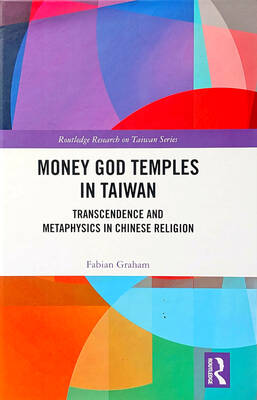
As someone who normally steers clear of books with “transcendence” or “metaphysics” in their subtitles, this reviewer — a casual observer of local belief systems since the 1990s — found Fabian Graham’s Money God Temples in Taiwan a challenging read. Those who’ve only dipped their toes into temple culture will likely need to parse several sections with special care if they’re to keep up with the author, a British ethnographic researcher whose previous books have investigated religious practices among ethnic Chinese in Southeast Asia. This scholarly volume examines a facet of Taiwan’s religious landscape that didn’t exist a century ago, and


 RSS
RSS