


Maritime search and rescue operations do not have borders, and China should not use a shipwreck to infringe upon Taiwanese sovereignty, the Coast Guard Administration (CGA) said yesterday.
The coast guard made the statement in response to the China Coast Guard (CCG) saying it saved a Taiwanese fishing boat.
The Chuan Yu No. 6 (全漁6號), a fishing vessel registered in Keelung, on Thursday caught fire and sank in waters northeast of Diaoyutai Islands (釣魚台).
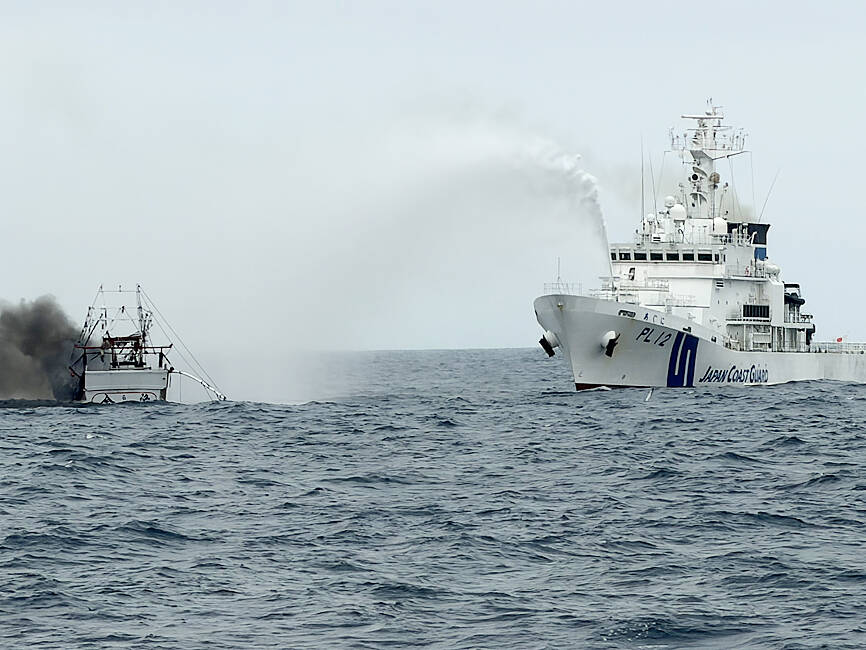
Photo courtesy of a reader via CNA
The vessel left Keelung’s Badouzih Fishing Harbor (八斗子漁港) at 3:35pm on Sunday last week, with seven people on board — a 62-year-old Taiwanese captain surnamed Chang (張) and six Filipino crew members.
The CGA said it received a report at about 5am on Thursday that Chuan Yu No. 6 was on fire about 77 nautical miles northeast of the Diaoyutais, which is within Japan’s search and rescue region.
The six foreign crew members were rescued by nearby fishing vessel Chuan Yu No. 36 the same day, but the captain was missing, it said.
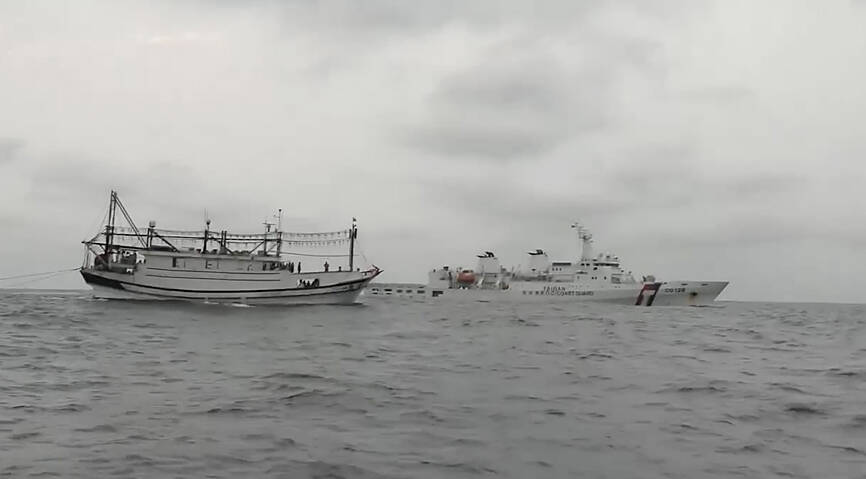
Photo copied by Lin Chia-tung, Taipei Times
Emergency protocols were activated and patrol vessel Taoyuan was dispatched from the Northern Sector Mobilization Unit to lead search and rescue operations, it added.
The Taoyuan arrived at the site of the incident — about 131 nautical miles northeast of Pengjia Islet (彭佳嶼) — late at 11pm on the same day, but due to poor sea conditions, the rescued crew members were temporarily sheltered aboard Chuan Yu No. 36 while the Taoyuan continued an intensive search for the missing captain, the CGA said.
However, China’s coast guard on Friday said it had conducted an “emergency rescue of a Chinese Taiwan fishing vessel in the waters near the Diaoyu Islands,” and that the “Chinese Taiwan” vessel caught fire about 76 nautical miles northeast of Huangwei Islet (黃尾嶼).
“After the incident occurred, CCG vessels on patrol missions proceeded to the incident site to extinguish the fire on the distressed fishing boat and launched a search and rescue,” the Chinese coast guard said. “Six people have been rescued and rescue work is ongoing.”
It also released four images showing their firefighting activities.
The CGA yesterday said China was infringing upon Taiwanese sovereignty, and engaging in political maneuvering and cognitive warfare.
The crew members of the boat were rescued by the nearby Taiwanese fishing vessel Chuan Yu No. 36, it said, adding that it immediately dispatched the Taoyuan and coordinated with the Japan Coast Guard, which also dispatched patrol aircraft and vessels to assist.
Another CGA patrol vessel, Yilan, was also deployed, it said, adding that the agency was still working with Japanese authorities in an intensive search for Chang.
Regarding China’s intentional use of the term “Chinese Taiwan fishing vessel,” the CGA said maritime search and rescue has no borders, and is a universally recognized value, so China should not use a shipwreck to infringe upon Taiwan’s sovereignty.
The six crew members were transferred to the Yilan at about 6am yesterday, and the vessel was expected to return to the Port of Keelung by 7pm, it said.
The search operation for the missing captain continues, and the CGA would not give up hope and would continue to commit all available resources to his rescue, in hopes of bringing him home safely as soon as possible, it added.
Additional reporting by Lin Chia-tung

A signaling system malfunction disrupted high-speed rail (HSR) services beginning at 8am today, with trains temporarily reduced to three northbound and three southbound trains per hour as authorities conduct inspections. The malfunction occurred on a section of track in Miaoli County during pre-operation checks early this morning, forcing northbound and southbound trains to use a single track, the HSR operator said. The regular schedule has been replaced with three hourly trains offering only nonreserved seating in each direction, stopping at every station, it said, adding that business class cars would still have reserved seating. Departures from terminal stations are scheduled at the top

Taiwan is still in the process of assessing the possibility of recruiting workers from Eswatini, the Ministry of Foreign Affairs said yesterday, adding that its goal is to help Eswatini upgrade its vocational training centers. If there are plans to recruit workers from Eswatini, safeguarding national security, protecting public health and ensuring the employment rights of Taiwanese would be prerequisites, Department of West Asian and African Affairs Director-General Yen Chia-liang (顏嘉良) told a news conference. Key considerations would also include filling labor shortages in specific industries, and fostering bilateral professional and technical exchanges, he said. Yen was asked about the progress of labor

A US uncrewed surface vessel (USV) encountered multiple Chinese warships during an autonomous transit of the Taiwan Strait, US defense company Seasats said in a statement on Wednesday. Seasats announced that a Lightfish USV had completed the first autonomous transit of the Taiwan Strait. Over five days, the USV traversed the entire length of the Strait while constantly monitoring surface vessel traffic, the company said. The Lightfish encountered multiple Chinese warships, one of which was a Chinese People’s Liberation Army Navy (PLAN) Type 056 corvette, it said. The Chinese vessels were operating “well within Taiwan’s exclusive economic zone without transmitting their identity via the

VERBOSE VESSELS: A CGA cutter and a China Coast Guard exchanged verbal barbs for more than a day in Taiwanese-controlled waters before the Chinese vessel left The Taiwanese and Chinese coast guards had a standoff near the strategically located Pratas Islands (Dongsha Islands, 東沙群島) in the north of the South China Sea, the Coast Guard Administration (CGA) said yesterday. The two sides engaged in intense radio exchanges over sovereignty claims during the 33-hour standoff. China Coast Guard vessel 3501 eventually left the restricted waters, 26.6 nautical miles (49.2km) west of the Pratas Islands, at 5pm yesterday, the CGA said. Lying approximately between southern Taiwan and Hong Kong, the Taiwan-controlled Pratas are seen by some security experts as vulnerable to Chinese attack due to their distance — more than


 RSS
RSS