


Chinese Nationalist Party (KMT) Chair Cheng Li-wun (鄭麗文) returned from her trip to meet People’s Republic of China (PRC) dictator Xi Jinping (習近平) bearing “a gift” for the people of Taiwan: 10 measures the PRC proposed to “facilitate the peaceful development of cross-strait relations.”
“China on Sunday unveiled 10 new incentive measures for Taiwan,” wrote Reuters, wrongly.
The PRC’s longstanding habit with Taiwan relations is to repackage already extant or once-existing policies and declare that they are “new.” The list forwarded by Cheng reflects that practice.
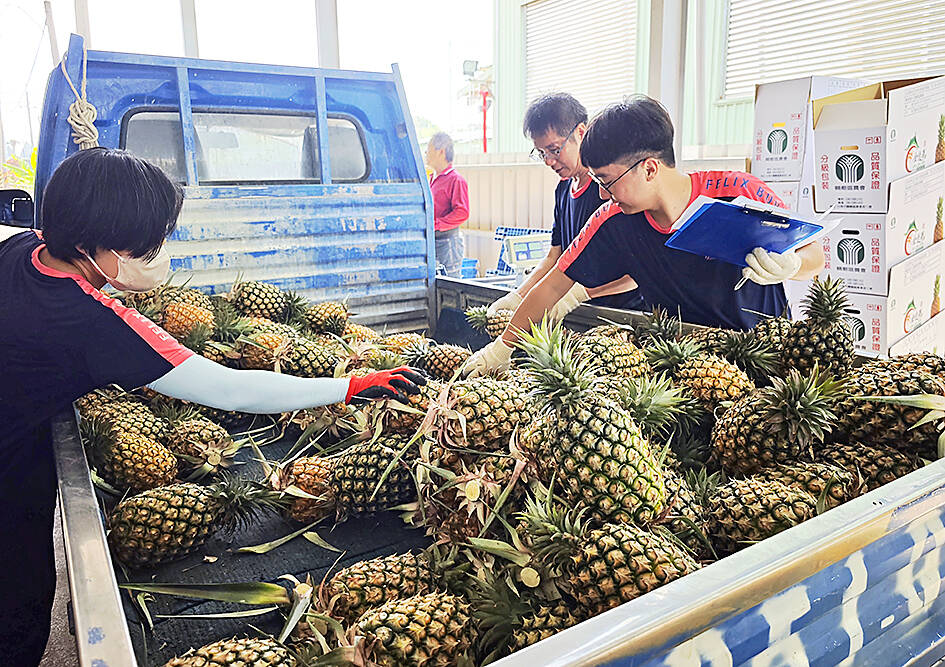
Photo: Wu Chun-feng, Taipei Times
NEW MEASURES?
Note the first item: establishing regular communication mechanisms between the Chinese Communist Party (CCP) and the KMT. The KMT and the CCP are already in regular, intimate contact. KMT officials at all levels visit the PRC, apparently to coordinate strategy against Taiwan’s democracy. What this appears to signal is a higher level of visible formality and structure, meaningless since the two parties already know each other well.
Inherent in this is the second measure, creating a bilateral exchange platform for young members of the KMT and the CCP. Former president Ma Ying-jeou (馬英九) leads a youth exchange program to the PRC every year. Ma told his CCP interlocutors in 2023 that both sides of the Taiwan Strait should ensure that exchanges between young people continue.
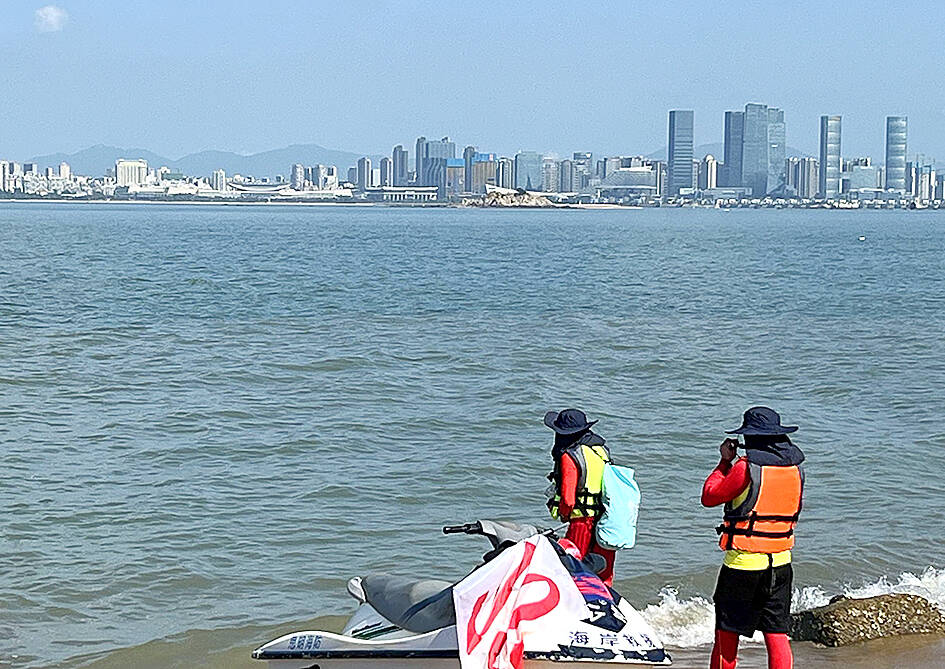
Photo: Wu Cheng-ting, Taipei Times
The third measure announced is an old policy: the construction of water, electricity, and energy links to the PRC between coastal Fujian and outlying Kinmen and Matsu islands, a policy long known as the “mini four links.” The PRC has also proposed building bridges to connect the islands to Fujian, which the government has balked at. The PRC has supplied water since 2018, and electricity links have been proposed for years.
How old is this program? Beginning in 2008 during the first Ma administration, the KMT and the PRC cooperated to develop what they called a “common living circle (共同生活圈)” combining China’s Fujian Province and the offshore islands. According to an excellent review at Jamestown China Brief by Kristian McGuire, this policy focused on Kinmen and Xiamen, the “Two Gates” (兩門), and Matsu and Mawei District in Fuzhou City, the “Two Horses” (兩馬). The current county chiefs of Kinmen and Liencheng (Matsu) counties, Chen Fu-hai (陳福海) and Wang Chung-ming (王忠銘), both KMT politicians, have been calling for the “common living circle” for years. Chen has also supported building a bridge to Xiamen since his first term in beginning in 2014.
Another “gift” is the expansion of commercial flights between the Taiwan and the PRC. Direct flights are an old policy. Expansions could have been offered at any time.
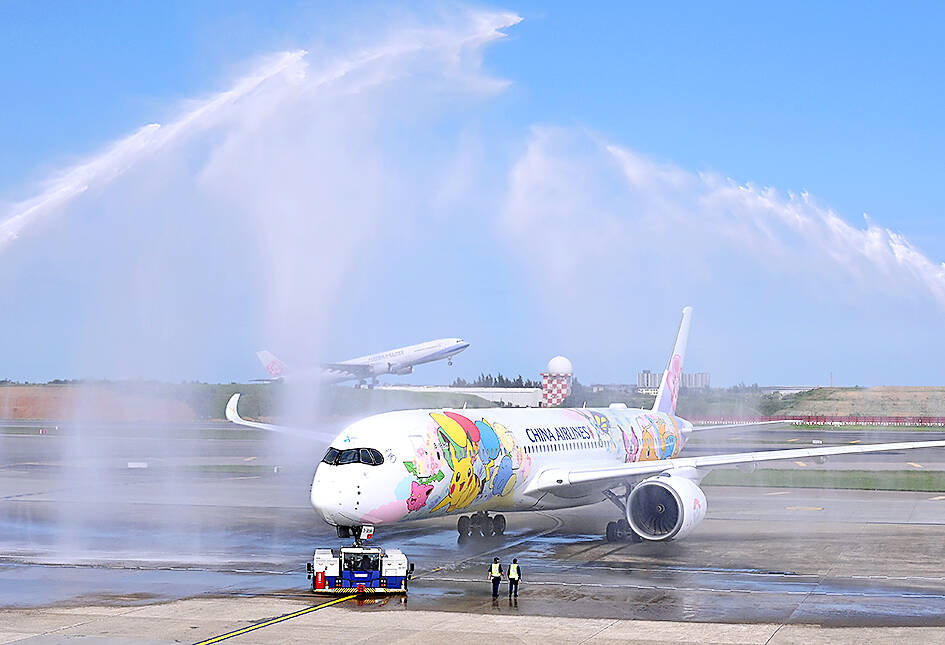
Photo: Chu Pei-hsiung, Taipei Times
The CCP also proposed making it more convenient for Taiwan’s agricultural and fishery products to enter China, and to expand promotion of such products. This of course would be based on “upholding the 1992 consensus” and “opposing Taiwan independence.” This requirement foreshadows how the policies will inevitably be killed: since they are political offerings, PRC political decisions will kill them.
There are two important reasons the CCP does this. The first is to create constituencies that become dependent on exporting to the PRC, which will make them lean KMT, especially in the south. After time has passed, the PRC will claim that the Democratic Progressive Party (DPP) government has done something it doesn’t like, and will cut off imports of the Taiwan products. This will cause the affected groups to yell at the DPP.
The second reason for expanded food and agricultural imports is simpler: the PRC seeks to plunder Taiwan’s advanced agricultural and food production technology. A few years ago I described how this had played out with Taiwan’s grouper exports to the PRC (“Notes from Central Taiwan: A different kettle of fish,” July 4, 2022). The PRC permitted grouper exports until it had appropriated Taiwan grouper technology, then killed the exports and constructed its own giant grouper production ships.
This is old policy: according to an Asia Times report, by 2012 the PRC had already constructed roughly two dozen “Taiwan Farmers Pioneer Parks” to steal Taiwan agricultural technology. The CCP mouthpiece China Daily reported in January that the Pingtan Agricultural Zone on Pingtan Island in Fujian “is set to accelerate the development of a pioneering “common market” between the Chinese mainland and Taiwan during the 15th Five-Year Plan period (2026-30).” The PRC is simply offering more of what it had already planned.
The PRC’s grouper campaign also highlights the third reason for selective PRC imports of Taiwan agricultural products: as Taiwan producers shift from food crops to cash crops, PRC exporters enter their food crop markets, gaining market share in Taiwan that will not be regained by Taiwanese cash crop farmers when the PRC closes their export market.
The CCP also proposed allowing PRC citizens from Shanghai and Fujian Province to travel as individuals to Taiwan, another exciting new “gift,” formally announced as policy in January last year, and supported by President William Lai (賴清德).
The final set of “new” measures is PRC approval for Taiwanese entertainment programs that have “healthy content” to appear on PRC TV and media platforms, and to facilitate Taiwanese production firms in creating short videos in China. The second of these has been ongoing for decades in different forms, dating back at least to Ang Lee’s (李安) Lust, Caution and even earlier.
The proposal to allow Taiwan entertainment has obvious political implications, aimed in part at shaping domestic PRC opinion of Taiwan. If PRC citizens see CCP ideas of Taiwan reflected in “Taiwan entertainment,” then they will more easily buy into CCP propaganda about Taiwan.
NO SECURITY COMMITMENTS
It is important to note what KMT Chair Cheng didn’t get: no agreements or proposals on mutual crimefighting, especially fraud. No concessions on “gray zoning,” PRC military threats, the intimidation flights, the regular undersea cable-cutting or anything else involving security. No concessions on PRC cyber attacks or technology theft. Nothing that the PRC “offered” involves a cost for the PRC, and all involve economic and political concessions (especially on democracy) by Taiwan simply to gain access. The first two measures, formalizing KMT-CCP meetings and youth exchanges, are clearly not incentives for Taiwan as a whole.
The package the PRC offered is thus a massive nothingburger consisting of policies of longstanding existence or in development. Several of the policies link Taiwan and Fujian Province. Subordinating Taiwan to Fujian has long been a program of the CCP (“Notes from Central Taiwan: Taiwan as Fujian in PRC Eyes,” Nov. 20, 2025).
It is hard to believe that Cheng herself does not know all this. She said in a January statement to the KMT Central Standing Committee that there is no need to “pick a side” between China and the US.
Apparently she has already chosen one.
Notes from Central Taiwan is a column written by long-term resident Michael Turton, who provides incisive commentary informed by three decades of living in and writing about his adoptive country. The views expressed here are his own.
A recent report from the Environmental Management Administration of the Ministry of Environment highlights a perennial problem: illegal dumping of construction waste. In Taoyuan’s Yangmei District (楊梅) and Hsinchu’s Longtan District (龍潭) criminals leased 10,000 square meters of farmland, saying they were going to engage in horticulture. They then accepted between 40,000 and 50,000 cubic meters of construction waste from sites in northern Taiwan, charging less than the going rate for disposal, and dumped the waste concrete, tile, metal and glass onto the leased land. Taoyuan District prosecutors charged 33 individuals from seven companies with numerous violations of the law. This
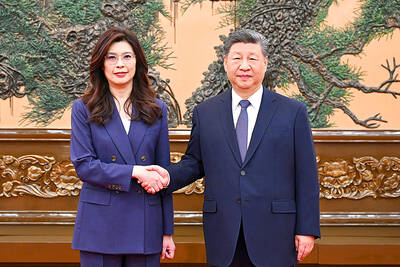
What is the importance within the Chinese Nationalist Party (KMT) of the meeting between Xi Jinping (習近平), the leader Chinese Communist Party (CCP), and Cheng Li-wun (鄭麗文), the leader of the KMT? Local media is an excellent guide to determine how important — or unimportant — a news event is to the public. Taiwan has a vast online media ecosystem, and if a news item is gaining traction among readers, editors shift resources in near real time to boost coverage to meet the demand and drive up traffic. Cheng’s China trip is among the top headlines, but by no means

As mega K-pop group BTS returns to the stage after a hiatus of more than three years, one major market is conspicuously missing from its 12-month world tour: China. The omission of one of the group’s biggest fan bases comes as no surprise. In fact, just the opposite would have been huge news. China has blocked most South Korean entertainment since 2016 under an unofficial ban that also restricts movies and the country’s popular TV dramas. For some Chinese, that means flying to Seoul to see their favorite groups perform — as many were expected to do for three shows opening
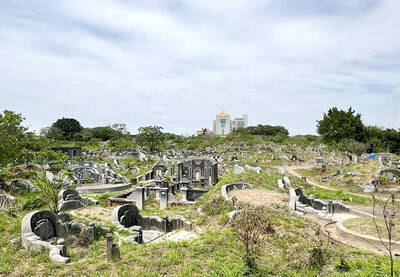
Apr. 13 to Apr. 19 From 17th-century royalty and Presbyterian missionaries to White Terror victims, cultural figures and industrialists, Nanshan Public Cemetery (南山公墓) sprawls across 95 hectares, guarding four centuries of Taiwan’s history. Current estimates show more than 60,000 graves, the earliest dating to 1642. Besides individual tombs, there are also hundreds of family plots, one of which is said to contain around 1,000 remains. As the cemetery occupies valuable land in the heart of Tainan, the government in 2018 began asking families to relocate the graves to make way for development. That


 RSS
RSS